

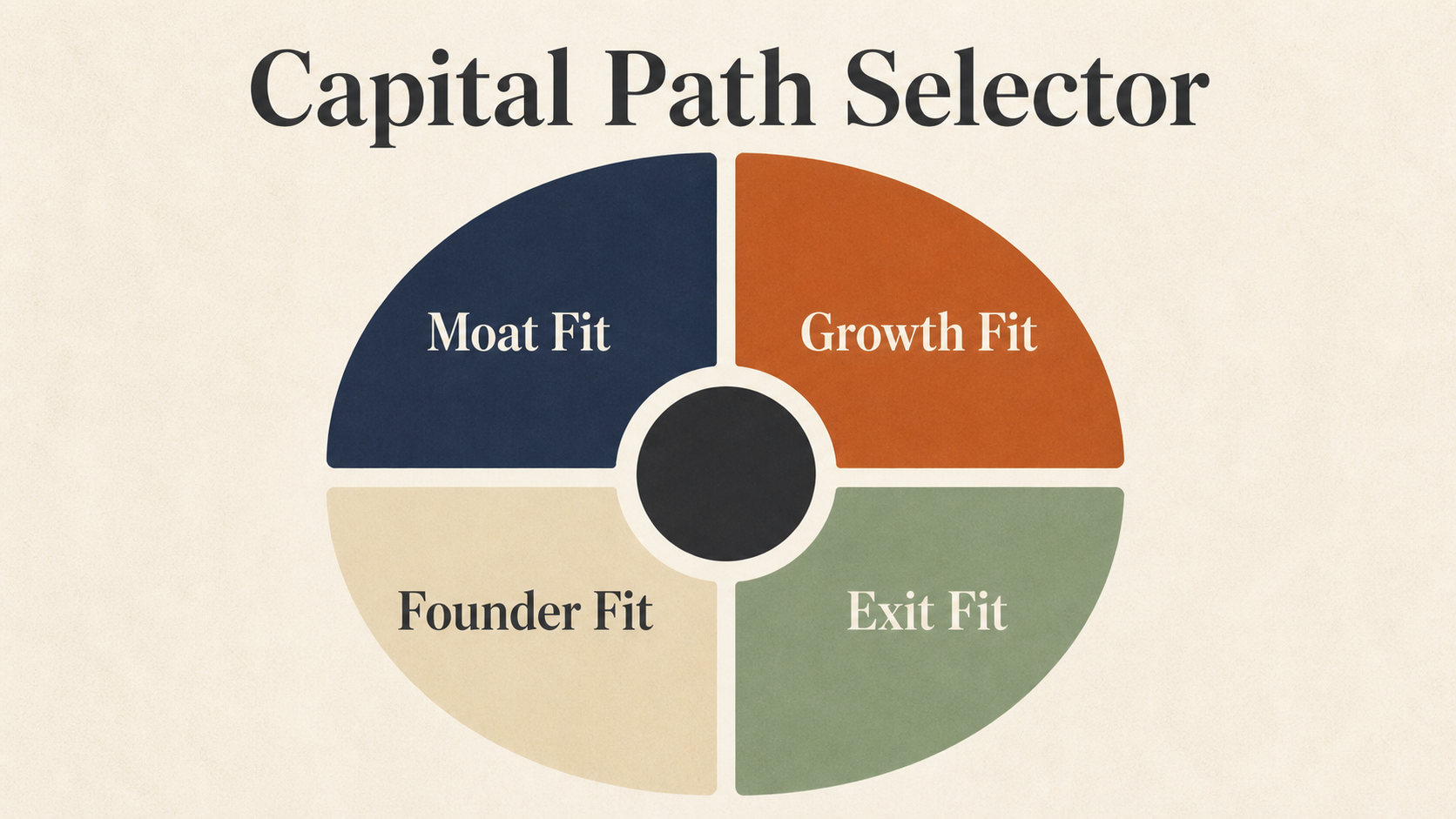
A capital path selector helps you compare startup funding routes before a pitch, application, or loan discussion begins. It asks whether each source fits your moat, growth plan, intended destination, founder situation, and current stage.
This matters because funding is not one decision. Bootstrapping, customer finance, grants, debt, angel investment, and venture capital create different duties. They also push a company toward different speeds and outcomes.
The FoundingCentral Capital Path Selector turns those trade-offs into a clear review. You can score ten routes, change the fit weights, test timing, rank today's options, and record the evidence behind your choice.
Download: Download the FoundingCentral Capital Path Selector workbook.
Why Startup Funding Should Start With Fit
A founder often begins with the provider: Which angel should I approach? Which venture fund invests in this field? Which grant is open?
Start one step earlier. Ask what the business needs to prove and what kind of capital supports that work. The right route depends on costs, pace, control needs, and the likely outcome.
For example, a paid pilot may fund an early B2B product and reveal what customers value. Venture capital may fund a faster expansion once sales become repeatable. Debt may suit stable cash flows, yet it can hurt a young firm that cannot meet fixed payments.
Our guide to startup funding strategy explains the broader menu. The selector helps you apply that menu to one venture at one point in time.
What the Capital Path Selector Measures
The workbook keeps the four tests in FoundingCentral's capital framework. It also scores timing as a separate question.
Moat Fit
Moat Fit asks whether the capital helps build the advantage your venture needs. That advantage could come from buyer trust, field knowledge, a data loop, distribution, hard technology, or low costs.
A large round may help an AI lab hire rare talent and pay for computing. The same round could weaken a service company by encouraging hiring before its operating model is sound.
Score one when the capital distracts from the needed advantage. Score five when it helps create or protect that advantage.
Growth Fit
Growth Fit asks whether the source supports the right pace. Some ventures gain from speed because network effects, market reach, or a tech lead matter. Others need careful tests, sound unit costs, or local trust before they grow.
Score one when the funder's pace may cause waste or premature scale. Score five when the capital and the business can move at a suitable speed.
Exit Fit
Every source of capital has a return logic. A lender expects repayment, while a grant maker expects the money to meet program goals. An equity investor expects the stake to rise in value and may need a sale or public listing.
Exit Fit tests whether that logic matches the company you want to build. A durable family company can serve its owner well yet remain a poor match for a fund that needs a large exit within a set period.
Founder Fit
Founder Fit brings control, personal cash exposure, governance duties, and relationships into the choice. It asks whether you can carry the obligations that come with the capital.
Bootstrapping can preserve control while placing more household wealth at risk. Angel funds can cut that cash burden but add dilution and new demands. Money from friends may arrive fast, but unclear views on loss can harm a close tie.
Use the founder runway guide before you set this score. A route that looks sound for the firm may still be unsafe for the founder's home.
Timing Readiness
A path can fit the venture and still be too early. Timing Readiness asks what evidence you need before taking the capital.
An angel round may make sense after three paid pilots. Debt may be safer after a year of steady cash receipts. A strategic investor may help once the partner's channel adds real sales.
The workbook keeps timing outside the four fit scores. It adjusts Weighted Fit for Timing Readiness to find Current Priority. Thus, a strong long-term route can rank lower today without being ruled out for good.
Compare Ten Routes With the Capital Path Selector
The Capital Paths sheet covers ten routes:
- Bootstrapping
- Customer finance
- Friends and family
- Angel investment
- Grants
- Debt
- Revenue-based finance
- Reward crowdfunding
- Strategic investment
- Venture capital
For each route, the workbook states the form of capital and a common use case. It also names the main benefit, a key risk, and evidence to seek first. These are starting points, since the real terms and legal duties depend on each agreement.
Startup India also presents bootstrapping, crowdfunding, angel investment, venture capital, loans, and government programs as distinct funding routes. A long list helps only when the founder has a way to choose.
How to Score the Capital Path Selector Honestly
The numbers do not make the decision objective. They make your assumptions visible.
First, remove routes that are not real options. A firm without steady sales should not give debt a high timing score just because a loan limits dilution. Likewise, a grant may have low readiness even if its terms fit well. Its award date may fall after the venture's key deadline.
Next, write one reason for every score. A bare score such as Angel investment: four explains nothing. Use a testable claim: An industry angel could open two target channels. Then check that claim with founders backed by the same angel.
Then record the evidence needed before taking the money. Useful evidence may include:
- Signed paid-pilot proposals.
- Customer acquisition and payback data.
- A downside cash-flow test.
- Investor references from founders.
- Grant eligibility and award dates.
- A map of control, information, and exit rights.
Finally, name the main red flag. If you cannot state how the path could harm the venture, your score may be too high.
A Worked Example From an Indian B2B Venture
The capital path selector becomes clearer in a worked example. Consider a hypothetical founder who builds compliance software for small Indian factories. Early calls show that buyers need a working product, local setup help, and evidence that the software cuts reporting work.
Three firms show interest in paid pilots. However, the product is not ready for sales across India. The founder has not tested a repeatable sales channel either.
Customer finance scores well on Moat Fit because paid pilots build workflow knowledge. It also scores well on Growth Fit because the company can learn from a small group. Timing Readiness is high because buyers are already discussing payment and scope.
Bootstrapping also ranks well, although the founder must protect household runway. Angel investment may be a useful second choice if the investor understands factory sales channels and accepts a measured pace.
Venture capital scores lower for now. The market may later support fast growth, but the sales engine has not been proven. After twelve successful deployments, the same founder could update the scores and reach a new answer.
This example shows why the choice can be a sequence. The venture might use founder cash for buyer research and paid pilots for product work. An angel could fund channel growth. Debt could later fund steady working-capital needs.
How AI Changes the Capital Choice
The capital path selector should reflect how AI changes costs. AI can lower the cost of research, first-pass code, support prep, and routine checks. As a result, some software firms can reach a useful test with less cash and a smaller team.
That change may support bootstrapping or customer finance. It may also delay an equity round until the founder has stronger evidence and better terms.
However, AI does not make every venture cheap. Model use, expert checks, data work, security, and human review all cost money. A firm that trains or runs large models may need a great deal of cash before sales begin.
Enter those costs in the plan and score the route against the real venture. Do not raise because AI firms are in fashion. Also, do not bootstrap just because AI can make a quick test product.
Turn the Capital Path Selector Ranking Into a Plan
The Dashboard shows the three highest Current Priority scores. Treat that ranking as a prompt for discussion. It does not decide for you.
Check how easy it is to change the order. If one score moving from three to four reverses the result, gather more evidence. Also review terms the model cannot capture in full, including board rights, security, personal guarantees, exclusivity, reporting duties, or limits on future funding.
Once you choose a route, complete the Decision Plan. Set one evidence milestone, one limit on acceptable terms, one red-flag check, an owner, and a review date. A useful plan could say:
Ask three target customers for paid-pilot terms within thirty days. Pursue customer finance if two agree to a defined scope and payment schedule. Revisit angel capital if the pilots show repeat demand but channel development needs more cash.
Then return to the selector after the milestone. Your capital plan should change when the evidence changes.
The Capital Path Selector is an educational planning tool. It does not give financial, investment, tax, or legal advice. Review major commitments and legal terms with a qualified professional.


