


Startup grants can help you build a prototype without selling shares or taking on a monthly loan payment. But an award letter does not mean the full amount is ready to spend. You may need to finish work, show evidence, and wait for approval before the next payment arrives.
Suppose your team wins a ₹10 lakh grant for a product trial. The lab wants an advance, while the grant pays money in stages. You can have a funded project on paper and still lack the cash to start the next task.
For Indian founders, the decision is whether the support fits the work you need to do and the cash you have. Start with the approved purpose. Then check eligibility, payment timing, and the duties you accept. This guide uses a hypothetical example to make that review concrete.
1. Match startup grants to the work you need
A useful grant helps you reach a milestone that matters to the venture. That could be a working prototype, a safety test, or evidence from a product trial. Decide what you need to learn before choosing which call to pursue.
If you mainly need money for routine stock purchases, a prototype grant may fit poorly. Also avoid changing the product just to match a funding theme. The grant can cover part of the bill while pulling the team away from customer demand.
Our startup funding requirement guide helps you define the next milestone and its costs. Use that plan to judge the offer. Keep the budget tied to the work you need to fund.
Read the permitted spending before building a budget
Ask which expenses the grant covers and when they become eligible. A cost incurred before approval may fall outside the rules. Check equipment purchases and founder pay separately, since programs can treat them differently.
For a concrete reference, the official Startup India Seed Fund Scheme guidelines describe grants up to ₹20 lakh for proof-of-concept validation, prototype development, or product trials. Section 8.1 specifies milestone-based installments. It also distinguishes grants from support through debt or convertible instruments for later stages.
That distinction matters when you see an incubator advertise seed support. Ask which instrument the offer uses and read its terms. An incubator is an organization that supports young ventures; its name alone does not tell you how the funding works.
The scheme document illustrates how a grant works. It does not confirm that an application window is open. Confirm the current call, available funding, and applicable rules with the program before applying. Source review: October 3, 2026.
2. Check eligibility before spending days on an application
For startup grants, a promising idea is only part of the test. The program may set limits on the company's age, ownership, sector, or prior support. A strong pitch cannot cure a basic mismatch with a required condition.
Build a short eligibility sheet with a rule, your evidence, and any question that needs a written answer. Include the date at which each condition applies. The date of incorporation and the date of application can both matter.
Separate eligibility from selection
The same official guidelines include DPIIT recognition and a limit on how old the company can be among their eligibility conditions. DPIIT is the Department for Promotion of Industry and Internal Trade. Read the full list and any updates; these examples do not establish that your startup qualifies.
Eligibility allows an application to enter the process. Selection still depends on how the program assesses it and the resources available. Therefore, keep your operating plan viable while the application is pending.
Check whether the program asks you to declare earlier public funding. Also ask how it treats the same expense in two applications. Keep records that let you explain what each source would pay for, so the budget is clear.
If a rule is unclear, send a precise question through the program's official channel. Describe the relevant dates and funding history. Save the response with the application, since a verbal assurance may be hard to rely on later.
3. Map when startup grants become usable cash
An approved amount and a payment schedule answer different questions. The award sets the potential support. The schedule shows when money can arrive and what you must do first. Put both into the cash forecast.
An advance can fund work before you pay suppliers. A reimbursement pays back eligible spending after you incur it and meet the evidence requirements. A milestone payment depends on a defined result. Check the actual agreement because programs can combine these methods.
Ask what starts the payment clock
Does the process begin when you submit a report, when a reviewer accepts it, or after a committee meets? Also find out who can approve a change if a test fails or a supplier delays delivery. Vague milestones can create disputes about whether the work is complete.
The Seed Fund Scheme guidelines link later payments to agreed milestones and require progress and spending records. That makes project evidence part of the funding plan. It should have an owner and time in the budget.
Plan for a delay even when a program states a target timeline. For example, missing invoices can slow review while payroll remains due. Show the effect of a late payment before you commit to the next bill.
If a loan would bridge the gap, use our startup business loans guide to test repayment. A grant still awaiting release should not be your only reason to assume the business can service debt.
4. Know what you commit to when accepting support
Startup grants can reduce dilution, but they still come with duties. Read the award letter together with the agreement and budget rules. Ask what happens if you miss a milestone, change the project, or stop the venture.
Check which events could trigger a request to return money. Also review how the program treats unused funds. Do not assume every failed experiment creates repayment, or that every grant lets you keep the balance. The specific terms decide.
Keep the evidence while doing the work
Save supplier invoices, payment proof, test results, and approved changes as the project progresses. A spending report is easier to prepare when each payment already links to a budget line. Rebuilding that trail months later takes time and can leave gaps.
Assign one person to check the next report and its deadline. Meanwhile, let the technical team know which result the reviewer must accept. A working sensor and a signed test report may be separate deliverables under the agreement.
Read any clauses on intellectual property, publicity, and use of project data. Intellectual property includes rights in inventions and other creations. Clarify who owns the work and what permission you give the program to use it.
AI can help turn the rules into a first checklist or organize a draft report. However, verify every extracted condition against the current document. Never let a generated summary decide eligibility or claim that a test succeeded.
5. Test startup grants with a cash-gap example
Consider a hypothetical Mysuru startup developing a sensor for food-storage conditions. It plans ₹12 lakh of project spending over six months. Assume a grant agreement offers ₹10 lakh in three payments: ₹4 lakh upfront, ₹3 lakh after a prototype review, and ₹3 lakh after a field-trial review.
The example uses hypothetical terms solely to explain the cash calculation. Assume the founders have ₹3 lakh available for the project. The table includes all planned project cash costs, with no customer receipts or other funding.
A ₹2 lakh contribution can still leave a ₹5 lakh gap
| Stage | Grant cash received | Project spending | Cash left with ₹3 lakh founder cash |
|---|---|---|---|
| Start | ₹4 lakh | ₹0 | ₹7 lakh |
| Before prototype review payment | ₹0 | ₹5 lakh | ₹2 lakh |
| Prototype review payment | ₹3 lakh | ₹0 | ₹5 lakh |
| Before field-trial review payment | ₹0 | ₹7 lakh | −₹2 lakh |
| Field-trial review payment | ₹3 lakh | ₹0 | ₹1 lakh |
The total project needs ₹2 lakh beyond the grant. However, the cash gap peaks before the last ₹3 lakh payment arrives. By then, the team has spent ₹12 lakh and received only ₹7 lakh from the grant. It needs ₹5 lakh from other sources to reach that point.
With only ₹3 lakh of founder cash, the team falls ₹2 lakh short. If it starts with ₹5 lakh instead, cash reaches zero before the final payment. That closes the modeled gap but leaves no reserve for delays or extra costs.
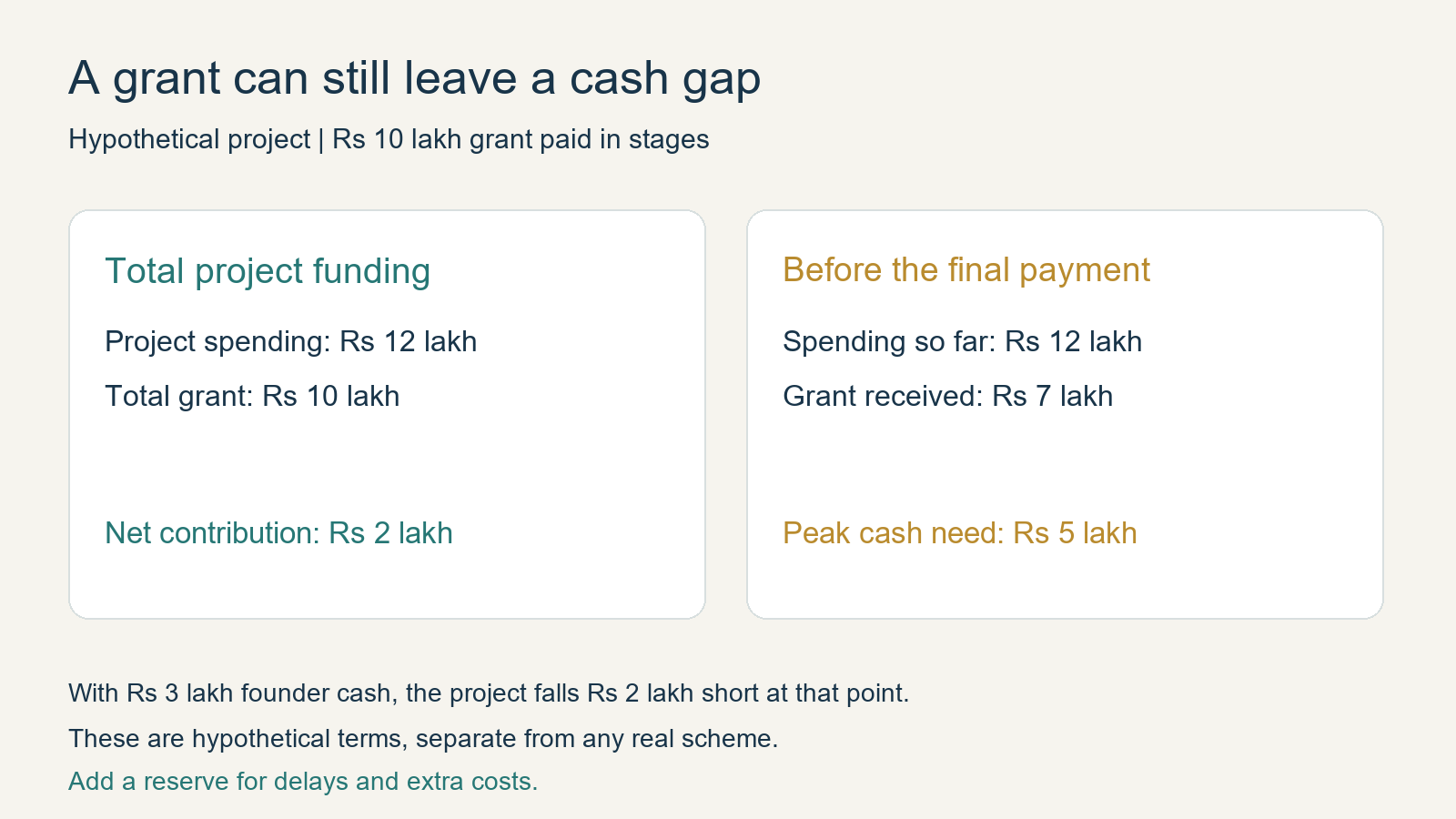
Hypothetical project cash test. Payment timing and milestone conditions differ by program; this is not an actual grant schedule.
Compare ways to cover the gap before accepting
The team could ask whether supplier payments can follow the review schedule. It could also reduce the first trial's scope, if the program agrees. Both choices need approval where they change the funded work or its milestones.
Customer advances may help when a buyer wants a defined pilot and accepts its delivery terms. Equity may provide cash without a fixed monthly repayment, but it brings dilution and agreed investor rights. Compare those obligations with the evidence the grant helps you produce.
Declining an award can make sense if the team cannot fund its required contribution or deliver the approved work. Likewise, a smaller project may teach more than a larger grant-led plan the business cannot finish. Judge the next useful result and the full cost of reaching it.
Put these answers in your grant-readiness file
- Which business milestone will the award help you reach?
- Which costs qualify, and from what date?
- What evidence shows that you meet every eligibility condition?
- Which payments arrive upfront, after spending, or after review?
- How much cash do you need before the last payment, including a reserve?
- Who will prepare the reports and maintain spending records?
- What changes need approval, and what could require a return of funds?
- Which alternative will you use if selection or payment takes longer than expected?
Before accepting startup grants, have your finance adviser check the cash plan and the relevant specialist review the agreement. Start work only when you can explain both the funded purpose and the cash needed to finish it. A useful award should help you obtain evidence the venture needs without creating commitments the team cannot carry.


