


Your startup funding requirement should cover the cash needed to reach a clear business milestone, plus time to act on the results. That sounds simple until you put dates against each payment. A customer may agree to buy in March and pay in May, while salaries leave your account every month.
For an early founder, the hard question is how much cash will buy useful proof. Hiring a sales team before you know who renews can burn money without answering that question. However, a small raise can also leave you halfway through a test with bills still due.
This guide helps you build a funding plan you can explain. It suits founders preparing a first raise and students testing a venture idea. All figures in the worked example are hypothetical; they are neither market benchmarks nor a forecast for a real company.
1. Tie your startup funding requirement to a milestone
First, write down the business question this round must answer. For a software venture, you might need to learn whether paying customers keep using the product after a pilot. For a hardware venture, you may need to prove that you can make a reliable unit at an acceptable cost.
Then turn that question into a dated test. “Launch the product” leaves too much room for debate. “By month nine, have six paying customers using the product each week, with renewal evidence from customers whose contracts have ended” gives the team something to check.
Six customers is an assumption for this example. Your own threshold depends on contract size, sales cycles, and the evidence a later investor will need. A milestone should reduce a specific risk in your business.
Y Combinator's seed fundraising guide connects the amount raised to the next fundable milestone. The useful principle is the link between money and proof. Its 2016 US funding figures should not set the budget for an Indian startup today.
Also decide what you will do if the test fails. Will you change the product, narrow the customer group, or pause new hiring? If the next step would be to raise again without new evidence, the milestone needs more work.
For an earlier venture, build evidence with a prototype before funding a full product build.
2. Build the cash plan month by month
Start with the cash you can use today. Exclude money reserved for unpaid dues or other commitments. Also keep the founder's personal emergency savings separate from the company's bank balance.
Next, list the cash that will leave the business each month. Include founder pay if the founder needs it to work full time. A plan that assumes free labor for a year may fail long before the product test ends.
Your startup funding requirement should include routine bills and costs that arrive in lumps. Startup India's funding guide identifies working capital, equipment, and product development among the uses of capital. For your own model, put each cost in the month you expect to pay it.
Check these lines before you add a broad buffer:
- People: salaries, contractors, hiring costs, and benefits.
- Product: cloud bills, software, equipment, and testing.
- Sales: travel, pilot support, commissions, and paid campaigns.
- Cash commitments: deposits, tax payments, loan repayments, and legal fees.
For an AI product, estimate usage costs at the planned number of customers. Then include the cost of checking outputs and handling errors. A cheap demo can become costly when customers use it every day.
Count receipts when the money reaches you
An invoice is not cash in the bank. If a customer pays sixty days after delivery, place that receipt two months later in the model. Similarly, a grant application or unsigned investor promise should not fund next month's payroll.
Use a cautious receipt estimate based on likely payment dates. Show uncertain sales in a separate case so they do not quietly become guaranteed cash. For inventory businesses, also model the gap between paying suppliers and collecting from buyers.
Finally, check the lowest cash point in each month. A positive year-end balance can hide a shortfall in June. If several large payments fall early in a month, use weekly rows around that period.
3. Calculate the startup funding requirement: an Indian example
Consider a hypothetical B2B software startup. The founders want to test repeat use and renewal by month nine. They plan twelve months of cash cover, including three months after the test to seek the next round of funding.
The business has ₹10 lakh of usable cash. Operating payments total ₹5 lakh per month, including founder pay. It also spends ₹6 lakh on setup in month one and keeps a minimum cash reserve of ₹5 lakh.
The founders expect customer receipts to start slowly. The model assumes no receipts in months one to three, ₹1 lakh per month in months four to six, and ₹2 lakh per month in months seven to nine. Receipts then rise to ₹3 lakh per month for the final three months.
| Cash item over twelve months | Amount |
|---|---|
| Operating payments: ₹5 lakh × 12 | ₹60 lakh |
| Setup payment in month one | ₹6 lakh |
| Total cash outflows | ₹66 lakh |
| Less customer receipts | ₹18 lakh |
| Less usable opening cash | ₹10 lakh |
| Add minimum cash reserve | ₹5 lakh |
| External funding required | ₹43 lakh |
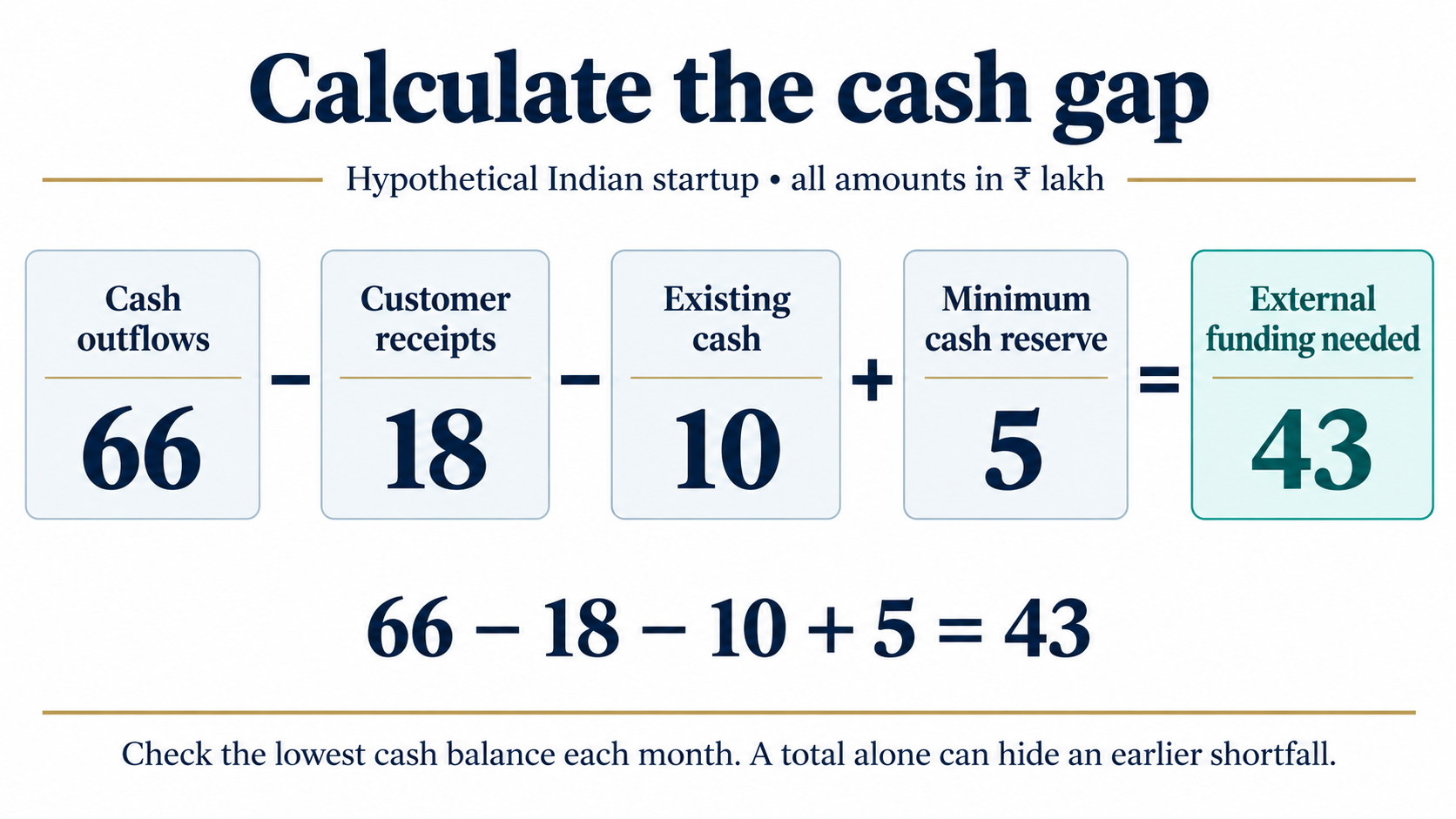
Illustrative cash calculation. Check the lowest monthly balance before using the total as a funding target.
In this case, the cash balance falls throughout the year, so the total gives the right answer. However, that shortcut fails when cash outflows and receipts create an earlier dip. The startup funding requirement must cover the largest gap below your chosen reserve across the whole plan.
Check that the monthly balances agree
Assume the full ₹43 lakh arrives before month one. Together with existing cash, that gives an opening balance of ₹53 lakh. Each closing balance equals opening cash plus that month's receipts, less its payments.
| Month | Customer receipts | Cash payments | Closing cash |
|---|---|---|---|
| 1 | ₹0 lakh | ₹11 lakh | ₹42 lakh |
| 2 | ₹0 lakh | ₹5 lakh | ₹37 lakh |
| 3 | ₹0 lakh | ₹5 lakh | ₹32 lakh |
| 4 | ₹1 lakh | ₹5 lakh | ₹28 lakh |
| 5 | ₹1 lakh | ₹5 lakh | ₹24 lakh |
| 6 | ₹1 lakh | ₹5 lakh | ₹20 lakh |
| 7 | ₹2 lakh | ₹5 lakh | ₹17 lakh |
| 8 | ₹2 lakh | ₹5 lakh | ₹14 lakh |
| 9 | ₹2 lakh | ₹5 lakh | ₹11 lakh |
| 10 | ₹3 lakh | ₹5 lakh | ₹9 lakh |
| 11 | ₹3 lakh | ₹5 lakh | ₹7 lakh |
| 12 | ₹3 lakh | ₹5 lakh | ₹5 lakh |
The final month reaches the reserve floor exactly. It leaves no spare cash beyond that reserve. Therefore, ₹43 lakh is a base-case estimate under these assumptions, with little room for the plan to slip.
If funding arrives in stages, enter each installment on its expected date. Then rerun the balances. A promised total does not solve a cash shortage before the next installment arrives.
4. Test your startup funding requirement against delays
A startup funding requirement changes when the timeline changes. Suppose the business needs three extra months to finish the test and secure its next source of cash. Keep receipts at ₹3 lakh and operating payments at ₹5 lakh in those months.
That extension uses another ₹6 lakh, lifting the required raise to ₹49 lakh. Separately, a twenty percent rise in monthly operating payments adds ₹12 lakh over the original year. The funding need then becomes ₹55 lakh.
If both changes occur, the extra three months each use ₹3 lakh. The total becomes ₹64 lakh: the original ₹43 lakh, plus ₹12 lakh for higher annual costs, plus ₹9 lakh for the extension.
| Case | External funding needed | Assumption that changes |
|---|---|---|
| Base plan | ₹43 lakh | Twelve months at the planned costs |
| Three extra months | ₹49 lakh | Original costs and final-quarter receipts continue |
| Higher operating payments | ₹55 lakh | Monthly operating payments rise from ₹5 lakh to ₹6 lakh |
| Both changes | ₹64 lakh | Higher payments continue through fifteen months |
These are planning cases, so they do not predict which outcome will occur. Also test late customer payments if collections are uncertain. Use specific changes to explain your buffer; avoid adding a percentage without knowing what it covers.
The reserve and the extra months serve different purposes. The reserve sets a minimum balance, while the extra months fund a longer plan. If you already included those costs elsewhere, do not add them again.
5. Match the raise to a plan you can deliver
Now compare the startup funding requirement with a smaller plan. Could you test the key assumption with fewer hires or one customer segment? If so, calculate that version separately and state what it will achieve.
Raising too little can force rushed decisions just as the test starts to produce results. However, a larger round can add dilution and pressure to grow faster. Extra cash also makes it easier to hire for work that does not yet need doing.
Avoid taking a smaller check and keeping the full spending plan. Agree on the narrower milestone first, then rebuild the cash schedule. The startup funding strategy guide can help you choose whether equity funding fits that plan.
Use this funding worksheet before investor meetings
| Question | What to write down |
|---|---|
| What must this money prove? | A dated milestone and the evidence you will collect |
| What cash can you use now? | Available opening cash after existing commitments |
| When will payments leave? | Monthly costs, including one-off bills |
| When will customers pay? | Receipt dates, with uncertain sales shown separately |
| What is the lowest balance? | The largest shortfall below your reserve floor |
| What happens if the plan slips? | A delay case and the costs it adds |
| What can a smaller raise achieve? | A revised milestone and spending plan |
Before you pitch, ask someone outside the team to check the dates and sums. Then update the model monthly using actual receipts and payments. That keeps the funding conversation tied to how the business works.
You should be able to explain the amount in one short paragraph: what the money will test, when the evidence will arrive, and how much cash each case needs. If you cannot do that yet, spend another hour on the plan before editing the pitch deck.


