


AI product readiness depends on whether customers can complete a real job with a result they can trust. A polished demo helps you show an idea. Before a limited launch, you also need evidence about errors, human checks, and what happens when a supplier fails.
Consider a hypothetical tool for a small Indian exporter. It reads shipment documents and prepares a draft record. The demo works on clean files that the founders chose. However, a buyer uploads a blurred scan, and the tool places a charge in the wrong field.
The screen still looks complete. Before using the record, the buyer must spot the error. The next step is to test the gap and define a safe scope for real use.
AI Product Readiness Starts With the Core Customer Job
Start with the prototype's core customer benefit. Check the team's pace of building and improving working software, too. Next, ask whether the design fits the way the team plans to run the product. Customer feedback should also have shaped what the founders built.
These questions help you assess the prototype and the team's progress. They do not establish that the product can handle all real inputs or run without support. So keep the evidence for the demo separate from the evidence for daily use.
For example, the exporter needs correct records that fit an existing shipment process. A screen that extracts text proves one useful step. It leaves open whether the fields are right, whether staff can catch errors, and whether the record reaches the next system correctly.
The prototype-first guide helps you build evidence while learning from customers. This readiness review asks what must work before a customer relies on the product for a defined task.
Define Acceptable Results for AI Product Readiness
First, write what counts as a usable result. Include the fields that must be right and the checks required before the customer acts. Agree on this with the people who use the output. Their role in setting the standard makes the AI product readiness review more useful.
Then build a test set from the kinds of inputs those users face. Use data you have permission to process. Include routine cases, poor scans, missing fields, and examples that fall outside the intended scope. Keep some cases separate from the examples used to tune the system.
Test the whole job. Model output can look right while the workflow sends it to the wrong record or drops a required field. Trace the input through review, storage, and the final handoff.
Also record what a person must fix. Track the time spent checking results and how often the product needs a correction. A tool that succeeds only because founders quietly repair every output needs a different plan for wider use.
Keep a record of the version tested and the cases used. Then repeat the relevant tests after a model, prompt, or workflow change. Without that record, the team may miss a loss in quality while celebrating a new feature.
There is no single pass rate that fits every task. Set the standard based on the customer's use and the consequences of an error. A low-risk draft and a record used for a binding commitment need different checks.
Make Human Review Part of AI Product Readiness
Name who checks results before they leave the product. Next, specify what that person sees: the source file, the proposed fields, and any missing information. A reviewer needs enough context to detect the errors you expect them to catch.
Decide what the tool should do when it cannot finish. It might flag the record for review or leave the field blank. It should avoid silently turning uncertainty into a confident answer that the buyer treats as final.
Also make the fallback practical. If a person must finish the work, state who receives it and how soon they can respond. A fallback that depends on a founder being awake at all times will struggle as use grows.
The NIST AI Risk Management Framework offers voluntary guidance for managing AI risks across design, development, use, and evaluation. This article's readiness sheet helps organize a venture's next tests; it does not certify a product or replace use-specific requirements.
Fit the Product Into the Buyer's Work
Identify the user, the person who owns the budget, and the person responsible for the final result. They may be different people. A user can like a trial while the budget owner remains unsure whether the product solves a funded problem.
Next, trace where the tool fits. Identify the system that supplies the input, the person who reviews it, and where the accepted record goes. If staff must copy data across several screens, test that work as part of the product experience.
AI product readiness also requires checks on access and data handling. Limit access to the people who need it, and confirm that the intended data use fits the customer's agreement. A demo using sample files leaves those details untested.
Separate trial interest from ongoing demand. A paid pilot proves that someone paid for that pilot. Continued use, a business owner, and renewal evidence help you assess whether the tool has a lasting role.
Your AI-native or AI-enabled model affects the depth of work needed here. In both cases, the customer still depends on the full service. The model's answer is only one part of it.
Test AI Product Readiness Under Failures and Cost Pressure
List the suppliers the product needs to finish a job. Include the model provider, hosting, and paid tools. Then check which failure would stop the service and what the buyer would see.
For example, test a timeout and a rate limit. A rate limit caps how much you can use a service within a given period. Make sure a failed request stays visible and does not create a duplicate job when the system retries it.
If you plan to switch providers, test the effort required. A new model can produce different results, so a substitute needs its own quality checks. The mere existence of another API does not prove that it can replace your current supplier.
Track the cost of a usable result as well. Count retries, hosting, and human checks. A forecast based on one clean model call can miss much of the work required to serve actual customers.
Use the build, buy, or compose guide to revisit choices that block reliable delivery. This article concerns products using existing models. Training a foundation model needs a separate plan for research and training resources.
Worked Example: A Limited Exporter Pilot
Return to the hypothetical shipment tool. The founders test routine files and blurred scans, then check the output against source records. Suppose clean files work with review, but poor scans still cause errors that reviewers sometimes miss.
Meanwhile, the customer can import accepted records into its existing system. A named staff member agrees to check each file during the trial. However, the team has not yet tested how the product handles a supplier outage.
These findings support a narrow next step. Repair the poor-scan handling and test the outage before starting a limited pilot. During that pilot, use supported file types, retain review before use, and keep a clear route for cases the tool cannot finish.
| Area | Evidence needed before the pilot | Next action |
|---|---|---|
| Customer task | Correct fields in a usable shipment record | Agree on the required fields with the buyer |
| Output quality | Representative tests and visible error cases | Repair poor-scan handling and retest |
| Human review | A reviewer can catch the known errors | Test the review screen with actual staff |
| Workflow fit | Accepted records reach the next system | Run a complete job through the handoff |
| Supplier failure | A failed job stays visible with a fallback | Simulate a timeout and recovery |
| Cost | Full spending per usable record | Include retries and staff review time |
Each gap in this AI product readiness review needs an owner and a test. Also set the boundary of the pilot: supported inputs, who may use it, and what actions require review. State how the team will pause the trial if a failure threatens that boundary.
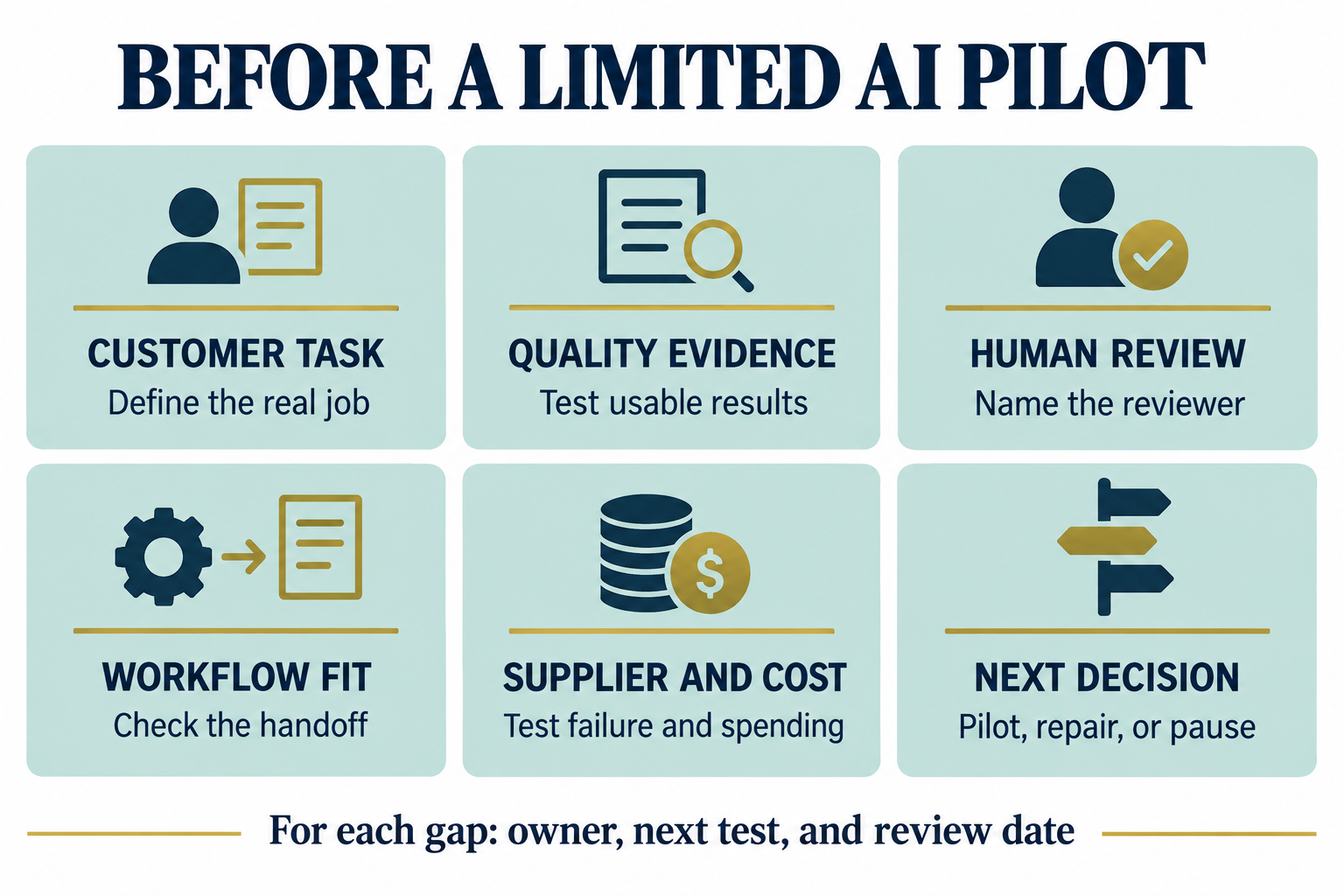
Use the sheet to record evidence and gaps for one customer task. This planning sheet provides no launch certification.
Choose a Pilot, a Repair, or a Pause
A bounded pilot makes sense when the team can deliver the defined task, manage known errors, and support users within the stated scope. Start small enough that staff can observe the work and respond to problems.
Choose targeted repair when a clear gap prevents that limited use. For example, fix the review screen if it hides the fields staff must check. Adding more demo features will not close that gap.
Pause the rollout if you cannot define a safe scope or support a failure. Record what evidence would let the team reconsider. A pause should lead to a clear test, so the team knows what to do next.
After reliable use begins, evaluate product-market fit through continued customer value and repeat demand. AI product readiness answers whether you can deliver the next limited task. Lasting demand requires further evidence.
Choose one real customer job today. Write its acceptance standard, the evidence you have, and the gaps still open. Give each gap an owner and review date before committing to a launch.


