


Product-market fit becomes clearer after the launch excitement fades. Someone tries your tool, praises the demo, and joins the trial. A month later, do they still use it when the real work arrives?
That question should shape your next growth decision. Look for a clear group that gets lasting value, returns when the need recurs, and pays on terms that work. Then check whether the pattern holds across new groups of buyers.
You may have strong demand among small exporters while larger firms still need a different product. Treat each move into a new market as a fresh test. A good result in one segment gives you a place to build from, but it doesn't settle the next market.
Define Product-Market Fit for One Buyer Group
Start by naming the buyer, the problem, and the conditions under which your product helps. For example, a tool that helps owner-run exporters prepare shipping documents serves a different need from trade software for large firms.
Write a clear claim: small apparel exporters use the product for recurring shipments because it cuts document corrections. That claim gives you something to measure. A claim about helping all small businesses leaves too much room to interpret any activity as progress.
Segments group people with similar needs. A signup cohort groups buyers who started in the same period. Track both, since each answers a different question.
The segment shows where your offer works. The cohort shows whether buyers keep receiving value as time passes. Compare cohorts at the same age: a six-month-old group has had more time to leave than last week's signups.
For seasonal ventures, match the review period to the buying cycle. A grower who orders once each season may be a loyal customer despite months without purchases. Daily activity would measure the wrong behavior.
Read Product-Market Fit Through Retention
Retention measures how many buyers continue a meaningful activity after they start. Choose that activity before you plot the curve. A login is a weak product-market fit signal if the useful outcome is a completed shipment file.
For a subscription tool, track active accounts and renewal separately. A customer may keep paying because an annual contract hasn't expired, even though the team stopped using the product. Conversely, free users may stay active without becoming paying buyers.
Plot the share of each cohort that still completes the core task over time. Then compare recent cohorts with older ones. A curve that levels off can suggest a group keeps finding value, but the share that stays and the costs still matter.
Small samples can swing sharply after one cancellation. Show the customer count alongside the percentage, and keep the time window visible. Avoid declaring product-market fit from a young cohort that hasn't reached its first renewal.
When retention falls, speak with buyers who left and those who stayed. Ask what changed in their work and what they use now. Lost demand, unreliable output, and difficult onboarding call for different responses.
Use the Survey as One Product-Market Fit Signal
Sean Ellis's survey asks how buyers would feel if they could no longer use the product. The familiar answer choices include very disappointed, somewhat disappointed, and not disappointed. The question tests how strongly users value continued access.
In his account of Superhuman's process, Rahul Vohra describes Ellis's 40% benchmark for very disappointed responses. Superhuman surveyed people who had recently experienced the core product. It also used their feedback to identify who valued the product and why.
Use that benchmark as a rough guide. A response from a devoted trial user doesn't tell you whether the buyer will renew. Before drawing a conclusion, record who could take the survey, how many replied, and which segment they represent.
Ask what benefit they would miss and what could replace it. If buyers name the same useful outcome without prompting, you gain a clearer product direction. However, mixed answers may reveal several use cases that need a closer look.
Keep the rules for choosing users consistent when you repeat the survey. Also interview people who stopped using the service, since a survey of current users leaves their experience out. A high score deserves a follow-up check against actual use and payment.
Check Payment and Customer Pull
Repeat payment adds product-market fit evidence that buyers value the result enough to bear a cost. Yet discounts, long contracts, and personal relationships can make that evidence hard to read. Track renewals at the intended price and note unusual terms.
For business subscriptions, net revenue retention compares revenue from the same starting group of buyers over time. It includes expansion, contraction, and churn while excluding revenue from new buyers. Therefore, large upgrades can hide losses among smaller accounts.
Read revenue retention alongside the share of accounts that stay. There is no single percentage that proves product-market fit across software, services, consumer goods, and seasonal businesses. Set expectations around your model, customer cycle, and costs.
Customer pull adds another view. Buyers may return without a reminder, introduce peers, or ask to roll the product out elsewhere. Record those actions with their source so a referral reward doesn't look like unprompted praise.
In business sales, a shorter sales cycle can help, but check what caused it. A lower price or simpler approval process may close deals faster without improving lasting value. Likewise, a long enterprise sales cycle doesn't by itself mean the product is a poor fit.
Example: Product-Market Fit for Small Exporters
Consider a hypothetical venture in Tiruppur that helps apparel exporters check shipment documents. Owner-run firms use it before repeat shipments, while larger exporters ask for approval controls and links to existing systems.
The founder's dashboard combines both groups. New enterprise trials lift total activity, even as some small firms stop returning. Because new users keep arriving, the main chart looks healthy.
Separate the segments and signup cohorts. For small firms, examine completed checks across repeat shipments and payment after the trial. For larger firms, examine whether teams complete real jobs after onboarding and whether the person who controls the budget agrees to paid use.
Suppose the small firms that remain report fewer corrections, yet onboarding consumes hours of founder support. Demand may be promising while delivery still needs work. Record the time spent on support before planning a large increase in customer volume.
Meanwhile, enterprise interest remains early evidence because those users haven't renewed or used the tool across enough shipments. The next step is a limited test of their workflow. Keep the enterprise product-market fit verdict separate from the small-firm verdict.
This distinction protects the original buyers too. If enterprise requests dominate the roadmap, the team may neglect the simple checks that small exporters value. Track whether those buyers still get their core outcome as the product changes.
Check Whether AI Novelty Is Wearing Off
An AI demo can attract users who want to try a new capability. Your product-market fit review should ask what happens after that first experience. Do they finish useful work, correct fewer errors, or return for the next task?
Measure the result buyers depend on. For the export tool, generating a draft matters less than producing a file the customer can use after review. Track required corrections and manual checks alongside task completion.
Costs matter too, because a popular service may depend on extensive human repair. Include time spent on support and review when checking whether you can serve more buyers. If the team quietly fixes every output, usage alone overstates readiness.
As alternatives improve, ask departing users which option they chose and why. A rival feature may reduce your appeal, while better workflow integration may help you keep buyers. Avoid assuming that any feature has a fixed competitive lifespan.
Use the startup moat evidence test to examine why a rival would struggle to match the customer benefit. Product-market fit and defensibility answer related questions; keep evidence for each claim visible.
Turn Product-Market Fit Evidence Into a Growth Decision
Prepare a one-page review for each group you plan to serve. This worksheet brings the signals together so you can decide what to do next. Use the same fields each time so the team can see what changed.
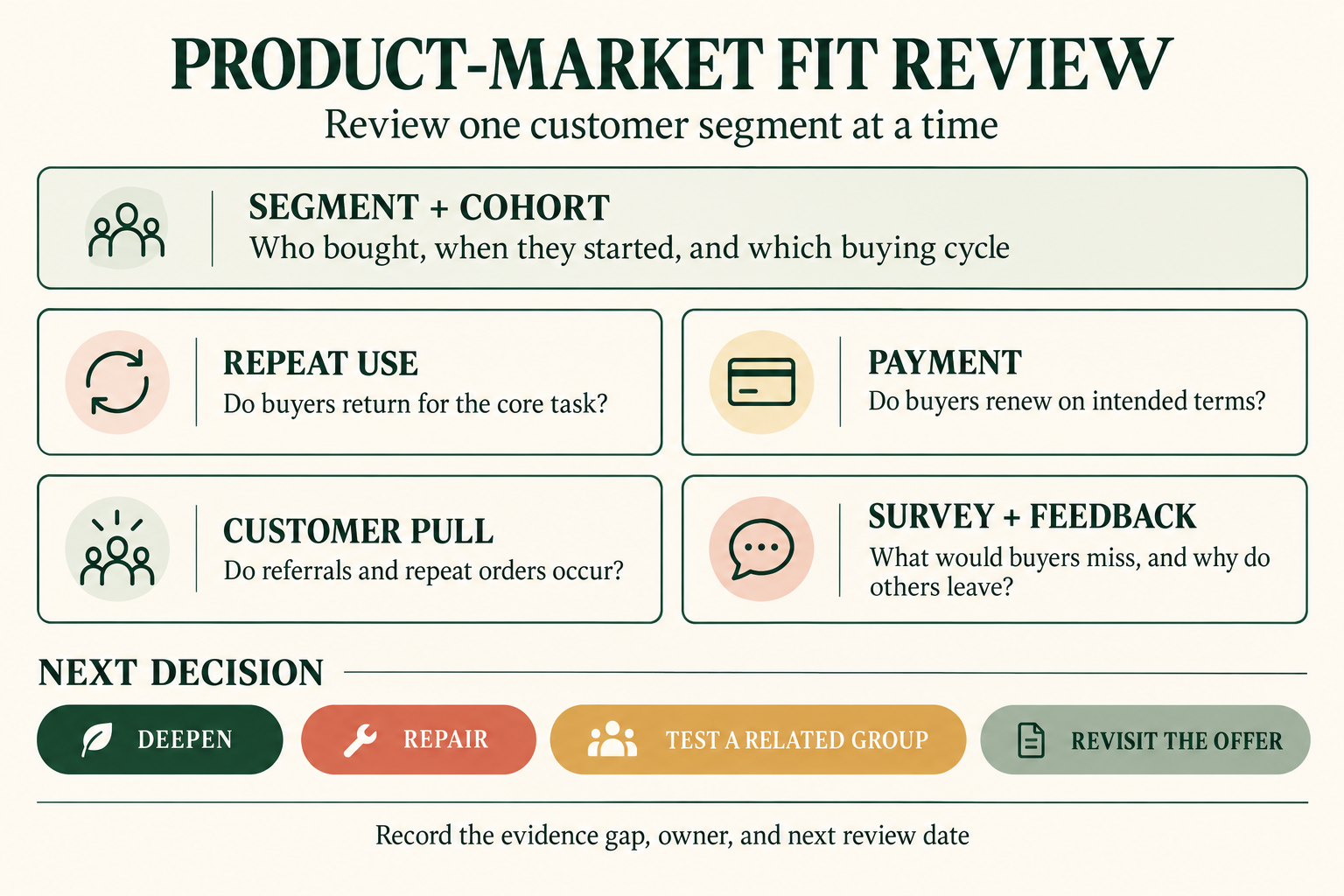
Record the group of buyers and signup dates first. Next, name the useful action and the time window that makes sense for its buying cycle. Add retention counts, renewal results, and relevant survey feedback.
Then state the gaps. You may have repeat use with no proof of payment, or renewal data from only a few founder-managed accounts. Naming the gap helps you choose the next test without overstating the result.
End with one of four actions:
- Deepen the segment: repeat use and paid value look promising; improve delivery before taking on much more volume.
- Repair a weak point: buyers want the result, but onboarding or reliability keeps blocking it.
- Test a related group: the original segment looks healthy; validate the new group's needs with a small commitment.
- Revisit the offer: repeated tests show weak return use or willingness to pay; reconsider the problem, segment, or solution.
For each action, assign an owner and set the next review date. Write the evidence that would change your decision before collecting the next batch of results. The startup experiment guide can help you turn that gap into a test.
Choose the Next Test
Before increasing spending to win new buyers, check that existing buyers keep getting value and that you can deliver it reliably. Next, use the scaling strategy guide to check the work and systems behind your growth plan.
Your next step is small: choose one segment and review its oldest useful cohort. Put repeat use, payment, and buyer feedback on the same page. Decide what you can support today and what you still need to learn.


