


A startup moat should help you keep winning customers when a rival can copy your visible features. Before you claim one, ask what gives buyers a reason to stay and what would stop a competitor from offering the same benefit. Your answer needs evidence from the work you do.
Imagine another team launching a similar product next month. It uses the same AI model and charges less. Would your customers move, or would they lose something they value by leaving?
This question helps you separate an early lead from a lasting edge. Use the tests below to choose where to invest scarce time and cash.
A Startup Moat Needs a Benefit and a Barrier
A useful feature helps the customer. A moat also makes that benefit hard for a rival to match while earning a worthwhile return. Ask both questions before spending on a defense.
For example, a fast report may help a buyer close the books sooner. If any vendor can produce it with the same tools, speed alone gives you little protection. The deeper edge might come from years of resolving that buyer’s messy records and handling exceptions well.
Even then, you have a startup moat claim to test. Customers may value your service while finding it easy to replace. Repeat purchases show demand; you still need to learn why the next supplier would struggle.
Keep product quality and value at the center of this work. A moat built around friction can push buyers to seek an exit. Help them succeed, and study which parts of that success a rival cannot readily reproduce.
Seven Sources of Lasting Advantage
Hamilton Helmer’s 7 Powers framework describes sources of lasting competitive advantage. The seven powers offer a way to inspect your startup moat. Each requires conditions you must demonstrate.
| Power | What creates the edge? | Question to test |
|---|---|---|
| Scale economies | Larger volume brings a cost edge | Can a smaller rival match your unit cost? |
| Network economies | More participants improve user value | Do existing users benefit when others join? |
| Counter-positioning | Copying your model would damage an incumbent’s existing business | What would that rival lose by matching you? |
| Switching costs | Moving costs the buyer time, money, or risk | What must the customer rebuild or relearn? |
| Brand | Earned trust or identity shapes choice | Will buyers still choose you at a higher price? |
| Cornered resource | Valuable access that rivals cannot readily obtain | Who else can secure the same rights or resource? |
| Process power | Hard-to-copy routines produce better results | Can another team reproduce the result from a written guide? |
A large customer list alone does not prove a network effect. For instance, a buyer may get no extra value when an unrelated customer joins your service. Look for an actual change in match quality, choice, or shared usefulness.
Likewise, a tidy operations manual does not prove process power. A rival might copy it and achieve the same result. The stronger claim involves skills and routines that take sustained learning to acquire.
Treat each row as a possible source of advantage. You can rule out a power that your current business cannot support. One well-supported candidate gives you more to work with than a list of seven vague claims.
How AI Changes the Copying Test
AI can change the effort needed to copy parts of your offer. Its effect depends on the task and the rival’s access to tools. Test that exposure before treating an AI feature as a startup moat.
For software, ask what another team could rebuild with a shared model and ordinary development tools. Then identify what still takes hard work: trusted delivery, local knowledge, or integration with a buyer’s daily tasks. Those may be moat candidates, but you must test them too.
A data claim needs similar care. Owning many files says little about whether they improve an outcome. Ask whether you have the rights to use them, whether they change customer results, and whether rivals can get an equivalent source.
For example, records of actual delivery failures might help a distributor plan routes. However, the benefit depends on how the team captures those records and uses them. A pile of old spreadsheets may add no useful edge.
Lower tool costs can help you offer a cheaper service. Yet rivals with access to the same tools can pursue that saving. Measure the full cost after review and rework before claiming a cost moat.
The build, buy, or compose guide helps you choose how to obtain a capability. After that decision, ask which advantage belongs to your venture and which comes from a supplier anyone can use.
Choose a Startup Moat You Can Test
The Moat-Architecture Decision Matrix asks founders to choose plausible sources of advantage and plan how to build them. For an early venture, start with one or two candidates that fit your next customer milestone. Add others when evidence supports the investment.
Write down the benefit buyers get from each startup moat candidate. Next, name the barrier a rival would face. If you cannot explain that barrier, mark the claim as untested and decide what could reveal it.
Give each candidate a status: unsupported, plausible, or supported by current evidence. These labels help you distinguish a plan from a result. They also avoid giving a weak claim more weight than it deserves.
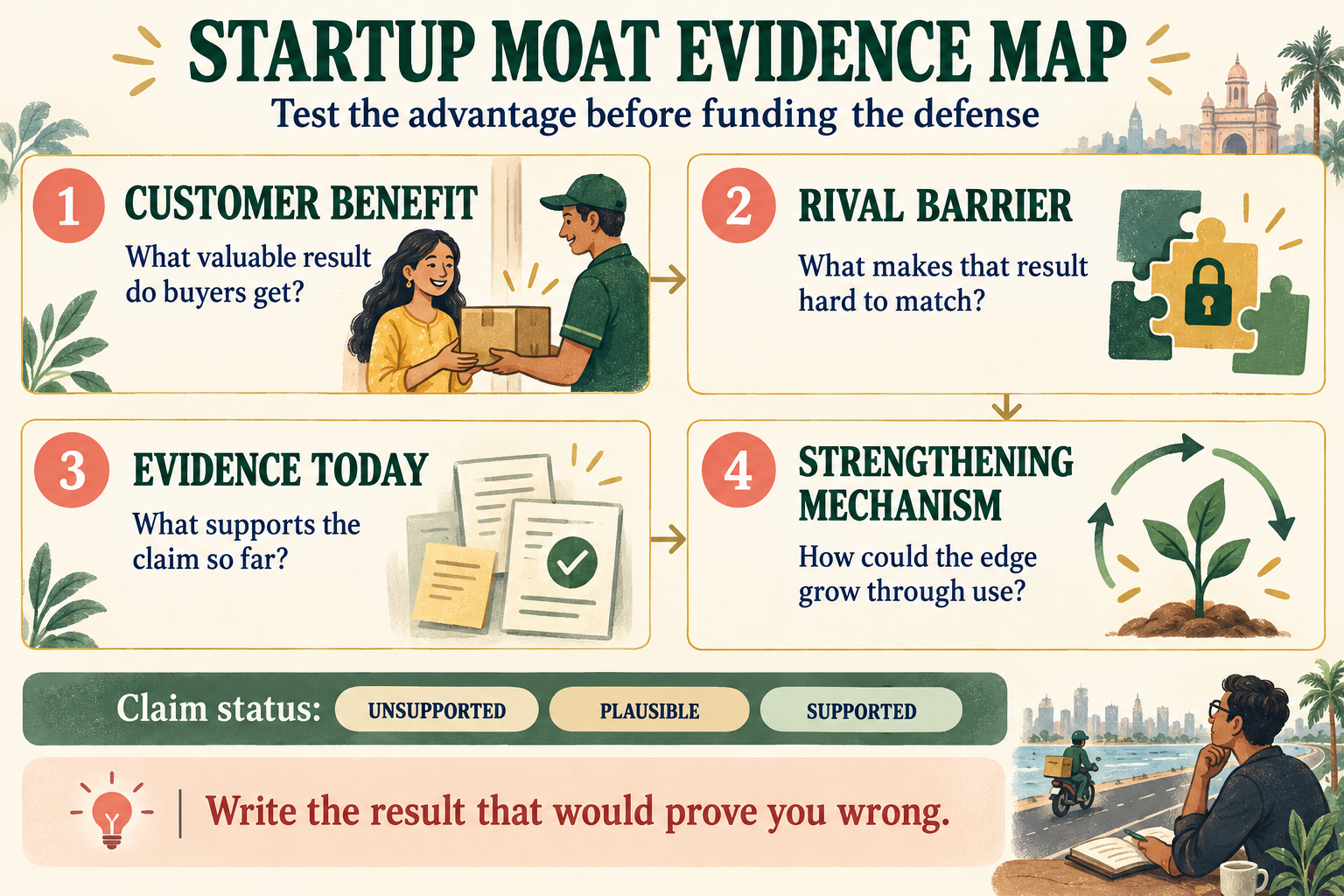
Then ask how the edge could grow through use. A team might learn from exceptions and reduce errors on later jobs. Or a network might improve the range of useful matches as relevant participants join.
Choose a measure that reflects that mechanism. Track error rates if you claim better delivery. If you claim switching costs, learn what a move would require through interviews and actual migration work where available.
Finally, name a result that would weaken your claim. Perhaps a rival matches your quality with a short trial. Or customers renew only because you offer a discount. A test that can only confirm your belief tells you little.
Startup Moat Example: A Regional Distributor
Consider a hypothetical distributor serving small food producers around Coimbatore. It uses purchased software and AI tools to plan deliveries. Its founder hopes that reliable service will protect the business as new distributors enter.
The team starts with a process-power hypothesis. It thinks its routines for handling missed pickups and route changes produce fewer failed deliveries. To test that, it logs each exception, its cause, and the action taken.
Next, it checks whether those routines improve results across comparable routes. It includes the staff time spent fixing problems. If the gains disappear after counting that work, the team must revise its claim.
The founder also considers switching costs as a startup moat candidate. Buyers may depend on agreed pickup windows and links to their order systems. However, a friendly relationship alone may not make a switch hard.
She asks buyers what they would need to change to try another supplier. A paid pilot might show that a rival can take over easily. That finding would narrow the moat claim even if buyers still like the current service.
The team writes down its working view: reliable delivery is the customer benefit; learned exception handling may create a barrier. It will invest in that routine only while evidence shows a useful gain. This scenario illustrates a method and makes no claim about a real company’s results.
Build Evidence as Demand Becomes Clear
Before product-market fit, when demand is still uncertain, your main task is to find an offer that customers want enough to keep using. Make modest choices that preserve future options. For example, record failures and customer feedback in a form you can use later.
Avoid a large startup moat project whose benefit depends on demand you have yet to prove. An exclusive resource with no willing buyers can still drain your cash. Choose a small test that teaches you about value and defense together.
Once demand becomes repeatable, you can invest more in the routines that produce an edge. Even then, compare the cost with other uses of cash. Better delivery may deserve attention before a new region or a broad marketing push.
The solo founder and team guide helps you assign owners to that work. The team learns only if someone checks the data and changes the routine after a failure.
For AI workflows, start with a system your team can inspect. Anthropic’s engineering guidance recommends simple solutions and adding complexity when needed. Test whether a change improves your result before treating extra automation as an advantage.
Explain Your Startup Moat Without Inflating It
An investor, lender, or partner may ask why another business cannot catch up. Answer with the claim you can support today. If your startup moat is still a hypothesis, say what evidence you plan to collect next.
Use a short structure: the customer’s benefit, the rival’s barrier, the evidence so far, and how the advantage could strengthen. Add the result that would change your view. That last part shows how you will test the claim.
For the hypothetical distributor, an honest answer might describe its exception-handling routine and the delivery records under review. It would also acknowledge that the team has yet to prove how hard the routine is to copy.
Keep the measures tied to the claim. Total revenue may show growth while revealing little about switching costs. Likewise, a model benchmark may show technical skill without explaining why a customer will stay.
Review your memo when the buyer, product, or supplier changes. The startup scaling guide can help when the next decision is where to add capacity. Check whether growth strengthens your proposed edge or merely creates more work.
Start your moat memo with the customer you serve today. Choose one candidate, write the benefit and barrier, and run a test that could prove you wrong. Use the result to decide what deserves your next investment.


