


Deciding whether to build or buy AI shapes what your startup spends, controls, and depends on. A founder can buy a finished tool, connect existing services, or develop a feature in-house. Each route creates a different workload.
Consider a software venture adding customer support. A ready-made assistant may handle routine questions well. Yet the same tool may struggle when an answer depends on the customer’s order history and a local distributor’s records.
Before choosing a vendor or hiring engineers, define the job. What must improve for the customer? Which parts must you control? Then compare the options for that feature.
If you haven’t mapped the wider system, begin with the startup technology choices guide. This article takes the next step: deciding how to obtain one AI feature.
Build or Buy AI? Consider the Compose Option
The routes need different skills because a finished app, a connected workflow, and a custom model each create their own work.
| Route | What you do | When it fits | What you must own |
|---|---|---|---|
| Build | Develop the feature, which may include adapting and operating a model | Specific performance or control supports your advantage | Engineering, testing, deployment, and upkeep |
| Buy | Adopt a finished product and configure it | A standard tool meets the need with limited changes | Vendor checks, setup, access controls, and results |
| Compose | Connect models, data, and tools into your own workflow | Your customer needs a distinct workflow using existing building blocks | Integration, testing, monitoring, and vendor changes |
Build: Develop the Capability You Need
Building lets your team change how a feature works. However, that control requires ongoing work. Someone must maintain the code, test changes, and deal with failures.
For AI, the build route may include adapting an existing model using your own examples and running it yourself. Training a general-purpose model from scratch is a much larger undertaking. Keep those costs separate when you plan the budget.
Choose a build route when the feature gives you a lasting edge and your team can support it. Check both conditions before committing.
Buy: Adopt a Finished Product
Buying can help you launch with less engineering work when your needs match the product. For example, an established help-desk tool may already offer answer drafting and ticket summaries.
Still, a subscription leaves work for your team. Check the setup effort, usage limits, data terms, and route to human support. If a standard tool meets the need, extra custom work may bring little return.
Compose: Connect Existing Building Blocks
Composing means assembling a feature from existing services. Your application might connect a language model to approved product guidance and an order system. An application programming interface, or API, lets these systems share requests and results.
Here, your team builds the workflow while an external vendor supplies the model. You can shape the customer experience while someone else supplies the basic parts.
A composed workflow needs tests, clear permissions, monitoring, and a person who owns failures. Budget for that work before you approve the route.
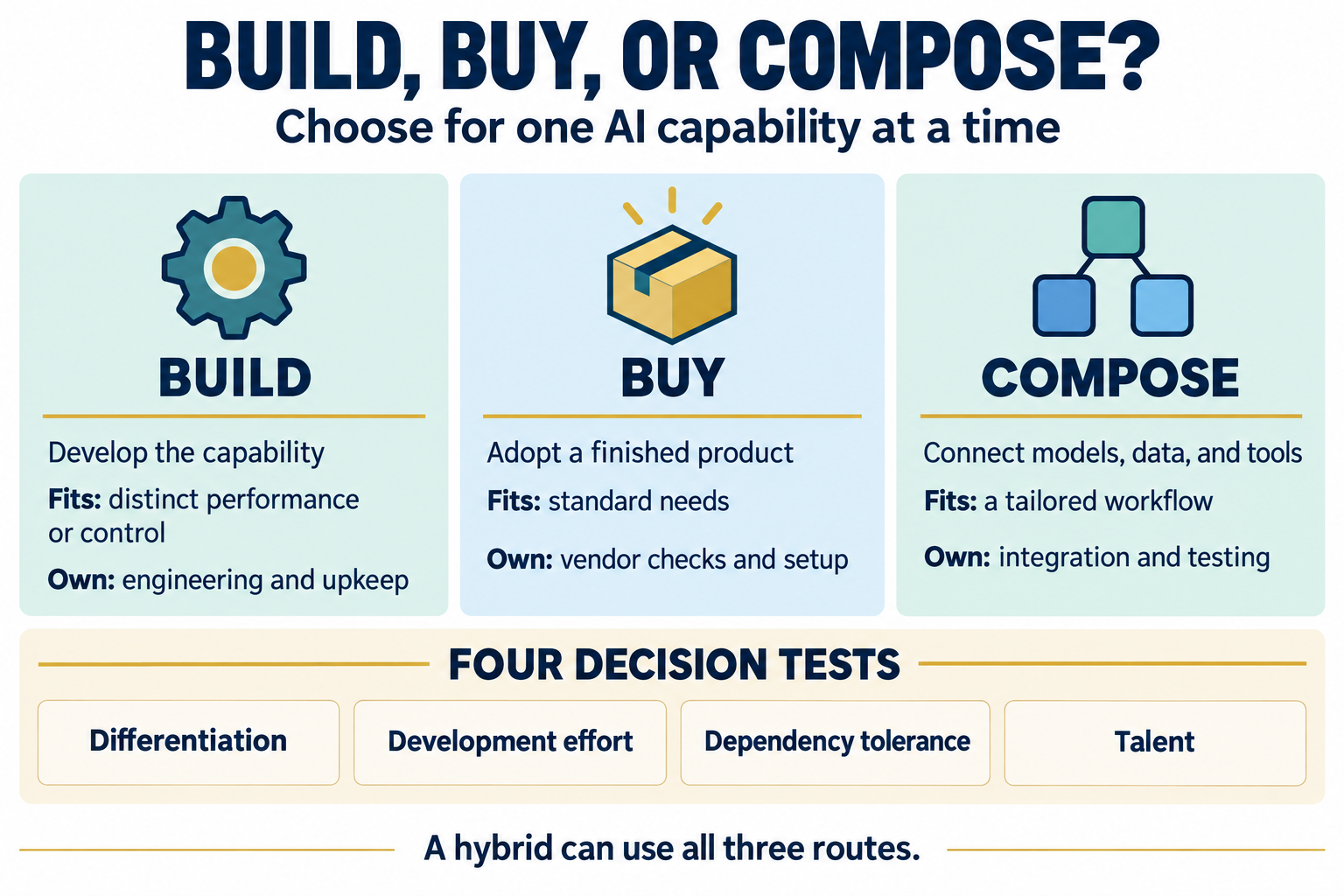
The three routes can work together. Apply the four tests to the job your venture needs done.
Four Tests Before You Build or Buy AI
The Build-Buy-Compose Decision Matrix uses four tests. Apply each test to one feature. A broad plan such as “AI for operations” hides too many choices to judge well.
Instead, write a narrow description: “Draft answers to delivery questions using approved product guidance and current order records.” You can now compare routes against the same job.
1. Does This Capability Help You Stand Apart?
Ask why a customer would choose your venture. Is the answer tied to this feature, or does the feature simply help you operate?
For a local retailer, ticket summaries may be a support task. For a firm selling support software, correct handling of unusual customer requests may help win a sale.
Even then, owning the base model may add little. Your advantage could come from workflow design, useful data, or connections to customer systems. Identify the layer that creates value before choosing what to build.
The AI-native versus AI-enabled guide helps you place this choice within the venture’s wider design.
2. How Much Work Does AI Actually Save?
AI tools can speed parts of development. However, a working demo leaves many costs untested. Measure the work needed to serve real users well.
Compare setup, links to other systems, testing, and upkeep across the routes. Include the time required to handle unusual requests. A tool that works on clean examples may need more support when users submit missing details.
Anthropic’s engineering guidance recommends starting with simple solutions and adding complexity when it improves outcomes. That supports a practical test: can a narrow workflow do the job before you introduce a more autonomous agent?
Next, ask a tech adviser to estimate the work after launch for each route. Faster coding only improves the decision when the resulting system remains affordable to run.
3. Which Dependencies Can You Accept?
Buying and composing create ties to outside vendors. Building also relies on hosting and expert staff. Compare what can fail and how you would respond.
A model vendor may change prices or retire a model. A software vendor may remove a feature. Meanwhile, a cloud outage may stop a workflow your customers rely on.
Ask what happens next. Can staff continue manually? Can you export the data? How much work would a switch require?
For a key feature, ask an engineer to assess a thin interface between your workflow and the model vendor. This can reduce some switching work, although you must still test each model. Add a second vendor only when the risk of an outage justifies the extra cost.
4. Who Can Run It After Launch?
First, match the route to the skills you can sustain. Buying needs careful vendor management and setup. Composing needs people who can connect systems, test behavior, and monitor the workflow.
Building may require deeper model and hosting skills. If those skills rest with one contractor, document what happens when that person leaves.
Ask who can find the cause of a bad result on a busy Monday morning. A polished demo cannot answer that question. Assign an owner, write clear notes, and agree on a support plan before launch.
Build or Buy AI: A Worked Hybrid Example
Consider a hypothetical Indian software company serving regional distributors. Its customers ask about stock, dispatch dates, and delayed deliveries. Some messages mix English with a local language.
The founder wants quicker replies while keeping staff responsible for promises that could affect a customer order. Define the task: draft an answer from approved product guidance and live order records, then send it to staff for review.
Together, the four tests suggest a hybrid:
- Buy the help desk because its standard ticket and staff-management functions meet the need.
- Compose the drafting workflow by connecting a model to approved records and the order system.
- Build the customer-specific rules that decide which records a user can access and when a draft needs escalation.
The company keeps people responsible for delivery promises. It tests regional-language messages and incomplete order references before widening access.
This example shows how a hybrid choice can work; it reports no real company’s results. Another venture might find that a ready-made tool already handles the whole job.
The pilot should answer four questions:
- Are the drafts accurate?
- Do they save staff time?
- Will users receive better replies?
- What does each useful result cost?
Set pass thresholds before the test begins.
Build or Buy AI: Compare Total Cost
The subscription fee or model bill is only part of the budget. Compare costs over the same period and likely workload. Otherwise, a low launch cost can conceal expensive upkeep.
Include setup, links to other systems, model use, hosting, testing, checks, staff review, support, and the cost of a move. For a build route, add the cost of ongoing code work and releases.
Then calculate cost per useful result. A useful result meets the quality standard you set, such as an accurate draft that staff can approve. Also count failed attempts, repeated requests, and human corrections in the total cost.
For example, a cheaper model may require more checking. A higher-priced tool may reduce setup time enough to justify its fee. Test both assumptions with your own workflow.
Connect the budget to the founder runway planner. A route that works well can still use cash you need for sales or customer research.
Build or Buy AI: Check Vendor Dependence
Group your outside ties into model vendors, specialist software tools, and hosting. Each layer needs a different response. Once you list these ties, the weak point is easier to see.
Before committing, check these items:
- Data: What can you export, who can access it, and what do the vendor’s terms allow?
- Changes: How will you learn about price, feature, or model changes?
- Continuity: What can your team do during an outage or a failed response?
- Exit: What would a move cost in money, staff time, and lost service?
Model retirement affects your planning. Claude’s model-deprecation documentation records retirement schedules and suggested replacements. Check your vendor’s own notices and budget time to test a replacement before the deadline.
The founder owns the business trade-off. Ask the engineering team to explain the tech costs and have an outside adviser challenge assumptions that would be expensive to reverse.
Run a Short AI Pass on the Choice
The AI Pass below shows which rules still hold and which parts AI changes.
- Still true: Match the investment to customer value, available cash, and team skills.
- Compressed: AI can shorten parts of coding and testing, so check cost estimates against a small pilot.
- Inverted: Connecting existing building blocks can make a tailored workflow practical for a small team.
- New question: How will changes in model quality, price, or access affect the workflow?
- Wrong assumption: A small venture must either accept a finished product or develop every component itself.
Then treat those points as questions to test. Their relevance depends on the feature and your stage.
Write Your Build or Buy AI Decision Brief
Keep the decision on one page. Record the feature, customer outcome, chosen route, and reasoning across the four tests. Then add the owner, budget, pilot thresholds, and fallback.
Also include a date for review and events that could bring it forward. A price rise, weaker results, more work, or a new buyer need may call for a fresh review.
Review the brief at least every three months while the feature changes quickly. Revisit it when the venture reaches a new stage as well. Your team, cash, and need for control may have changed.
Before committing further, run the smallest pilot that can challenge your chosen route. Compare the results with the thresholds you wrote down. Use that evidence to keep the approach, adjust the workflow, or test another option.


