


Monthly investor updates get harder when the business has a mixed month. Sales grew, but a customer left. You hired someone, yet the product milestone slipped. What should you put in the email?
After your first angel or seed round, investors need a clear account of what happened to the business they backed. A few screenshots and a cheerful opening may leave their main questions unanswered. They need enough context to judge progress and know where they can help.
Start with the decision the update should support. Perhaps you need a customer introduction, advice on a delayed launch, or agreement on a spending change. A short, honest report gives that discussion a useful starting point.
This guide is for first-time founders managing existing investors. It includes a hypothetical Indian software startup and a format you can adapt for your next monthly email.
1. Give monthly investor updates a clear purpose
An update should show what changed since the last report and why it matters. Lead with the largest change in the business, even when it makes the month look less impressive. Then explain the action you are taking.
The Founder Institute's investor-update template puts metrics at the center and recommends a monthly cycle. Treat that as a practical starting point. Agree on the timing and recipients with your own investors, since their needs can differ.
For example, set a regular send date after your finance records are ready. Name the person who gathers the figures and the founder who approves the report. If a number remains provisional, label it and say when you will confirm it.
Separate the routine email from urgent decisions
A monthly note cannot handle every matter. If cash receipts collapse or a major customer leaves, consider whether you need an earlier conversation. Waiting for the next scheduled email may leave too little time to respond.
Also check the information rights and reporting duties in your signed agreements. An informal update may support that work, but you still need to meet the actual requirements. Ask your advisers which decisions require a separate board or investor process.
Our funding-process guide explains why receiving cash leaves further duties under the deal. Put those duties on a calendar so the update fits the wider reporting schedule.
2. Choose the numbers for monthly investor updates
Use a small set of measures that you can define and check each month. For a subscription business, that may include monthly recurring revenue and paying customers. A manufacturer may need order delivery, collections, and margin instead.
Monthly recurring revenue, or MRR, is the monthly value of recurring subscription revenue under your stated method. Keep setup fees and other one-time sales separate. Also explain how you treat discounts, paused accounts, and canceled subscriptions.
Cash receipts answer a different question: how much money actually came in? A customer can owe you revenue without paying you yet. Therefore, show cash alongside sales measures when the gap affects your ability to meet bills.
Keep the definitions steady
Visible's guide to investor updates stresses consistent measurement so readers can follow changes over time. If you report paid accounts this month, keep that definition next month. Switching to registrations can make growth look stronger while hiding a sales problem.
Show the prior month beside the current result. Then add the target where you had one. A short explanation should say what drove the gap and whether it changes the next decision.
Useful financial rows include usable cash at month-end and net cash used during the month. In this article, net cash used means cash payments minus operating cash receipts, excluding funding inflows. State your own method clearly if you use a different burn measure.
For a business using cash, a simple runway estimate divides usable cash by the monthly cash gap. However, the result assumes that gap stays steady. If you plan to hire or expect a large payment, also show a forecast that reflects the change.
3. Show the mixed month in your monthly investor updates
Consider a hypothetical Chennai startup selling workflow software to small food processors. It ends August with twenty paying accounts and ₹54 lakh of usable cash. September brings six new accounts, while two existing accounts leave.
The team had targeted September MRR of ₹3.6 lakh. It finishes at ₹3 lakh. Meanwhile, support and onboarding costs increase, so the monthly cash gap grows from ₹5 lakh to ₹6 lakh.
| Measure | August | September | What the change means |
|---|---|---|---|
| Paying accounts at month-end | 20 | 24 | Six joined and two left during September |
| MRR at month-end | ₹2.4 lakh | ₹3 lakh | Growth, but below the ₹3.6 lakh September target |
| Operating cash receipts | ₹2 lakh | ₹3 lakh | Cash collected during each month |
| Cash payments | ₹7 lakh | ₹9 lakh | Costs rose with support and onboarding work |
| Net cash used | ₹5 lakh | ₹6 lakh | Payments minus operating receipts |
| Usable cash at month-end | ₹54 lakh | ₹48 lakh | No September funding or other cash movements |
| Runway at that month's cash gap | 10.8 months | 8 months | A rough estimate before future spending changes |
MRR rose by 25%, while the number of paying accounts grew by 20%. Neither figure tells the whole story. Of the twenty accounts present at the start of September, eighteen remain at month-end: 90% customer retention for that starting group.
Explain the risk behind the growth
The founders learn that the two departing customers struggled to complete setup. They assign a cofounder to review the onboarding steps and test a shorter process. The next update should report whether the change helped new customers start using the product.
The cash line needs attention too. With ₹48 lakh and a steady ₹6 lakh monthly gap, estimated runway is eight months. However, if the founders protect a ₹12 lakh reserve, only ₹36 lakh remains above that floor.
At the same cash gap, the reserve floor is six months away. This does not mean the company can safely wait six months to act. Payment timing and future costs can bring the decision forward.
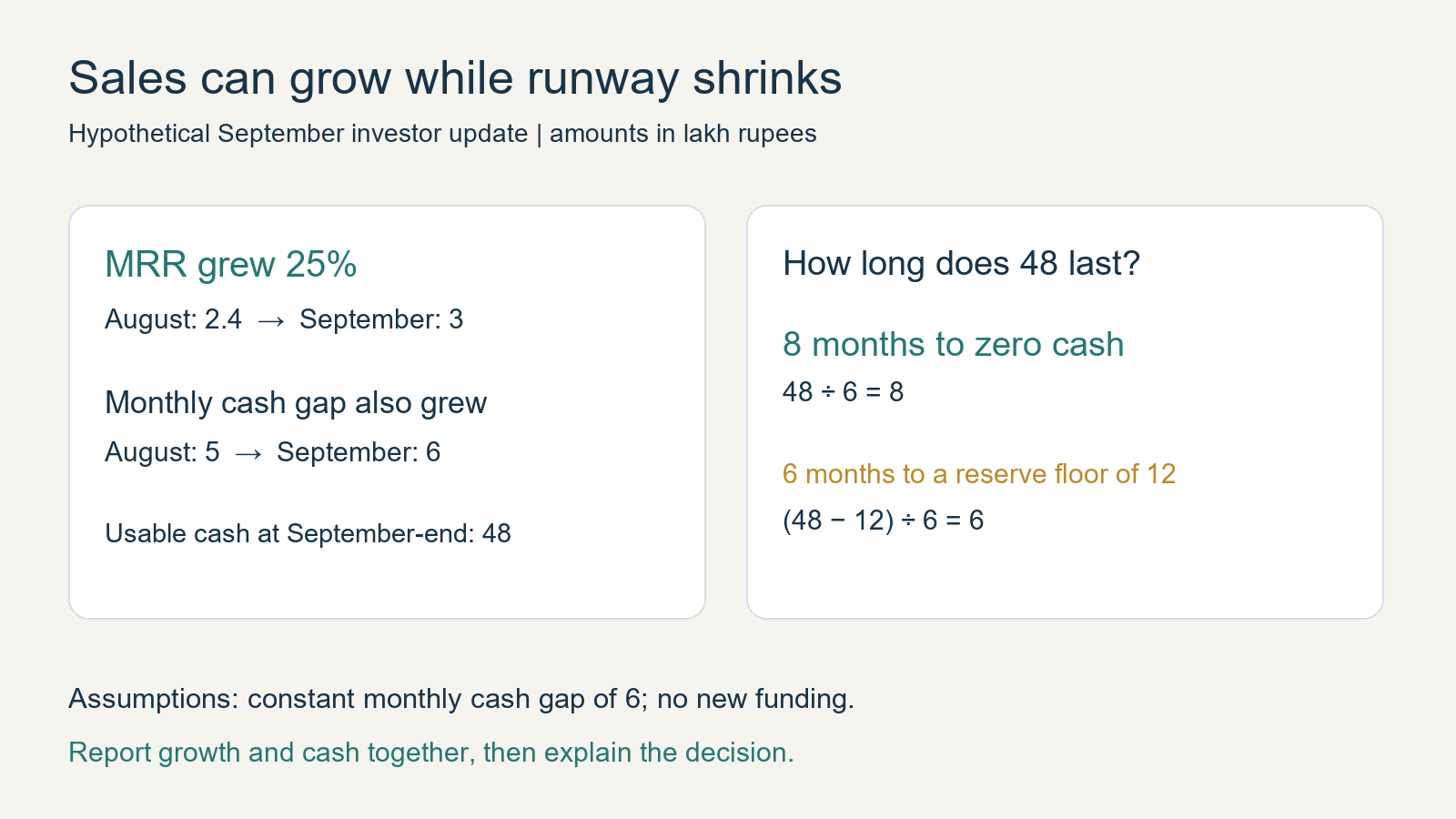
Hypothetical example. Both estimates assume a constant ₹6 lakh monthly cash gap and no new funding.
Our funding-requirement guide helps connect cash to the milestone it must support. Use that link in the discussion: what must the company prove before its cash reaches the chosen limit?
4. Pair setbacks with actions and specific asks
Report the missed target directly. State the result, explain what you know about the cause, and name the corrective action. Where the cause is uncertain, say what you will investigate before the next report.
For our example, the useful message is that MRR reached ₹3 lakh against a ₹3.6 lakh target. Two customers left after setup problems, and the team is testing a shorter onboarding process. The founders should also explain the extra support cost and how they will track it.
Make it easy for an investor to help
A request for help with sales leaves the investor to work out what you need. Instead, describe the buyer and the purpose of the introduction. Add a brief message they can forward after checking with the recipient.
The Chennai founders could ask for introductions to two operations managers at food-processing firms in Tamil Nadu. They want to discuss setup problems before expanding the sales effort. A focused request lets an investor decide whether their contacts fit.
For hiring help, link the role description and say which experience matters. If you want advice, name the decision and the date by which you need it. Also close the loop on earlier requests so investors know what happened after they helped.
Monthly investor updates should leave room for disagreement. If you have already decided to defer a hire, say so and explain the reason. If the decision is still open, set out the options and the evidence you need.
5. Use a repeatable format for monthly investor updates
Keep monthly investor updates compact and put supporting material behind controlled links. Investors should be able to find the main change, cash position, and request without opening a long slide deck. A table can carry the numbers, leaving the prose to explain them.
The following is an illustrative update for the hypothetical company above. It uses the same figures and assumptions. Replace every detail with checked information from your own business.
Worked example: September investor update
Subject: September update: sales grew, onboarding needs work
Main change: We ended September with twenty-four paying accounts and ₹3 lakh MRR. Two customers left after setup problems, and MRR missed our ₹3.6 lakh target.
Numbers: MRR was ₹2.4 lakh in August. September operating receipts were ₹3 lakh and cash payments were ₹9 lakh, giving ₹6 lakh net cash used. Month-end usable cash was ₹48 lakh. At that gap, runway is eight months to zero and six months to our ₹12 lakh reserve floor.
Response: A cofounder will lead the onboarding review. We will test a shorter setup process with the next group of new customers and report completion rates. We are deferring an additional support hire until we understand which steps create the extra work.
Ask: Can you introduce us to two operations managers at food-processing firms in Tamil Nadu? We want feedback on the setup process before adding more customers. We can provide a short note for you to forward.
Next report: We will show setup completion, customer retention, and the effect on support costs. We will also update the cash forecast before revisiting the hire.
Turn the example into your own template
Use the same headings each month: main change, numbers, response, ask, and next report. Keep the metric table and its definitions alongside them. Then compare the draft with the last update to catch unexplained changes.
Before sending, reconcile cash to your records and check the reporting period. Confirm that the recipients should receive the information. Put detailed customer data or sensitive documents behind appropriate access controls.
AI can help draft the prose from a checked table, but a founder must verify every figure and explanation. A tool may invent a cause for a missed target if the notes leave a gap. Also use a tool and data-sharing arrangement that fit the company's confidentiality duties.
Start your next update by filling in the numbers before writing the opening. Then choose the change that needs an explanation and the request an investor can act on. The finished email should make the next conversation easier to have.


