


A go-to-market channel is the route through which a customer finds, evaluates, and buys your product.
That definition sounds simple. Yet many founders select a channel because it is cheap to launch or popular with other startups.
A software founder copies a consumer brand's paid-acquisition strategy. A consultant tries product-led growth because it sounds easy to scale. Meanwhile, a new brand starts a blog even though its customers shop through creators and marketplaces.
Each channel can work in the right setting. However, a poor match consumes cash and founder time. Often, the team learns too late that the route never suited its customer.
You need a more disciplined selection process. First, compare all six acquisition channels. Then score their fit and concentrate resources on the best two or three.
Start With Six Go-to-Market Channels
Most young ventures acquire customers through some combination of six channels. In practice, the right mix depends on how customers already behave.
| Channel | Acquisition mechanism | A useful early signal |
|---|---|---|
| Content | Guides, videos, podcasts, or tools attract customers | Suitable readers request a call or begin a trial |
| Community | Peer networks and events build trust and referrals | Members introduce other qualified prospects |
| Product-led growth | A free tier, sharing loop, or trial attracts users | Users obtain value and invite others without sales support |
| Paid acquisition | Search, social, creator, or marketplace ads buy distribution | A controlled experiment wins customers at a viable cost |
| Sales-led acquisition | Founders or salespeople identify and close accounts | A repeatable approach produces qualified meetings |
| Partnerships | Firms, platforms, or industry groups refer customers | Partners deliver real opportunities, not only announcements |
These channels are parallel choices. Treating them as sequential stages creates a false order. Therefore, you do not have to use them in a preset sequence.
For example, an enterprise software venture may need sales-led acquisition and partnerships from day one. A self-serve tool may combine product-led growth with content. Meanwhile, a specialist advisory firm could start with founder-led content and a professional community.
So begin with customer behavior. Where do suitable prospects search, learn, compare, and request advice?
Score Each Go-to-Market Channel
Give each channel a score from one to five on four criteria. A one means poor alignment, while a five means strong alignment. The analysis exposes your current assumptions before you make a large investment.
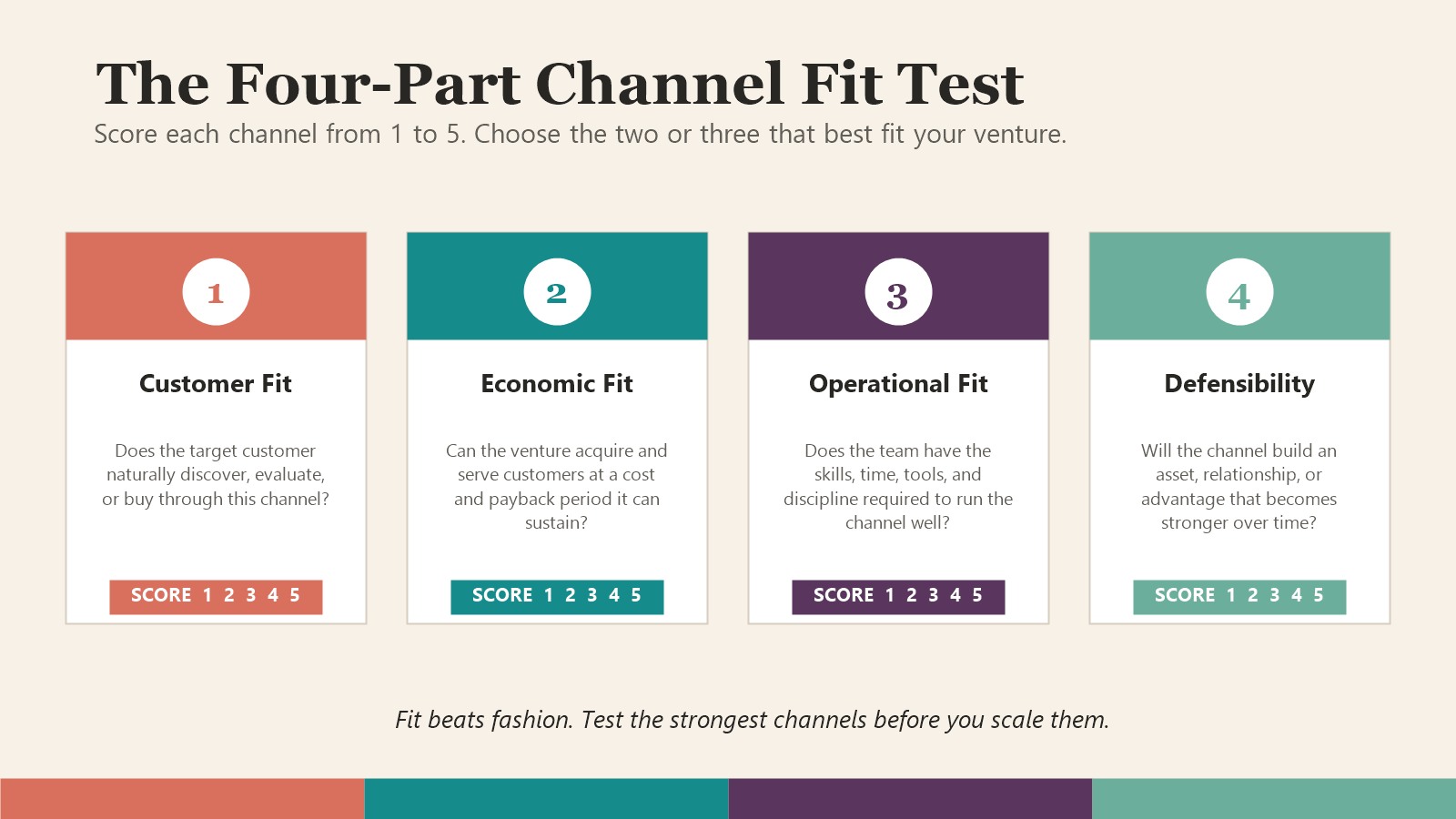
1. Customer fit
Does your target customer naturally encounter this channel?
Developers may learn through documentation, technical communities, and free trials. Large companies may buy through account teams, advisers, or technology partners. By contrast, consumers may discover brands through search, social media, creators, retailers, or marketplaces.
Your customer discovery work should supply the evidence. Ask customers where they found their current solution. Also learn whose advice they trust and what happens before a purchase.
2. Economic fit
Can the venture afford to acquire and serve customers through this channel?
Paid acquisition provides data quickly, but each new customer has a direct cost. Sales-led acquisition consumes founder or employee time.
Content can become efficient as its library expands. Still, it needs sustained effort before the investment compounds. Product-led growth reduces sales effort only when the product demonstrates value with limited help.
Estimate the full cost of a controlled experiment. Include labor, tools, creative work, commissions, discounts, and the founder's time. Next, compare the total with realistic customer value and the time required to recover the investment.
3. Team fit
Can your team run the path well?
A channel is more than an account on a platform. For example, content requires editorial judgment and specialized knowledge. A community requires patient leadership.
Paid acquisition depends on frequent creative experiments. Sales-led acquisition succeeds through disciplined follow-up. Partnership work demands steady relationship management. Finally, product-led growth needs careful design and measurement.
AI can reduce the operational workload. For example, it can support research, content preparation, prospecting, creative variants, and analysis. However, it cannot create trust or make a poorly chosen channel fit the customer.
4. Moat fit
Will the path build an edge that gets stronger with time?
A trusted content library can build reach and trust. A good peer group forms ties that rivals cannot copy fast. Product-led growth can create data, links to other tools, and sharing loops. Partner deals can place your firm inside a wider network.
Paid ads often build less of a moat on their own. A rival can bid for the same group. Ads may still be right for you. Even so, know whether you are building an asset or renting reach.
Pick Two or Three, Not All Six
First, add the four scores for each path. Then choose the top two or three for focused tests.
Next, remember that each go-to-market channel needs a base level of effort. One weak blog post, two sales emails, a small ad, and a silent WhatsApp group do not form a broad plan. They form four tests that teach you very little.
Stripe's guide for startups shares a linked lesson. Several founders it spoke with stressed the need to find one sound sales path and improve it before they spread their budget.
Still, your selected channels should operate as a coherent acquisition strategy.
- Content can teach prospects before a sales call.
- A peer group can share content and send referrals.
- A free product can reveal good accounts for the sales team.
- Ads can test messages that later improve free content.
- Partners can expand the reach of sales, content, or the product.
Then, write the link in one line: “We will use [main path] to spark demand and [support path] to close or spread it.” If the line feels forced, your mix may lack a clear reason.
Test Your Go-to-Market Channel Before You Scale It
Your score creates a temporary hypothesis. Run a fixed test with one customer group, one offer, one message, and one sign of success.
For example, a founder may contact forty well-chosen accounts to test direct sales. A list of 5,000 names would add noise. Track replies, good calls, next steps, and the time the work takes. More volume will not fix a weak customer group or a vague offer.
A content test could answer five urgent questions for one type of customer. Track whether the right readers reach your offer, join a list, ask for a call, or start a trial. In the same way, a partner test should track leads and sales; signed agreements alone reveal little.
Use the same labels each time you review results. Google Analytics explains how channel groups sort traffic sources. You can also make custom groups that match your own plan. Clear labels stop paid, free, partner, and referral traffic from blending together.
Before you spend more, ask four questions:
- Did the path reach the right buyer?
- Did that buyer take a useful next step?
- What did the test cost in cash and time?
- Can the team repeat the work and keep it good?
Therefore, scale only when the facts support it. If they do not, change the buyer group, message, offer, or path. Then run a new test.
An India-Based Example
Think of a made-up Indian startup that helps small factories prepare compliance records. At first, its founder plans to run Instagram ads because they are easy to start. Customer interviews point elsewhere. Factory owners tend to rely on accountants, trade groups, and trusted software sellers.
The four tests change the plan. Paid social scores low on customer fit and cost.
Direct sales scores well because each early deal needs a clear demo. Partnerships also score well because accountants and trade groups already hold trust. Content takes a support role through short compliance guides.
The startup picks direct sales as its main path. Its go-to-market channel mix uses partners to expand reach, while content helps buyers learn. In addition, its working prototype gives the founder something real to show in sales calls.
This mix may fail another small-business startup. A simple accounting app may favor product-led growth and partnerships. Use customer habits, cost, team skill, and moat to shape your own choice.
Make Your Go-to-Market Channel Choice Clear
Your first go-to-market channel will shape more than promotion. It affects the product, hiring plan, cash needs, customer relationships, and speed of learning.
List all six paths. Score each one on the four tests. Pick two or three, state how they work together, and set a small test for each. Also note why you rejected the other paths for now.
That last step keeps trendy ideas from slipping back into the plan. More importantly, it turns sales from a set of random tasks into a clear founder choice.
Continue through the Sell library as we add guides on sales, content, community, partners, paid growth, and product-led growth.


