Home Blog Page 2

AI-Native Startup or AI-Enabled Business: Which Should You Build?

0

An AI-native startup makes artificial intelligence central to its product, operations, and team. An AI-enabled business uses AI to improve a more conventional product or service. However, most founders should not force this choice into a binary. The stronger answer is often a deliberate hybrid.

The distinction matters because it changes what you must build and whom you must hire. It also shapes your funding needs and sources of advantage. Calling a venture “AI-native” may sound ambitious. Yet the label creates no value unless the underlying design supports the claim.

The founder’s real question is simpler: Where must AI sit for this venture to deliver a valuable and defensible customer outcome?

What an AI-Native Startup Actually Means

First, the definition of an AI-native startup goes well beyond using a large language model or adding a chatbot to a website. AI sits near the core of three parts of the venture:

  • Product: The customer would receive a substantially different or weaker outcome without AI.
  • Operating model: AI performs, coordinates, or improves important work inside the company.
  • Team: The venture needs the skills to evaluate models, manage data, control costs, and handle AI-specific risks.

For example, consider a company building language models for Indian languages. Its model design, training data, tests, computing stack, and cost to serve all shape the product. Therefore, AI forms part of the company’s tech and commercial base.

Sarvam offers a useful Indian example. The company says it is building sovereign foundation models from scratch for Indian languages and needs, work that places AI at the center of its product and tech system. So Sarvam fits the AI-native startup label; our label draws on the company’s public account. We do not have an inside view of its work, and Sarvam’s sovereign LLM announcement explains the scope of that effort.

Still, this route can create great value. However, it also exposes the founder to fast model shifts, inference costs, testing demands, safety questions, and a small pool of AI talent.

An AI-Enabled Business Starts Somewhere Else

Meanwhile, an AI-enabled business begins with a familiar customer need. It applies AI where the tool can cut costs or improve the experience. For example, the core promise may be better payments, faster logistics, more accurate quality checks, simpler accounts, or faster customer support.

For example, an agribusiness marketplace might use AI to forecast demand, spot defects, or plan delivery routes. If buyers mainly value reliable sourcing and delivery, the company remains an agribusiness venture with strong AI tools. It does not become AI-native simply because several work flows use models.

Even so, this model is fully valid. In fact, it can be stronger when market knowledge, sales reach, trust, and delivery matter more than in-house AI research.

However, the danger lies in treating AI as a decorative feature. A generic assistant that customers neither need nor use adds cost without strengthening the business. So each AI feature needs a clear job. It might cut waiting time, raise accuracy, improve sales, lower service cost, or make a new outcome possible.

Why the Hybrid Middle Is Often the Better Choice

Meanwhile, many promising ventures sit between the two poles. Their products depend meaningfully on AI, but they do not need to own a foundation model or organize the entire company around AI research.

In practice, three hybrid patterns are especially useful.

AI-Augmented Vertical Software

First, the company serves a defined industry and puts AI into a focused workflow. For example, it may help a hospital sum up clinical records, a lender review documents, or a factory spot defects. Then, deep workflows, private feedback data, links to customer systems, and field knowledge can form the moat. The base model alone rarely provides enough protection.

AI-Orchestrated Services

By contrast, the customer buys a completed outcome. Software remains behind the scenes. AI completes part of the work, while people handle judgment, exceptions, and client ties. As a result, a small firm could deliver research, compliance help, hiring, design, or export documents with a much leaner team than an old-style service firm.

Agentic Execution Platforms

Here, AI does more than recommend. It completes a chain of tasks across tools, with set rights and human review. So these ventures may move closer to the AI-native end. Task control, testing, reliable results, and safeguards become core product problems.

Therefore, the hybrid middle can be a stable choice. In fact, it is often the best match between customer value and founder resources.

Use the Venture Locator for an AI-Native Startup Decision

Download: Download the FoundingCentral Venture Locator workbook (.xlsx). It includes the three Venture Locator scores, Build-Buy-Compose decisions, an AI risks and readiness review, and a one-page Venture Verdict.

Founders can make the choice more concrete with a simple Venture Locator. Score the venture from 1 to 10 on three dimensions.

Use these anchors for the scores:

  • Product score: A low score means AI improves a familiar offer. A high score means the customer outcome depends on AI.
  • Operating-model score: A low score means AI supports isolated tasks. A high score means it coordinates core work and decisions.
  • Team score: A low score means field and sales skills dominate. A high score means AI engineering, model testing, and data skills are central.

Calculate the average:

  • Below 4: The venture is mainly AI-enabled.
  • From 4 to 7: The venture is hybrid.
  • Above 7: The venture is mainly AI-native.
Venture Locator scoring product, operating model, and team to classify an AI-native startup

The number starts a better conversation; it does not certify the venture. For example, a product score of 9 and a team score of 3 reveal a delivery risk. Likewise, a work score of 8 and a customer-offer score of 2 may describe a firm that uses a great deal of automation without an AI-native product.

After scoring, write down the consequences for product, talent, capital, and defensibility. That second step turns a label into a venture design decision.

Compare the Demands Before You Choose

In short, each model asks the founder to manage different work.

  • AI-native: Master models, data, tests, computing, and AI costs. Funds may go into AI talent, computing, data, and trials. The moat may come from a rare skill, a data loop, the tech stack, or learning built over time. The common failure is novel tech with no urgent demand.
  • Hybrid: Master the field, workflow, model tests, and customer use. Spending often goes toward product fit, field data, sales reach, and a few key tech skills. Deep workflows, feedback data, trust, and reach can protect the firm. Too many unlinked tools can destroy that edge.
  • AI-enabled: Master the market, customer ties, daily work, and selective AI use. Sales, working capital, and customer growth may consume more cash than the AI itself. Brand, trust, sound delivery, and scale may provide the moat. Generic AI features rarely set a firm apart.

An AI-native startup also carries a heavier testing load. Founders must test quality, failure modes, bias, privacy, security, and human review. The NIST AI Risk Management Framework calls for risk controls through the full life of an AI system. Even an early-stage company should decide what it will measure, who owns each risk, and when a person must step in.

One Company Can Occupy More Than One Position

The label can vary by feature and change over time. Razorpay illustrates the point. Its main field is payments, where knowledge of rules, merchant reach, uptime, and risk work remain vital. The company has also described AI tools for fraud checks and announced deeper model work for payments.

Those public statements suggest that Razorpay is hybrid as a whole and closer to AI-native in a few uses. This is our reading of the available evidence. Razorpay has not supplied the label. Its Shield risk-engine description shows AI inside a core payments workflow.

This example exposes a flaw in company-wide labels. A founder does not need one fixed answer for the whole venture. So review each key feature on its own merits.

Decide What to Build, Buy, or Compose

Once you know where the venture sits, make a separate choice for every major feature.

  • Build where the feature can set the venture apart and the team can support it.
  • Buy where a reliable product solves a necessary but non-differentiating problem.
  • Compose where existing models, data services, software, and custom workflows can produce the required outcome.

For many startups, composing is the sensible starting point. A founder can combine a model vendor, search system, private workflow, test layer, and human review. There is no need to build a model from scratch.

However, ease can create vendor risk. So record how quickly you can replace each vendor, export the data, retain prompts and tests, and respond to price or quality changes. Tech choices become strategic when they affect unit costs, customer trust, or the venture’s moat.

Before committing serious capital, use a prototype to build credible evidence. Test whether the AI feature improves a customer outcome under real-world conditions.

Five Mistakes That Distort the Choice

1. Choosing a Label for Investors

An AI-native pitch cannot make up for a weak customer problem. Start with the outcome, then choose the design.

2. Assuming Model Ownership Creates a Moat

Owning a model may raise cost and add work without winning customer favor. A moat needs a source of strength that grows with use. It might come from private learning, workflow lock-in, trust, sales reach, or better unit costs.

3. Underestimating Category Knowledge

AI can speed up work, but it does not remove rules, buying habits, real-world limits, or local context. This point matters in Indian finance, health care, farming, and government markets.

4. Hiring Ahead of Evidence

Do not build a large AI team merely to signal ambition. Prove the key feature first. Then hire when gains in control, speed, or safety justify the fixed cost. The same discipline applies when planning a startup scaling strategy.

5. Treating the Decision as Permanent

Models improve, vendors change, costs fall, and customers reveal new needs. Accordingly, review the position at major product, funding, and growth stages.

Write a One-Page Venture Verdict

Before the next product cycle, write a one-page verdict with seven answers:

  1. What customer outcome are we promising?
  2. Which part of that outcome genuinely depends on AI?
  3. What are our product, operating-model, and team scores?
  4. Are we AI-native, hybrid, or AI-enabled today?
  5. What will we build, buy, or compose for each key feature?
  6. What must become defensible over the next twelve months?
  7. When will we review this decision again?

Then connect the verdict to capital. A model-heavy plan may need more tech spending and more time to work well. A market-led venture may gain more from customers, revenue, and selective automation before outside funding. The startup funding strategy guide can help align funding with business basics and resist fashionable choices.

The goal is to build the smallest, strongest system that can deliver the promised outcome and improve with use. Sounding like an AI company adds nothing. So some founders will build an AI-native startup. Others will choose a hybrid or AI-enabled design whose ambition comes from the outcome it delivers.

Startup Scaling Strategy: Grow Output Before Headcount

0

A startup scaling strategy should improve output before it adds headcount. A new hire can ease a real workload problem. However, hiring can also hide a broken process, add fixed costs, and create more work for the founder.

That difference matters more in the AI era. Small teams can now handle work that once needed several specialists. Yet AI does not make every role unnecessary. It changes the order in which you should examine the work.

Before opening a position, ask a harder question: should this work be removed, redesigned, automated, contracted, or owned by an employee?

Stop Treating Headcount as Progress

A larger team can make a young company look established. Founders may cite staff numbers when talking to customers, investors, or other entrepreneurs. Still, headcount is an input. Revenue, customer outcomes, resilience, and learning are results.

Every employee also brings a total cost. Salary is only the visible part. Hiring, training, software, equipment, office needs, oversight, and coordination all consume cash and time. Therefore, a hire must create more value than the role costs and the burden it adds.

This does not mean that founders should avoid hiring. It means that hiring should follow evidence. The company should know what constraint the role will remove and how the result will be measured.

Zerodha offers a useful Indian counterpoint to headcount-led growth. In a 2026 conversation on its official Z-Connect site, founder Nithin Kamath described the company as flat and said its core team remained small.

He also noted that the firm had more people in 2016 than in 2024. Zerodha works in a specific market, so it cannot serve as a model for every venture. Even so, its example shows that scale and team size do not have to move together.

The rule is simple.

Fix the work first.

Add a person only when hiring is the best choice.

Build Your Startup Scaling Strategy Around the Work

Begin with the work. Leave the job title until later. Then place every recurring task in one of three groups.

AI-orchestrated work

Software can complete this work from start to finish. A person reviews unusual cases and checks quality. Examples include routing support requests, preparing routine reports, matching records, or drafting standard follow-ups.

Choose this group only when the process is stable and errors are easy to fix. Someone must still own the result. Automation without ownership merely makes mistakes move faster.

AI-augmented human work

A person stays in charge, while AI cuts research, production, or coordination time. This pattern suits customer success, analysis, software development, marketing, and many finance tasks.

A study published by the National Bureau of Economic Research followed 5,179 customer-support agents. Access to a generative AI assistant raised issues solved per hour by 14% on average. However, the gains varied sharply. Newer and less-skilled workers gained the most, while experienced workers saw little benefit.

That variation matters. Do not apply one productivity assumption to the whole company. Test each workflow and each group of users.

Human-led work

Some work depends on judgment, trust, duty, physical action, or hard conversations. AI may provide information, but a person should lead the work.

Examples include senior hiring, large sales deals, safety choices, complex complaints, formal approvals, and sensitive customer issues. In these areas, the human role is part of the value.

Use This Startup Scaling Strategy Hiring Test

Once you classify the work, run five tests before choosing a full-time hire.

1. Is the work necessary?

Remove reports, meetings, approvals, and features that no longer affect a customer or a key decision. A startup should not automate work that it should stop doing.

Ask who uses the output and what action it changes. If nobody can answer, eliminate the task for two weeks and watch what happens.

2. Is the demand frequent and stable?

A full-time role fits work that returns at a steady level. By contrast, a contractor may fit a short project, an expert task, or a seasonal peak.

Do not turn a temporary rush into a permanent cost. First, measure the volume over several cycles.

3. Can the process be described?

If the founder cannot explain the work, a new employee will struggle to perform it. Capture the inputs, main steps, decision rights, expected output, and way to handle exceptions.

This does not require a large operating manual. A one-page workflow and a few real examples can expose missing decisions before the employee starts.

4. What is the cost of an error?

Routine, reversible work is a stronger automation candidate. High-stakes work needs more review. Financial transfers, legal commitments, safety decisions, and sensitive customer issues require clear human control.

Klarna shows the boundary. Its 2025 annual filing says its AI assistant handled 80% of customer-service chats during the year.

The company also said customers could still choose human support. That figure reflects Klarna’s process and customers. Design both the automated path and a clear route to human support.

5. Will the role remove a measured constraint?

Name the result that should improve. It might be response time, output, sales, customer retention, or error rate.

Then set a review date. If the metric does not improve, examine the workflow and the role before adding another person.

Choose Among Five Responses

The hiring test should lead to one of five responses.

Startup scaling strategy choices before hiring: eliminate, redesign, automate, contract, or hire
Five responses to consider before adding a full-time role.
  • Eliminate work that does not support a customer, control, or decision.
  • Redesign a process that has needless handoffs, checks, or rework.
  • Automate stable, repeatable work with clear rules and a safe path for unusual cases.
  • Contract limited, expert, seasonal, or test work.
  • Hire when ongoing ownership, context, judgment, or workload calls for a full-time role.

These choices can also work together. For example, a company might remove an unused report and automate data collection. It could then contract out the initial setup and hire one operations lead to own the result.

The aim is a team sized to deliver the needed result safely each time. Making it smaller adds no value once that standard is met.

Work Through a Scaling Decision

Consider a hypothetical Indian software company serving small manufacturers. It has thirty paying customers and receives a growing number of support requests. The founder assumes the company needs four support agents.

The team studies one month of requests. Almost half relate to setup steps that the product explains poorly. Another group asks for order status, which the system already stores. The rest involve factory work and need skilled judgment.

The company postpones the four hires. First, it improves onboarding and adds automatic status updates. It then gives one skilled customer success manager an AI search tool based on approved product material. That person owns complex cases and reviews automated answers each week.

After eight weeks, the company checks response time, repeat inquiries, customer satisfaction, and unresolved cases. If demand still exceeds safe capacity, it now has evidence for the next hire. More importantly, it knows which skills that person needs.

The order matters.

The company used AI after fixing the product and removing repeated work. It reserved human attention for the cases where it mattered.

Make Systems the Core of Your Startup Scaling Strategy

Hiring too soon creates more than cash pressure. It gives the founder more people to manage and more choices to align. As a result, the team can grow while output barely moves.

Before hiring, confirm that the product and market are ready for more capacity. The prototype-first guide explains how to build evidence before committing more resources. Also check whether the real constraint is demand. The go-to-market channel guide helps you test that question.

Finally, connect the plan to capital. A larger payroll shortens runway and may create a funding need that better systems could have delayed. Use the startup funding strategy to test whether added capital supports a real scaling milestone.

A sound startup scaling strategy does not praise a small team for its own sake. It makes every new role earn its place. Define the work, choose the right model, and hire only when a full-time owner is the best answer.

Continue through the Scale library as we add guides on systems, teams, culture, growth, cross-border expansion, and changes in the founder’s role.

Startup Funding Strategy: A Simple Guide to Better Choices

0

A startup funding strategy should answer one question before you contact investors: what must this money make possible?

Many founders begin elsewhere. They polish a deck, build an investor list, and try to look fundable. Meanwhile, customer work slows down. The founder may spend months raising money before proving what the business can sell.

That sequence sometimes makes sense. A capital-heavy venture may need outside money before it can produce useful evidence. However, many other ventures can build a prototype, win customers, or earn revenue first.

The right answer is not “always bootstrap” or “raise as early as possible.” Instead, choose the funding path that fits your moat, growth plan, exit goal, and life. Then decide whether outside money is needed now, later, or not at all.

Start With the Purpose of the Money

Money is useful only when it changes what the business can do. Therefore, name the result before naming the source.

You may need funds to finish a prototype, get a license, buy equipment, purchase inventory, or enter a market. You may also need them to hire an expert or cover a long sales cycle. These are business needs. Fundraising comes later.

Startup India’s funding guidance makes a similar distinction. It lists purposes such as product development, licenses, working capital, sales, and equipment. It also warns that raising external funds can easily take more than six months.

Before starting that process, write a one-sentence purpose:

We need [amount or resource] to achieve [specific milestone] within [time period], because that milestone cannot be reached reliably through current revenue or available resources.

If you cannot complete that sentence, you may have a fundraising impulse rather than a clear plan.

Use Four Tests for Your Startup Funding Strategy

Funding changes more than the bank balance. It can affect your pace, ownership, board, risk, product, and exit. A useful startup funding strategy tests each path against four forms of fit.

1. Moat fit

What edge are you trying to build, and how much money does it require?

A frontier AI company may need costly computing, rare talent, and fast research. A hardware company may need tools and stock. In both cases, delay can let a richer rival move first.

By contrast, a consulting firm may build know-how and trust through paid work. A niche software firm may start with a narrow product and paid pilots. More money will not always make these moats stronger.

Ask whether the money creates an edge or merely pays for more activity. Staff, ads, and office space can raise costs without making the business harder to copy.

2. Growth fit

How quickly should this business grow?

Venture capital works best when a company can turn large sums into fast, hard-to-copy growth. The market must be large enough, and the economics must support that pace. Investors also need the chance of a very large return.

However, many sound firms should grow more slowly. A niche service firm, local brand, or family firm may favor steady cash flow and owner control. A VC timetable can harm a business that works well on other terms.

3. Exit fit

What outcome are you building toward?

VC funds need a path to cash out. That often means a sale, an IPO, or another deal within the fund’s life. You do not have to promise an exit date, but the company must offer a credible route to liquidity.

Bootstrapping gives you more freedom to stay on your own. Debt, buyer funding, and revenue-based finance can also support long-term ownership. Still, each has its own cash demands.

Choose money whose expected endpoint matches yours. Otherwise, the clash may appear later through growth goals, board votes, or pressure to sell.

4. Founder fit

Can you live with the demands created by this path?

Bootstrapping protects ownership, yet it can strain savings and household income. A funding round can extend runway, but it adds reporting, board work, and growth demands. Debt keeps your equity intact, though repayment can hurt when cash flow is weak.

Your personal runway is part of the startup strategy. So are your risk limits, need for control, family duties, and willingness to manage outside shareholders.

Do not choose a funding path that fits the sheet but not the person who must run it.

When “Bootstrap First” Makes Sense

Bootstrapping first does not mean rejecting investors forever. It means building enough proof to gain options.

Sramana Mitra calls this a “bootstrap first, raise money later” sequence. Her 1Mby1M approach puts buyers, sales, and profit before fundraising becomes the main task.

The sequence works well when:

  • You can produce a useful prototype at modest cost.
  • Buyers will pay early through sales, pilots, deposits, or design partnerships.
  • The market does not demand a winner-takes-most race.
  • Your moat comes from process, trust, content, a user group, or niche skill.
  • A small team can operate the business effectively.
  • Better proof would improve your terms or choice of investors later.

AI has made this sequence viable for more firms. One person can now use AI for research, software development, design, customer support, and review. As a result, some firms can run a real test with less money and fewer staff.

The prototype-first approach supports the same logic. A working product and buyer response give investors evidence they can assess.

Zoho offers an Indian example of bootstrapping at scale. On its company story page, Zoho links its choice to avoid VC with the freedom to stay private and invest with patience. Not every firm should copy Zoho. The point is that the way you fund a firm should support its aims.

When Raising Now Is the Better Choice

Some founders use “bootstrap first” as an excuse to starve a business that needs speed or large fixed costs. That can be as harmful as raising too soon.

Raising now may make sense when:

  • A prototype needs costly research, hardware, regulatory approval, or core systems.
  • Rules create a long and costly path before the first sale.
  • Network effects reward a fast start on both sides of a market.
  • The firm must pay for stock, sales channels, or a factory before sales grow.
  • A market window may close before customer revenue can fund the work.
  • The firm can credibly reach the scale and exit that equity investors need.

Even Y Combinator, which funds high-growth startups, says the choice depends on the business. Its Bootstrap or VC discussion notes that most firms do not raise VC and that this can be an excellent choice. For firms built to grow very fast, however, outside money can be vital.

The key question is not whether VC is good. Ask whether your firm can use it well.

Do Not Ignore the Middle Paths

Founders often compare only personal savings with venture capital. In practice, a startup funding strategy can combine several paths.

  • Customer-financed growth works when buyers will fund pilots, deposits, subscriptions, or advance orders. However, early customers may pull the product toward narrow needs.
  • Grants suit research, social impact, climate, biotech, and public priorities. Applications take time, and the money may carry use limits.
  • Angel equity can add expertise, credibility, or access. Yet dilution and expectation alignment matter from the first check.
  • Debt can work when cash flow or assets support steady repayment. The payments continue even when growth slows.
  • Revenue-based finance may suit firms with predictable sales that want to limit dilution. Revenue sharing leaves less cash for near-term operations.
  • Reward crowdfunding lets customers pre-order a tangible or creative product. It also creates delivery and campaign risk.
  • Strategic investment can unlock distribution, technology, or market access. The relationship may limit future partners or choices.
  • Venture capital supports rapid scale and high funding needs. In return, growth, governance, dilution, and exit demands become part of the company’s structure.

These choices are not always mutually exclusive. For example, a B2B venture may bootstrap its first product, charge for design partnerships, and later add angel capital. Once revenue becomes predictable, it may use debt or revenue-based finance for expansion.

The order matters. Each stage should earn the next form of capital rather than create dependence on another round.

Apply the Capital Path Selector

Open the downloadable FoundingCentral Capital Path Selector to compare the routes, adjust the weights, and record your decision.

Capital Path Selector for evaluating a startup funding strategy
Compare each funding option across moat fit, growth fit, exit fit, and founder fit.

Score each realistic path from one to five on the four tests below.

  • Moat fit: Does the money help build the advantage the venture needs? A score of one means it is misaligned; five means it is strongly aligned.
  • Growth fit: Does the source support the right pace without forcing waste? One means the pace is wrong; five means it is suitable.
  • Exit fit: Do the provider’s return needs match your intended destination? One signals conflict; five signals a strong match.
  • Founder fit: Can you carry the financial, governance, and relationship demands? One means poor fit; five means the path is sustainable.

Next, add one more line for timing: what evidence could you produce before taking this money? A path may fit the company but still be premature today.

Select the best one or two options. Then write the assumptions behind every score. The numbers start the discussion; the reasoning makes the decision useful.

An India-Based Example

Consider a hypothetical founder building compliance software for small Indian manufacturers. The first plan calls for a large seed round, a ten-person sales team, and rapid national expansion.

Customer interviews change the picture. Buyers want a working product, local implementation help, and proof that the software reduces reporting effort. Three manufacturers will pay for pilots, while an industry association offers access to a concentrated group.

Bootstrapping and customer-financed growth score well on moat and founder fit. They allow the company to build workflow knowledge without a large permanent team. A small angel round may become useful later, especially if the investor understands manufacturing channels.

Venture capital scores lower at this stage because the growth engine is not yet repeatable. After twelve successful deployments, the score may change. The company could then raise to expand a proven sales and implementation system.

The choice is not ideological. Evidence changes both the path and its timing.

Make the Capital Decision Before the Fundraising Story

Fundraising is a demanding sales process. It can also create the illusion that investor interest validates the business.

Y Combinator’s Michael Seibel argues that fundraising rounds are not company milestones. Customer value, sound economics, and durable progress matter more.

Before approaching investors, answer five questions:

  1. What exact milestone requires capital?
  2. Why can revenue, a smaller test, or another source not fund it?
  3. Which form of capital fits the moat, growth plan, exit goal, and founder?
  4. What evidence would improve the decision or terms later?
  5. What will you stop doing if the raise takes six months?

A strong startup funding strategy may end with a venture round. It may also end with customer finance, a grant, debt, patient growth, or a mix. The goal is to choose capital that supports the business you intend to build.

Continue through the Fund library as we add practical guides on bootstrapping, angels, grants, debt, venture capital, cap tables, and investor relations.

How to Choose Your First Go-to-Market Channel

0

A go-to-market channel is the route through which a customer finds, evaluates, and buys your product.

That definition sounds simple. Yet many founders select a channel because it is cheap to launch or popular with other startups.

A software founder copies a consumer brand's paid-acquisition strategy. A consultant tries product-led growth because it sounds easy to scale. Meanwhile, a new brand starts a blog even though its customers shop through creators and marketplaces.

Each channel can work in the right setting. However, a poor match consumes cash and founder time. Often, the team learns too late that the route never suited its customer.

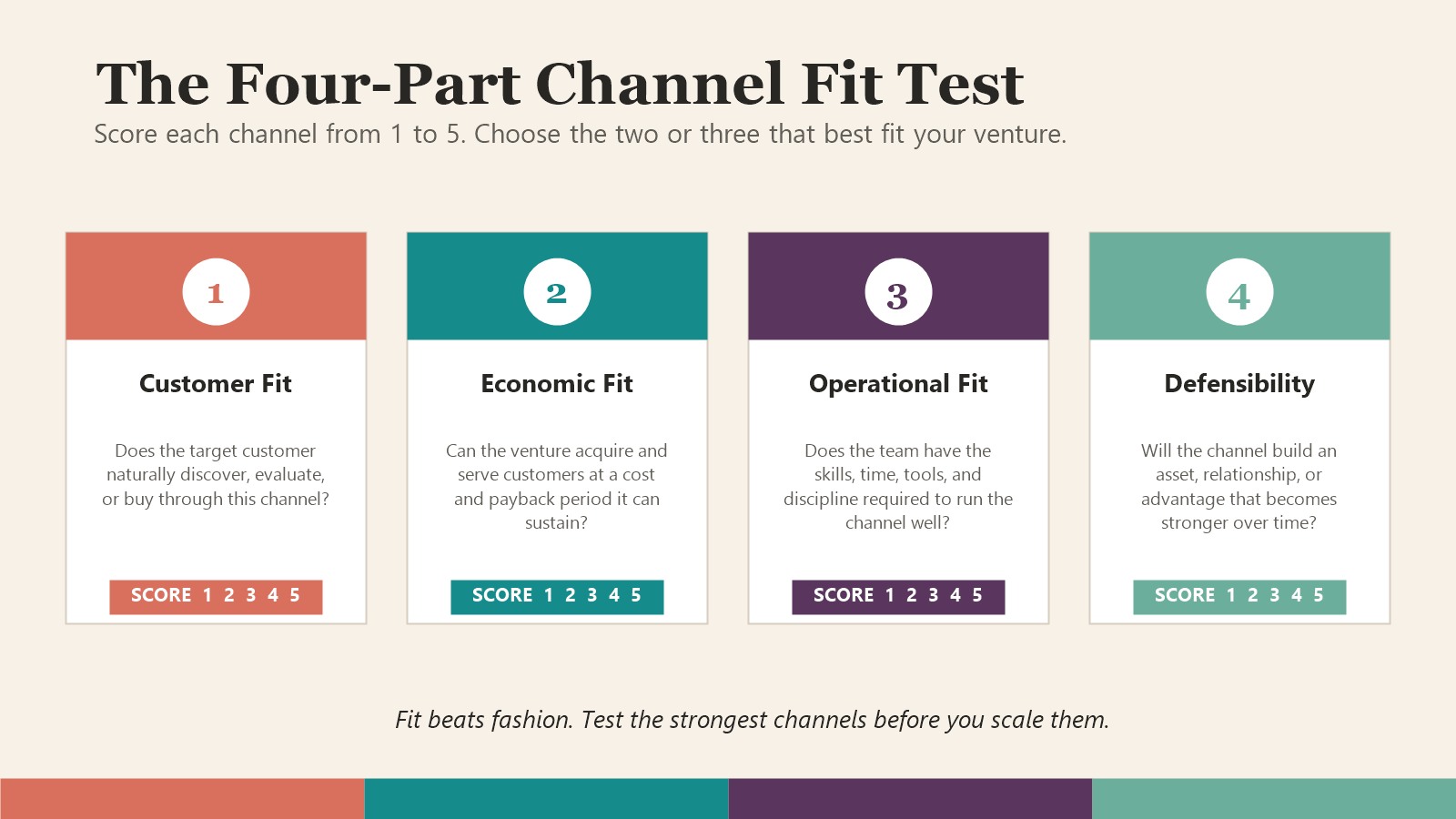
You need a more disciplined selection process. First, compare all six acquisition channels. Then score their fit and concentrate resources on the best two or three.

Start With Six Go-to-Market Channels

Most young ventures acquire customers through some combination of six channels. In practice, the right mix depends on how customers already behave.

Channel Acquisition mechanism A useful early signal
Content Guides, videos, podcasts, or tools attract customers Suitable readers request a call or begin a trial
Community Peer networks and events build trust and referrals Members introduce other qualified prospects
Product-led growth A free tier, sharing loop, or trial attracts users Users obtain value and invite others without sales support
Paid acquisition Search, social, creator, or marketplace ads buy distribution A controlled experiment wins customers at a viable cost
Sales-led acquisition Founders or salespeople identify and close accounts A repeatable approach produces qualified meetings
Partnerships Firms, platforms, or industry groups refer customers Partners deliver real opportunities, not only announcements

These channels are parallel choices. Treating them as sequential stages creates a false order. Therefore, you do not have to use them in a preset sequence.

For example, an enterprise software venture may need sales-led acquisition and partnerships from day one. A self-serve tool may combine product-led growth with content. Meanwhile, a specialist advisory firm could start with founder-led content and a professional community.

So begin with customer behavior. Where do suitable prospects search, learn, compare, and request advice?

Score Each Go-to-Market Channel

Give each channel a score from one to five on four criteria. A one means poor alignment, while a five means strong alignment. The analysis exposes your current assumptions before you make a large investment.

Go-to-market channel scorecard comparing customer fit, economics, operational fit, and defensibility

1. Customer fit

Does your target customer naturally encounter this channel?

Developers may learn through documentation, technical communities, and free trials. Large companies may buy through account teams, advisers, or technology partners. By contrast, consumers may discover brands through search, social media, creators, retailers, or marketplaces.

Your customer discovery work should supply the evidence. Ask customers where they found their current solution. Also learn whose advice they trust and what happens before a purchase.

2. Economic fit

Can the venture afford to acquire and serve customers through this channel?

Paid acquisition provides data quickly, but each new customer has a direct cost. Sales-led acquisition consumes founder or employee time.

Content can become efficient as its library expands. Still, it needs sustained effort before the investment compounds. Product-led growth reduces sales effort only when the product demonstrates value with limited help.

Estimate the full cost of a controlled experiment. Include labor, tools, creative work, commissions, discounts, and the founder's time. Next, compare the total with realistic customer value and the time required to recover the investment.

3. Team fit

Can your team run the path well?

A channel is more than an account on a platform. For example, content requires editorial judgment and specialized knowledge. A community requires patient leadership.

Paid acquisition depends on frequent creative experiments. Sales-led acquisition succeeds through disciplined follow-up. Partnership work demands steady relationship management. Finally, product-led growth needs careful design and measurement.

AI can reduce the operational workload. For example, it can support research, content preparation, prospecting, creative variants, and analysis. However, it cannot create trust or make a poorly chosen channel fit the customer.

4. Moat fit

Will the path build an edge that gets stronger with time?

A trusted content library can build reach and trust. A good peer group forms ties that rivals cannot copy fast. Product-led growth can create data, links to other tools, and sharing loops. Partner deals can place your firm inside a wider network.

Paid ads often build less of a moat on their own. A rival can bid for the same group. Ads may still be right for you. Even so, know whether you are building an asset or renting reach.

Pick Two or Three, Not All Six

First, add the four scores for each path. Then choose the top two or three for focused tests.

Next, remember that each go-to-market channel needs a base level of effort. One weak blog post, two sales emails, a small ad, and a silent WhatsApp group do not form a broad plan. They form four tests that teach you very little.

Stripe's guide for startups shares a linked lesson. Several founders it spoke with stressed the need to find one sound sales path and improve it before they spread their budget.

Still, your selected channels should operate as a coherent acquisition strategy.

  • Content can teach prospects before a sales call.
  • A peer group can share content and send referrals.
  • A free product can reveal good accounts for the sales team.
  • Ads can test messages that later improve free content.
  • Partners can expand the reach of sales, content, or the product.

Then, write the link in one line: “We will use [main path] to spark demand and [support path] to close or spread it.” If the line feels forced, your mix may lack a clear reason.

Test Your Go-to-Market Channel Before You Scale It

Your score creates a temporary hypothesis. Run a fixed test with one customer group, one offer, one message, and one sign of success.

For example, a founder may contact forty well-chosen accounts to test direct sales. A list of 5,000 names would add noise. Track replies, good calls, next steps, and the time the work takes. More volume will not fix a weak customer group or a vague offer.

A content test could answer five urgent questions for one type of customer. Track whether the right readers reach your offer, join a list, ask for a call, or start a trial. In the same way, a partner test should track leads and sales; signed agreements alone reveal little.

Use the same labels each time you review results. Google Analytics explains how channel groups sort traffic sources. You can also make custom groups that match your own plan. Clear labels stop paid, free, partner, and referral traffic from blending together.

Before you spend more, ask four questions:

  1. Did the path reach the right buyer?
  2. Did that buyer take a useful next step?
  3. What did the test cost in cash and time?
  4. Can the team repeat the work and keep it good?

Therefore, scale only when the facts support it. If they do not, change the buyer group, message, offer, or path. Then run a new test.

An India-Based Example

Think of a made-up Indian startup that helps small factories prepare compliance records. At first, its founder plans to run Instagram ads because they are easy to start. Customer interviews point elsewhere. Factory owners tend to rely on accountants, trade groups, and trusted software sellers.

The four tests change the plan. Paid social scores low on customer fit and cost.

Direct sales scores well because each early deal needs a clear demo. Partnerships also score well because accountants and trade groups already hold trust. Content takes a support role through short compliance guides.

The startup picks direct sales as its main path. Its go-to-market channel mix uses partners to expand reach, while content helps buyers learn. In addition, its working prototype gives the founder something real to show in sales calls.

This mix may fail another small-business startup. A simple accounting app may favor product-led growth and partnerships. Use customer habits, cost, team skill, and moat to shape your own choice.

Make Your Go-to-Market Channel Choice Clear

Your first go-to-market channel will shape more than promotion. It affects the product, hiring plan, cash needs, customer relationships, and speed of learning.

List all six paths. Score each one on the four tests. Pick two or three, state how they work together, and set a small test for each. Also note why you rejected the other paths for now.

That last step keeps trendy ideas from slipping back into the plan. More importantly, it turns sales from a set of random tasks into a clear founder choice.

Continue through the Sell library as we add guides on sales, content, community, partners, paid growth, and product-led growth.

Prototype First: Build Evidence Before You Raise

0

Prototype first means showing what your venture can do before asking investors to trust what it might become.

A pitch deck can explain the market, business model, and funding plan. However, it cannot prove that customers understand the product or that your team can build it. A working prototype starts to answer both questions.

The deck still has a role, but the order of work changes. Build and test the central promise first. Then use the deck to explain what the evidence means and how funding could speed the next stage.

What Prototype First Really Means

A prototype serves a different purpose from a smaller final product. It is a working test built to answer one clear question.

Can the customer complete the key task? Does the new approach remove enough pain to matter? Can the founder turn an idea into something that works? Most of all, what changes after a real customer uses it?

The prototype-first approach therefore brings building and learning together. You do not disappear for three months, produce a polished demonstration, and then seek reactions. You build a narrow version, put it in front of customers, and improve it while the evidence is fresh.

This is why prototype first should follow customer discovery, not replace it. Interviews help you find the right problem. The prototype then tests whether your answer changes what customers do.

Build Evidence Before You Build the Deck

Founders often begin fundraising with a story. The story covers the problem, market, product, team, and financial potential. Yet every slide creates another claim that an investor must assess.

A prototype turns some of those claims into proof people can see. An investor can watch the customer journey. The founder can show which beliefs failed, what users asked for, and which product choices changed. As a result, the discussion relies less on confidence alone.

The same proof helps a founder who plans to bootstrap. Prototype first also helps beyond fundraising. It can prevent early hiring, needless tech spending, and months of work on extra features.

However, the prototype must test the venture's core value. A beautiful dashboard proves little if bad data is the real risk. Likewise, a smooth marketplace proves little if neither side will complete a sale.

Before building, finish this sentence:

This prototype will show whether [specific customer] can [important action] and obtain [measurable outcome].

If the sentence contains three customer groups or several outcomes, the scope is still too broad.

Use the Four-Part Investability Test

An impressive prototype earns attention. An investable prototype produces proof. This four-part test helps you tell the difference.

Prototype first investability test covering core value, build speed, production fit, and customer learning

1. Core value

Does the prototype demonstrate the main promise of the venture? Give it a score from one to five.

A five lets the target customer complete the core task and see the intended result. A one hides the main promise behind mock screens, nice-looking extras, or claims about hidden work.

2. Build speed

Did the team reach a useful test quickly? Again, score it from one to five.

Speed matters because a young venture has little time and few facts. Fast work creates more learning cycles. Still, speed should not reward careless code, security gaps, or a product that cannot support the test.

3. Production fit

How much of the prototype can move toward a real product? A score of five does not require full-scale use. It means the key system choices point in the right direction.

Some throwaway work makes sense. A manual process may test demand before you automate it. By contrast, hidden shortcuts are risky when they make the test look more complete than it is.

4. Customer learning

What did target customers do with the prototype, and what did you change afterward? This is the strongest part of the test.

A founder's own demo is not customer proof. Therefore, save the highest score for repeat user tests, clear notes, visible changes, and proof tied to a prior belief.

Add the four scores. A high score can support a serious investor discussion. Scores in the middle show what work remains. At the low end, the test offers an early warning while fixes remain cheap.

AI Makes Building Faster, Not Choosing Easier

AI coding tools let one founder or a small team attempt much more. They can create screens, connect services, write tests, explain new code, and fix bugs. So many software prototypes now take less time and fewer people.

However, the main limit often shifts. Someone must still choose the customer, problem, workflow, success measure, and acceptable level of risk. A tool can act on a bad choice just as fast as a good one.

Anthropic's 2026 study of roughly 400,000 Claude Code sessions supports this point. People made most planning choices, while the coding agent made more execution choices. In addition, people with stronger domain knowledge achieved better results. The message for founders is simple: AI raises the value of clear judgment.

AI-assisted building also creates new duties. Generated code may introduce security flaws, licensing questions, fragile dependencies, or hidden costs. Therefore, test the key paths, review sensitive code, and mark the parts that need expert care. Anthropic's own agentic-coding guidance stresses verification, testing, and controlled workflows.

An India-Grounded Prototype-First Example

Consider this teaching case, which does not depict a real firm. An Indian software venture helps small factories prepare compliance records. At first, the founder imagines a broad platform with file storage, alerts, reports, payments, and an AI assistant.

Customer interviews reveal a narrower problem. Factory managers lose hours turning scattered purchase and production records into one recurring compliance report. The founder therefore builds a prototype around that single workflow.

The first version accepts sample records, flags missing fields, and produces a draft report for review. It does not include payments or analytics. During ten guided tests, managers repeatedly correct the same two classifications. The founder changes the input flow and adds an approval step.

This prototype now carries four useful signals. It shows the core value, proves that the founder can ship, suggests a viable technical approach, and captures customer learning. More features would have cost more while producing weaker proof.

The case also shows an Indian execution issue. Customers may rely on WhatsApp files, spreadsheets, and hands-on help because clean system integrations can be rare. The right prototype must reflect that fact. Otherwise, it tests an ideal workflow that customers will not use.

Know When Prototype First Needs Adjustment

Prototype first is a strong default, but it is not a universal formula.

Hardware, biotech, regulated finance, and deep-tech ventures may need long research or approval cycles. In those cases, the best proof may be a tested component, simulation, technical benchmark, design partner agreement, or approval plan. The founder should still show proof, though a full working product may not be realistic.

A rough test can also beat a polished build. Landing pages can test interest. A concierge service can test whether customers value the result, while a Wizard-of-Oz prototype can place a person behind a process that looks automated. Both test behavior before costly code.

Polish needs similar care. Better AI tools make attractive screens easier to create, yet a fine surface can hide an untested belief. Add polish when it makes the test more reliable, builds trust, or adds clarity. Do not add it just to make the prototype look funded.

Finally, do not confuse a prototype with product-market fit. Early users may praise a demo without paying, returning, or changing what they do. Prototype first creates proof sooner; it does not remove the need for more tests.

Run a 30-Day Prototype-First Sprint

You can apply the approach without building an entire company in one month.

Days 1–3: Define the test. Name the customer, core action, expected result, and riskiest belief. Decide what proof would change your mind.

Days 4–7: Choose the build method. Decide what to code, connect, simulate, or do by hand. Pick tools that fit the test and your ability to check the result.

Days 8–17: Build the narrow path. Create only what the customer needs to experience the core value. Keep a log of assumptions, shortcuts, and unresolved risks.

Days 18–25: Observe customers. Put the prototype in front of suitable users. Watch what they do, ask neutral questions, and record the same facts for each session.

Days 26–28: Revise once. Fix the largest recurring obstacle and defer the remaining comments. Then test the changed path again.

Days 29–30: Score the evidence. Apply the four-part Investability Test. Write one page with the scores, findings, gaps, and next choice.

You may choose to keep building, run another test, pause, or prepare to raise capital. Each choice is sound when the proof supports it.

Prototype First, Then Tell the Story

The strongest fundraising story rests on evidence: what you believed, what you built, what customers did, and what you learned.

Prototype first gives that story weight. It also helps a bootstrapped founder use scarce time well. Build the narrowest test that can challenge the core belief, gather real reactions, and let the result shape what comes next.

Continue through the Build library as we add guides on technology choices, team design, AI-native ventures, and defensibility.

Customer Discovery: A Practical 20-Interview Sprint

0

Customer discovery turns a startup guess into a hypothesis you can test. You learn from real buyers, real work, and real choices before a costly build begins.

Many founders reverse that sequence. They build first, show the product to a few friendly people, and ask whether they like it. The praise feels good, but it provides little reliable evidence.

A short discovery sprint gives you a clear path. You state one precise hypothesis, interview the right customers, build a small test, and end with a firm choice.

Five-step customer discovery sprint from hypothesis to verdict

Customer Discovery Is Not Market Research

Market research gives you the broad view. It can size a market, list competitors, and show price ranges. Yet it cannot tell you what one customer does when a problem hits during a busy workday.

Customer discovery gets that close. You examine how the customer handles the problem today. You ask what the process costs, where it breaks down, and who controls the budget.

Steve Blank’s Customer Development Manifesto says founders must test their claims outside the office. Stanford’s Customer Development Process makes the same point. Your view of the buyer is still a guess until fieldwork tests it.

Therefore, do not begin by asking whether people admire your idea. Begin by investigating what they actually did before they heard your pitch.

Write One Claim Before the First Interview

The sprint needs a hypothesis that evidence can support or reject. Without one, twenty interviews may produce interesting observations but no defensible decision.

Keep it to one page. Write down:

  • the customer’s role, industry, and type of organization;
  • the problem in plain words;
  • the process the customer currently uses;
  • the time or money the current workaround consumes;
  • your preliminary idea for a better solution; and
  • the proof you need before you move ahead.

Define a narrow customer segment. “Small firms need better finance tools” is too broad. “Finance heads at Indian factories with fifty to 200 employees struggle to reconcile supplier invoices” gives you a testable proposition.

This hypothesis is not a promise. Instead, it is a provisional explanation that you are willing to disprove.

Find the Right Twenty Customers

The easiest people to reach rarely form a representative sample. Friends and former colleagues may know you too well, and they may soften criticism to protect the relationship.

Choose twenty people who match the customer described in your hypothesis. If procurement heads are the target, do not substitute consultants for them. If you target Tier-2 manufacturers, do not interview only software firms in Bengaluru.

First, specify the characteristics that every participant must match. Next, recruit them through industry associations, direct email, customer referrals, and professional networks. A warm introduction helps only if it connects you with a relevant participant.

Also estimate the sprint’s time and cost. The founder runway guide explains why even a short experiment belongs in both your household budget and your venture budget.

Run Ten Problem Interviews

Use the first ten interviews to understand the problem. Do not present your proposed solution yet.

Ask about events that have already happened. For example:

  • “Tell me about the last time this went wrong.”
  • “What did you do next?”
  • “Who else had to help?”
  • “How much time or money did that take?”
  • “What have you tried so far?”
  • “Who can approve a new spend?”

Do not ask, “Would you use an AI tool for this?” Also avoid, “Would you pay ₹5,000 a month?” Both questions ask the customer to guess about the future.

Rob Fitzpatrick’s The Mom Test offers a useful principle. Ask about previous behavior and specific facts because aspirations and opinions are weak evidence. During these initial interviews, concentrate on the customer’s situation. Save product promotion for later.

Build After You See the Problem

After ten interviews, compare your original hypothesis with the evidence. Look for repeated tasks, high costs, recurring pain points, and unsuccessful alternatives. Also preserve observations that contradict your preferred interpretation.

Now build the smallest prototype that can test your revised hypothesis. It might be a clickable screen, a manual service behind a simple page, a short demo, or one working feature. It does not need to resemble the finished product.

AI tools can accelerate this work. They can draft code, generate sample data, suggest interface layouts, and connect ready-made services. As a result, a credible experiment may take days. A conventional build could take weeks.

Yet acceleration creates a new risk: you can now build the wrong product much faster. Use the saved time to strengthen the hypothesis. Resist adding unnecessary functionality.

Run Ten Solution Interviews

Use the next ten interviews to evaluate the prototype. Demonstrate it, observe the customer using it, and examine whether initial interest produces meaningful action.

Do not guide the participant through every difficult step. Instead, record where they hesitate, what they ignore, and which capability they request first. Their behavior often communicates more than their comments.

Then ask for a fair next step. It might involve a paid pilot, a design-partner agreement, access to safe sample data, a letter of intent, or a meeting with the budget owner.

Each commitment costs the customer some time, money, trust, or reputation. Therefore, it provides stronger evidence than verbal enthusiasm. “This is interesting” is a courteous remark; a customer who commits something valuable has provided a meaningful signal.

Use AI Without Giving Away Judgment

AI can transcribe audio, group similar comments, and find statements that challenge your claim. This can save many hours.

Still, do not let a model make the final call. Models find patterns even when the evidence is weak. They may combine two different customer needs or give one unusual response too much weight.

Use AI as a reading aid. First, ask it to list themes and facts that do not fit. Next, check each key point against the raw notes. Finally, write the result in your own words.

The founder should lead the early interviews as well. If you pass them to someone else, you lose the customer’s own words, tone, and work context.

End Customer Discovery With a Clear Choice

Customer discovery matters only when it changes what you do. At the end of the sprint, choose one of three paths.

Move ahead. The problem keeps coming up, customers take real steps, and the test fits their workflow. You can now test pricing and the wider business model.

Change and repeat. The problem is real, but the customer group, work step, payer, or solution needs work. Rewrite the claim and run a tighter sprint.

Turn or stop. The evidence rejects a key part of the idea. Change direction, or stop before you spend more time and cash.

This choice links customer discovery to real learning. One sprint should test one key claim and lead to one choice. Many tests with no shared direction are only busy work.

Talk Before You Add Features

A twenty-interview sprint cannot remove all risk. However, it brings the idea into contact with customer evidence while the cost of being wrong is still low.

Write the claim and reach the right people. Keep problem interviews and product tests apart. Ask customers to make a commitment that costs them something, since action tells you more than praise. Use AI to speed up the analysis while you keep the final judgment.

Continue with FoundingCentral’s Validate guides and founder resources as you turn proof into your next startup choice.

Founder Runway Is Part of Your Startup Strategy

0

Founder runway is how long your household can live without relying on uncertain startup income. Most founders track how long the company can survive. However, fewer calculate how long their household can keep going.

That gap can shape every major choice. A founder under money stress may chase investors too early. They may accept poor terms or hire too soon. As a result, a cash problem at home can become a startup problem.

Sometimes a larger funding round solves the problem. In other cases, you need a clear plan for savings and income outside the venture.

Separate Startup Runway from Founder Runway

A startup has its own budget and runway. Your household has another set of needs. Therefore, the two should not share one vague financial plan.

Company runway shows how many months the venture can run before its cash runs out. Founder runway shows how long you can meet core personal and family costs. Both matter, but they answer different questions.

This split matters when one person supports the home. It also matters when you have school fees, loan payments, health costs, or parents who rely on you. In practice, these bills do not pause while the venture seeks a clear match between its offer and customer demand.

Research has long linked business ownership with household finances. A National Bureau of Economic Research study on business ownership and household saving found that business investment and household saving choices are closely linked. The pattern varies by country and founder. Still, the main lesson is useful: money at home and money in the venture affect each other.

Calculate Your Founder Runway

You can estimate founder runway with a simple formula:

Founder runway = savings you can access now ÷ monthly household cash gap

Founder runway decision timeline linking household finances to startup milestones

First, add up your core monthly household costs. Include housing, food, insurance, school fees, debt payments, health care, and family support. Leave out costs you can pause without harm.

Next, subtract stable income that will continue while you build. That may include a spouse’s salary, rent, investment income, or a fixed consulting contract. Do not count hoped-for sales or a funding round that has not closed.

Finally, decide whether the company can safely pay you. Paying yourself can be reasonable when the salary fits its runway and funding plan. Using the business bank account as a home reserve hides the financial health of both the company and your household.

For example, suppose essential household costs are ₹90,000 a month. Stable household income is ₹30,000, so the monthly shortfall is ₹60,000. If accessible savings total ₹9 lakh, the founder has about fifteen months of runway.

Use that number to set dates for action. It tells you when to review income, spending, funding, or the venture itself.

Choose Full-Time Work to Protect Founder Runway

Founder runway should shape the decision to work full time. Startup culture often treats quitting a job as a test of courage. Under this view, a serious founder must remove every safety net. A founder can care deeply about the venture while other income pays some of the bills.

A founder can work full time and still avoid hard choices. By contrast, another founder may make steady progress while teaching one course or serving one client. Outside work can protect that founder’s judgment without weakening the venture.

Of course, some ventures need full-time attention from the start. A regulated firm or retail site may leave little room for other work. The right choice depends on the venture, the founder’s role, the cost of delay, and the household’s needs.

The Startup India guide to early funding describes bootstrapping as relying on savings and revenue. That path can preserve control. However, it also puts more pressure on the founder’s own funds. A bootstrapping plan is incomplete if it ignores the founder’s household budget.

Use Bridge Income to Extend Founder Runway

Bridge income can extend founder runway while the venture finds its feet. It may come from consulting, teaching, freelance work, an advisory role, or a part-time job.

The best bridge work is steady and limited. It covers a known part of the cash gap without taking over the week. Ideally, it also helps the venture through market knowledge and customer access.

However, bridge income can become a trap. A growing consulting practice may pay well but consume the hours needed to learn from customers. Meanwhile, many small jobs can break your focus even when the total workload looks light.

Therefore, set limits before accepting the work. Choose fixed days, an income target, a client limit, and a clear end point.

For more planning tools, explore the FoundingCentral Resources section. Bridge work gives the venture time to reach the point where it can support your full-time focus.

Apply the Bridge-or-Distraction Test

Before accepting outside work, test it against four questions.

Is the income predictable?

One stable job is easier to plan around than many irregular assignments. Therefore, compare the likely income with the time spent finding and managing the work.

Is the work compatible?

Check for conflicts of interest, employer rules, ownership of the resulting work, and client confidentiality. Also ask whether the work helps or harms your reputation in the startup’s market.

Can you limit the time?

Set a clear weekly time limit. For example, you might reserve one day for teaching or cap consulting at two clients. Without a boundary, paid work will often expand because it produces immediate rewards.

Is the trade-off worthwhile?

Compare the income with the progress you may lose. A contract that covers half the cash gap in one day a week may help. However, work that takes three days for a small payment probably does not.

If the arrangement passes all four tests, it is likely a bridge. If it fails two or more, it is probably a distraction.

Set Founder Runway Decision Triggers

A founder runway number becomes useful only when it changes your actions. Therefore, connect it to milestones and review dates.

At twelve months of runway, you might review home costs and startup pricing. When nine months remain, you might add bridge income or seek customer-funded growth, such as advance payments or paid pilots. With six months left, you may need to seek funding, pivot, take on more paid work, or shut down in a controlled way.

Treat these examples as starting points. Your triggers should reflect your bills, family duties, venture type, and comfort with risk. Still, setting them early helps you avoid choices made in panic.

Discuss the plan with the people who share the risk. A spouse or partner should know the spending limit, review dates, stop conditions, and worst-case scenario. Write down what happens if income falls, funding is late, costs rise, or the venture needs more time.

For founders in India, household risk makes this planning more urgent. The Global Entrepreneurship Monitor 2024/2025 report notes that nearly four in ten Indian adults reported lower household income in 2024. That figure does not describe every founder. However, it shows why a household buffer belongs in a startup plan.

Founder Runway Protects Better Decisions

Founder runway gives you time to make better decisions. It helps you reject a poor investor, test longer, keep costs low, and build at the pace the venture needs.

So work it out before you resign, raise money, or ask your household to manage without income. Then review it with the company’s runway each month. You may still choose to go all in.

However, clear numbers will guide that choice. The myth that hardship proves commitment should play no part in it.

Continue with FoundingCentral’s Start guides to plan the path from first idea to launch.