

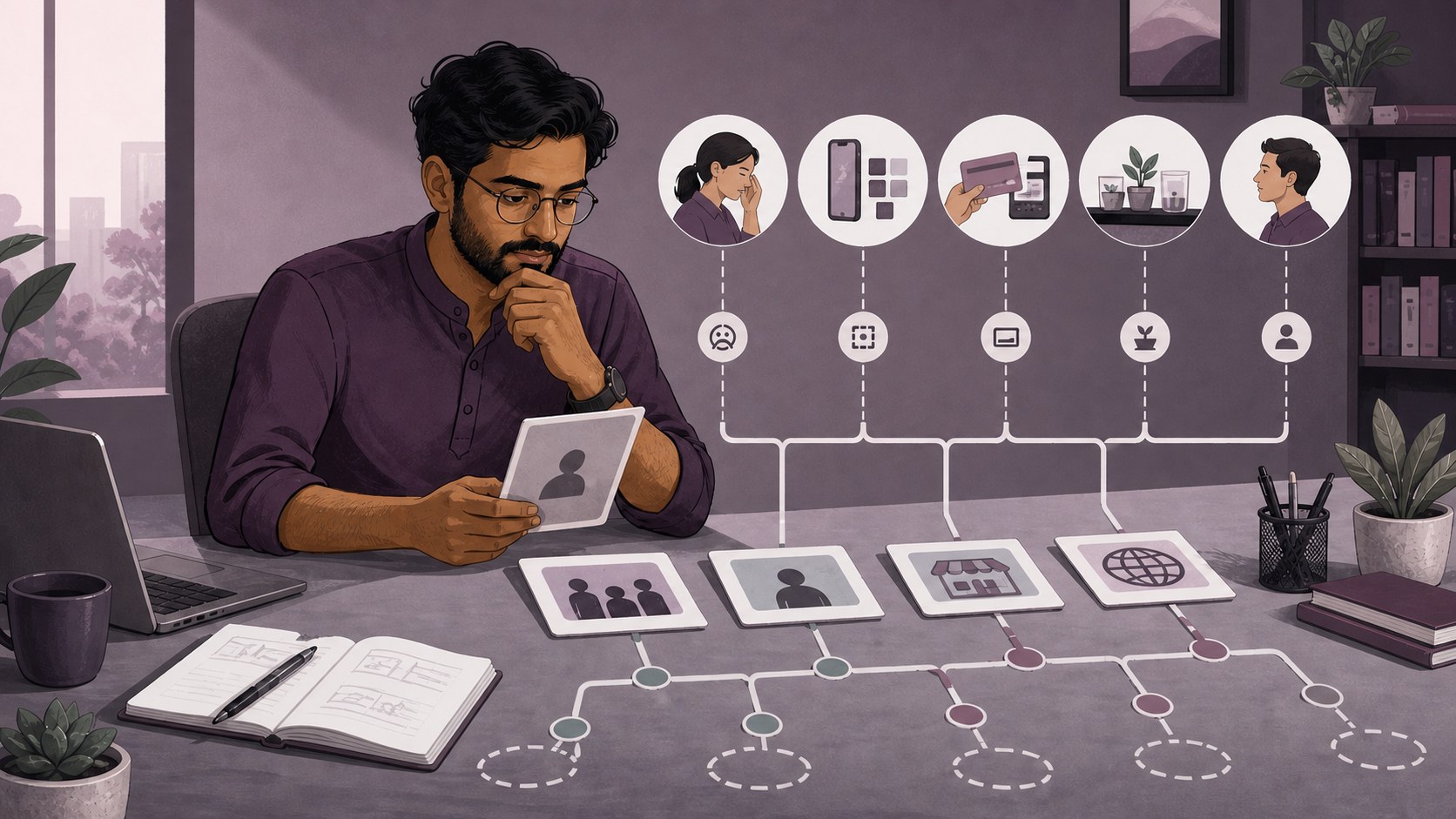
Startup ideas are easy to generate. Finding one that deserves months or years of your life is much harder.
The usual advice is to “find a problem and solve it.” That works when buyers feel the pain and pay for a poor fix. Yet some strong ventures begin another way. A new tool, rule, or habit makes something possible that people have never bought before.
That split matters in the AI era because you may find a gap, create a new market, or do both. Each path needs a different kind of proof. Mix them up, and you may reject a good idea too soon. You may also build a fine product that no one adopts.
This guide offers a clear Opportunity Filter. Use it to cut a long list down to one or two ideas worth a test.
Two Ways Startup Ideas Become Opportunities
Entrepreneurs often discover opportunities that already exist. A customer has a costly delay, uses an awkward workaround, or pays too much for a weak solution. The founder notices the gap and serves it better.
Airbnb’s first transaction fit this pattern. A design conference filled San Francisco’s hotels, while Brian Chesky and Joe Gebbia needed help paying their rent. They offered airbeds in their apartment, and three guests booked. Airbnb’s own S-1 filing describes that origin.
Other opportunities must be created. Customers may not yet have a budget, habit, or category for the product. The founder must build the offer and help customers learn a new way to work.
This second mode resembles effectuation. Entrepreneurship scholar Saras Sarasvathy describes it as acting from available means and focusing on what you can control. This logic gives less weight to predicting a fixed market. Her foundational Academy of Management Review paper explains the logic in detail.
Researchers Sharon Alvarez and Jay Barney also distinguish opportunity discovery from opportunity creation. In practice, many ventures combine both.
For example, a Tier 2 diagnostic clinic may discover strong demand for faster radiology reports. Yet an AI-assisted workflow would require the clinic to create new review steps, trust rules, and staff behavior. The demand exists; the workflow does not.
The lesson is simple: don’t ask only whether the problem exists. Ask what part of the opportunity already exists and what part you must create.
Find Startup Ideas Through Changes, Problems, and Founder Access
A blank page is a poor place to search for startup ideas. Begin with three sources of evidence.
1. Changes that alter what is possible
Look for a meaningful shift in technology, regulation, cost, infrastructure, or customer behavior. Then ask: what has become practical, affordable, or acceptable that was not possible two years ago?
AI can reduce the cost of content production, software development, analysis, and support. India’s digital public infrastructure can lower payment and verification friction. Climate pressure can change procurement priorities. Each shift opens several possible ventures, but it does not guarantee demand.
Therefore, name the changed constraint. “AI is growing” is too broad. “A small manufacturer can now classify visual defects without building a computer-vision team” is useful.
2. Problems that already carry a cost
Observe where people lose money, time, trust, or opportunity. Strong signals include spreadsheets that require constant repair, repeated phone calls, long travel, avoidable spoilage, delayed payments, and fees paid to weak alternatives.
Complaints alone are not enough. A problem becomes more credible when the customer has built a workaround or pays someone to manage it. Behavior is stronger evidence than enthusiasm.
3. Access that lets you learn faster
Your access may come from work experience, geography, family business, technical knowledge, or trusted relationships. Access does not prove the idea is good. Still, it can shorten the path to honest conversations and early trials.
This is where founder fit matters. An attractive market may still be a poor choice if you cannot reach customers, understand the operating environment, or remain committed long enough to learn.
Test Startup Ideas With the Six-Part Opportunity Filter
Write each idea in one line. Name the buyer, the pain or change, and the gain you plan to offer. Then score it with these six questions.
1. Is the problem real and frequent?
Describe the last time the buyer faced it. How often does it occur? What harm follows when no one solves it?
A rare nuisance seldom supports a sound firm. However, an infrequent problem can still matter when its financial or emotional cost is high.
2. Who feels it most strongly?
Avoid “small firms,” “farmers,” or “students” as your first group. Instead, choose a narrow set of people who share the same facts.
For instance, “independent Tier 2 clinics that send scan reports to outside experts” is narrow enough to test. A tight first group helps you learn. It does not limit the firm for life.
3. What changed now?
State why the idea makes sense now. A tool may cost less, a new rule may create a need, or buyers may form a new habit.
Next, test the reverse case. What if the change slows, reverses, or becomes available to every rival? A firm based only on short-term access to one AI model may lose its edge fast.
4. Is there evidence of payment or commitment?
The best sign is often a buyer who pays for a worse fix. Other good signs include a deposit, signed pilot, data access, staff time, or the right to test in a live workflow.
By contrast, “I would use this” is weak. People may praise an idea but refuse to change a budget or routine. Use customer discovery to study what they do now before you treat praise as demand.
This check separates startup ideas that attract compliments from those that earn commitment.
5. Can you test the central assumption cheaply?
Every idea hides one belief that could kill it. It may involve demand, trust, work habits, technical performance, profit on each sale, or the ability to reach buyers.
Design the smallest test that puts this belief at risk. You might sell a manual service, build a small demo, run a paid pilot, or ask buyers for data and staff time. The goal is not to impress. It is to learn before the costly build starts.
6. Does the opportunity fit the founder?
Consider your skills, access, funds, time, and personal runway. Then ask if you want the daily work as much as the prize.
A founder who loves product work may hate a firm built on long sales bids. A strong coder may need a sales ally. Someone with a family may need a model that earns cash sooner. These constraints do not reflect weak ambition.
Separate Robust Signals From Noisy Ones
The Opportunity Filter works only if you weigh evidence correctly. Otherwise, attractive startup ideas can survive because their weakest signals receive too much weight.
For a discovered opportunity, robust signals include existing spending, repeated workarounds, and measurable losses. Noisy signals include survey enthusiasm and broad statements that a market “needs disruption.”
For a created opportunity, the signals differ. A major fall in cost or time can be robust because it changes the venture’s economics. A design partner willing to change a real workflow is also meaningful. Yet a founder’s belief that customers will adopt a new behavior remains a hypothesis.
AI makes this distinction urgent. You can now build a polished demonstration in days. As a result, technical feasibility may arrive long before customer readiness. A working product proves that you can build, while customer adoption requires separate proof.
Run a Dual-Mode Test on Startup Ideas
First, take your lead idea and split a page into two columns.
In the first column, write what exists now: demand, spend, pain, poor fixes, and buyers you can reach. This is the discovery side.
In the second column, write what you must create: a new habit, workflow, trust rule, sales path, or way to earn. This is the creation side.
Next, give each column its own test. For the discovery side, talk to buyers and observe their current actions. For the creation side, run a small trial of real use. Don’t ask if people like the new process; give them a chance to use it.
Finish with a one-paragraph opportunity thesis:
We believe [specific customer] has [demonstrated problem], and the opportunity exists because [current change]. Customers already show demand through [behavior or spending], while we must still create [new behavior or system]. Over the next thirty days, we will test [critical assumption]. We will continue only if [decision threshold] occurs.
That paragraph turns a spark into a test plan.
What AI Changes About Startup Ideas—and What It Does Not
AI speeds up scanning, research, synthesis, and prototyping. A founder can compare markets, summarize interviews, and build early demonstrations much faster than before.
Not all startup ideas benefit equally. AI may lower the cost of testing one idea while making another easier for competitors to copy.
However, AI does not remove the need for customer evidence. It can generate plausible problems and convincing market narratives even when neither is commercially important. Use it to widen your search and speed your work, but don’t let generated confidence replace observed behavior.
AI also creates an obsolescence question: could the same technological progress that enables your idea make it irrelevant before you establish the business? If a general model may absorb your feature, build around customer access, proprietary workflow data, integration, trust, or an outcome the model alone cannot deliver.
Choose What to Test, Not What to Believe
You do not need full proof before you start. You need an idea with a real buyer, a clear change, signs you can see, a cheap test, and sound founder fit.
Score three startup ideas with the Opportunity Filter. Keep the best two. Then use the Venture Locator to compare their fit and choose one for a thirty-day test.
The goal is not to prove that your top idea is right. Instead, find what must be true before you make a costly commitment.


