


A business continuity plan for a solo AI startup should explain what happens when you cannot answer. Which customer promises can the business still keep? Who can handle an exception, and what should stop until you return?
AI may keep producing work while you are away. However, a customer can still wait for approval, an agent can reach its spending limit, or a failed login can block delivery. If every alert comes back to your phone, the business still depends on your availability.
Start with a modest goal: keep essential work covered during a short absence, with clear limits on what can proceed. You can then decide whether the remaining gaps call for a narrower offer, a backup arrangement, or a permanent role.
Start Your Business Continuity Plan with Customer Promises
List the commitments that would fall due if you were unavailable tomorrow. Include support response times and scheduled deliveries. Also note any account or supplier issue that could interrupt a service customers already use.
Next, ask how long each task can wait before a customer suffers a meaningful consequence. A research report due next week may allow time to rearrange work. A service that promises same-day responses needs coverage much sooner.
Write down the promise you actually made, because your website and sales conversations may tell different stories. If you have informally offered round-the-clock support, changing a footer will not settle those expectations. Discuss the service you can sustain with affected customers.
The solo AI startup business-model guide helps you assess which offers fit one founder's capacity. Apply the same test to periods when that founder is absent. An offer can be profitable during a normal week yet hard to support when an exception needs immediate attention.
Keep this first inventory short. Focus on the promises most likely to cause a serious delivery gap, then add less urgent work as you learn from testing.
Separate Automated Work from Human Decisions
Follow one customer job from its input to its final delivery. Mark where a person must check evidence or approve an action. Include the point at which the customer receives the result; generating a draft does not complete the job.
For example, an AI service may prepare a daily market brief without help. A missing source or a conflicting claim may still require a reviewer. If the only reviewer is away, the business needs a defined response to that case.
Your business continuity plan should distinguish work that can continue under existing rules from work awaiting judgment. Decide which actions can safely wait. Then make the system's behavior match that decision, including any message the customer receives.
In its February 2026 study of agent autonomy, Anthropic emphasizes whether people can monitor and intervene in deployed systems. The study concerns its own products and API traffic; it does not establish how reliably your startup operates. For your plan, ask who can intervene when you cannot.
Also examine less visible dependencies. A billing alert may go to a personal inbox, or a tool may require your phone for every login. Record those barriers before assuming a second person can take over.
Give Each Exception a Route
Use a small table to define what continues, what pauses, and what needs another person's decision. These routes should reflect the customer promise and the consequence of an error. Review them with whoever will provide cover.
| Route | When it fits | What the business does |
|---|---|---|
| Continue | The task fits tested rules and existing authority | Complete the work and record the result |
| Pause | Evidence is missing or the next action exceeds authority | Hold the job, preserve its state, and explain the delay |
| Escalate | A qualified backup can resolve the issue within agreed limits | Send the evidence to that person and track the decision |
For an agent, define the conditions that trigger a stop. These might include repeated failures, conflicting inputs, or a request outside the agreed scope. Use a retry limit and a spending cap appropriate to the task, and test that both work.
An alert needs someone who has agreed to receive it. Confirm the person's availability and what they can do during that period. An unanswered message in a group chat leaves the job waiting.
If no suitable person can cover an exception, pause that part of the service and plan the customer communication. Do not increase agent authority simply because the founder will be away. Choose the response you can justify while someone is present, then keep that boundary during the absence.
Make the Backup Arrangement Usable
A business continuity plan needs a person who can find the current work and understand its status. Agree on the scope of cover, compensation, and availability before relying on that person. A peer who offers advice may have neither the expertise nor the time to serve customers.
Prepare a short operating note with links to the work queue and source documents. Name the actions the backup can take and the promises they can make. Include examples of issues they should hold for your return.
For example, the person might resend an approved report or correct a known formatting fault. New prices and changes in customer scope may remain with you. If an urgent issue exceeds their authority, the note should say how to pause the affected work and whom to notify.
Use separate accounts with permissions suited to the role. Check access in advance without sharing your personal login or placing secrets in the operating note. A backup plan should preserve the controls that protect customer information.
Keep data recovery separate from work coverage. NIST's contingency-planning guidance describes recovery through coordinated procedures and technical measures, including temporary manual processing. For a small business, that distinction is useful: restoring a file and deciding what to send a customer are different jobs.
If regular coverage needs more time than an occasional arrangement can provide, revisit the role. The first startup hire guide explains how to define recurring work before hiring for it.
Test Your Business Continuity Plan for Two Days
Consider a hypothetical Pune founder running an AI-assisted market-monitoring service for small engineering suppliers. She wants the service to handle routine requests while she is unavailable for two working days. All counts below are assumptions for this example.
She first runs a supervised rehearsal, using a copied queue and test accounts where possible. She stays reachable for the exercise, but the backup follows the written instructions before asking for help. Any intervention becomes a gap to fix.
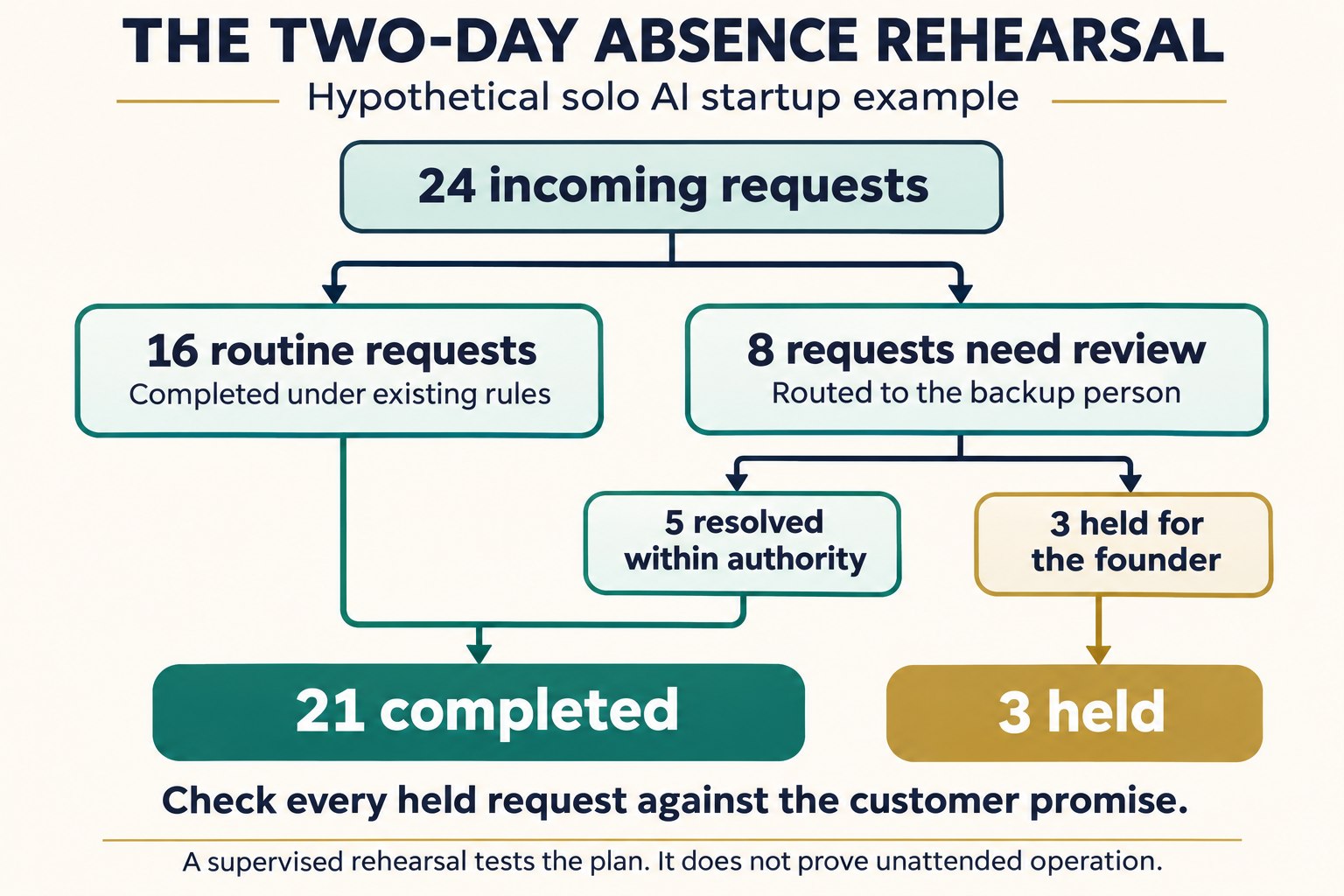
The exercise contains twenty-four incoming requests. Sixteen fit existing rules and complete without a new decision. Eight need review, including conflicting sources and requests for information outside the standard report.
| Result of the rehearsal | Requests |
|---|---|
| Completed through the routine workflow | 16 |
| Resolved by the backup within existing authority | 5 |
| Held because they need the founder's decision | 3 |
| Total requests accounted for | 24 |
Read the Rehearsal Result
The exercise therefore produces twenty-one completed requests and three held requests. That result does not prove the service can run unattended. The founder still needs to check whether the held requests conflict with promised response times.
For the three held requests, the backup sends an agreed status message and records the next action. If a customer needs an answer sooner, the founder must arrange qualified cover or agree on a different deadline before the absence. A courteous message alone does not fulfill the original promise.
She also records the backup's time and any calls she had to take. If the exercise works only because she resolves each hard case from her phone, the test has exposed the remaining dependence. She can then change that part of the service or improve the coverage.
Two days is a starting exercise chosen for this scenario. A service with tighter response promises may need a shorter test and faster intervention. Longer absences require a broader plan for management and customer commitments.
Use the Gaps to Change the Business
After the test, review every point where the backup lacked context or authority. Fix the operating note, adjust the workflow, and repeat the affected tasks. Update your business continuity plan whenever a material tool or service promise changes.
Some gaps reveal a simple process fault. A shared queue may replace scattered status messages, or a clearer input form may prevent repeated questions. Others reveal that the offer requires expertise you cannot cover alone.
Costs belong in the decision too. Include any standby fee, rehearsal time, and work the backup performs while you are away. If the service cannot support those costs, reconsider its price or response promise before adding customers.
Use the AI workload ledger to see whether constant checking already consumes your normal week. An absence test can reveal the same dependency more clearly, because it removes your quiet repairs from the process.
Start this week with one customer promise. Write the route for routine work and exceptions, name the person providing cover, and rehearse a small batch. A business continuity plan earns its place when someone else can follow it and you can see what still needs to change.


