


AI agent productivity should show up in finished work and time you can use elsewhere. If your agents produce drafts all night while customers still wait for your approval, examine the work after generation. The queue may have moved to your desk.
For a solo founder, that desk also handles sales, product choices, and customer problems. Each extra draft competes for the same hours of attention. Before adding another agent, find out which step limits the number of jobs you can finish.
This guide gives you a time ledger and a small operating test. Use them to decide whether to improve a workflow, reduce its scope, or add human help.
Define AI Agent Productivity Around a Finished Job
An AI agent can choose steps and use tools while working toward a task. A workflow follows a more defined sequence. Both need a clear result that you can inspect before claiming a productivity gain.
For example, a catalog-writing business might count one accepted product entry as a finished job. A draft with missing facts remains work in progress. If the buyer must make extensive repairs, include that burden when judging the result.
Keep the unit consistent when comparing approaches. A hundred short descriptions and a hundred complex product pages require different work. Also record the quality standard, so a faster process cannot appear better simply because you accept more errors.
Anthropic's guidance on effective agents distinguishes workflows from agents and recommends adding complexity when the task calls for it. Apply that principle to AI agent productivity: judge the chosen setup against a defined customer outcome.
The solo AI startup business-model guide helps you choose an offer you can support. Once the offer is clear, measure how much work the delivery process leaves with you.
Count All Founder Time in AI Agent Productivity
Start a simple ledger for each batch of jobs. Record active minutes spent on the process, including time outside the tool itself. Use actual task records where possible, because a fast first draft can dominate your memory of a long job.
| Stage | What to record | A question to investigate |
|---|---|---|
| Brief and inputs | Instructions, source gathering, data cleanup | Does every batch need a new explanation? |
| Generation | Active supervision and blocked waiting | Can you do useful work while it runs? |
| Review | Checking facts and judging quality | What evidence does the reviewer need? |
| Repair | Corrections and extra review passes | Which faults keep returning? |
| Monitoring and handoff | Failed runs, routing, status updates | How often must you intervene? |
Track elapsed delivery time separately from active labor. An overnight run can consume little of your time while still delaying the customer. Conversely, several quick runs can take substantial attention if you keep switching between them.
When two agents run at once, count your active minutes once. Also record what you stopped doing to supervise them. The ledger should help you understand the week you actually worked.
Research supports caution about simple speed claims. In a February 2026 update, METR explains why selection effects and concurrent agent use complicate its developer-productivity measurements. It describes its newer results as an unreliable signal of the current effect. That coding study does not establish the gains in your startup; it helps explain why local measurement matters.
Find Where AI Agent Productivity Stops Increasing
Follow a batch through the whole process. Count jobs waiting for input, review, repair, and final delivery. Then note the age of the oldest unfinished job at each step.
If drafts arrive faster than you can review them, the review queue grows. For example, suppose agents prepare thirty comparable jobs a day while you can finish reviewing twenty. Ten jobs join the queue each day, assuming no other changes. More generation would add to the unfinished work.
Next, examine why review takes time. You might be searching for source facts, applying unclear quality rules, or making a business decision that only you can make. Each cause calls for a different response.
Searching suggests a need for better inputs and visible source links. Unclear rules call for examples of acceptable and unacceptable results. A decision about customer scope or price may require your judgment even when the surrounding paperwork is automatic.
AI agent productivity can also stall before generation. A buyer may send incomplete files, or an integration may need manual setup. Mark the actual constraint before assuming the reviewer is the problem.
Compare AI Agent Productivity on the Same Work
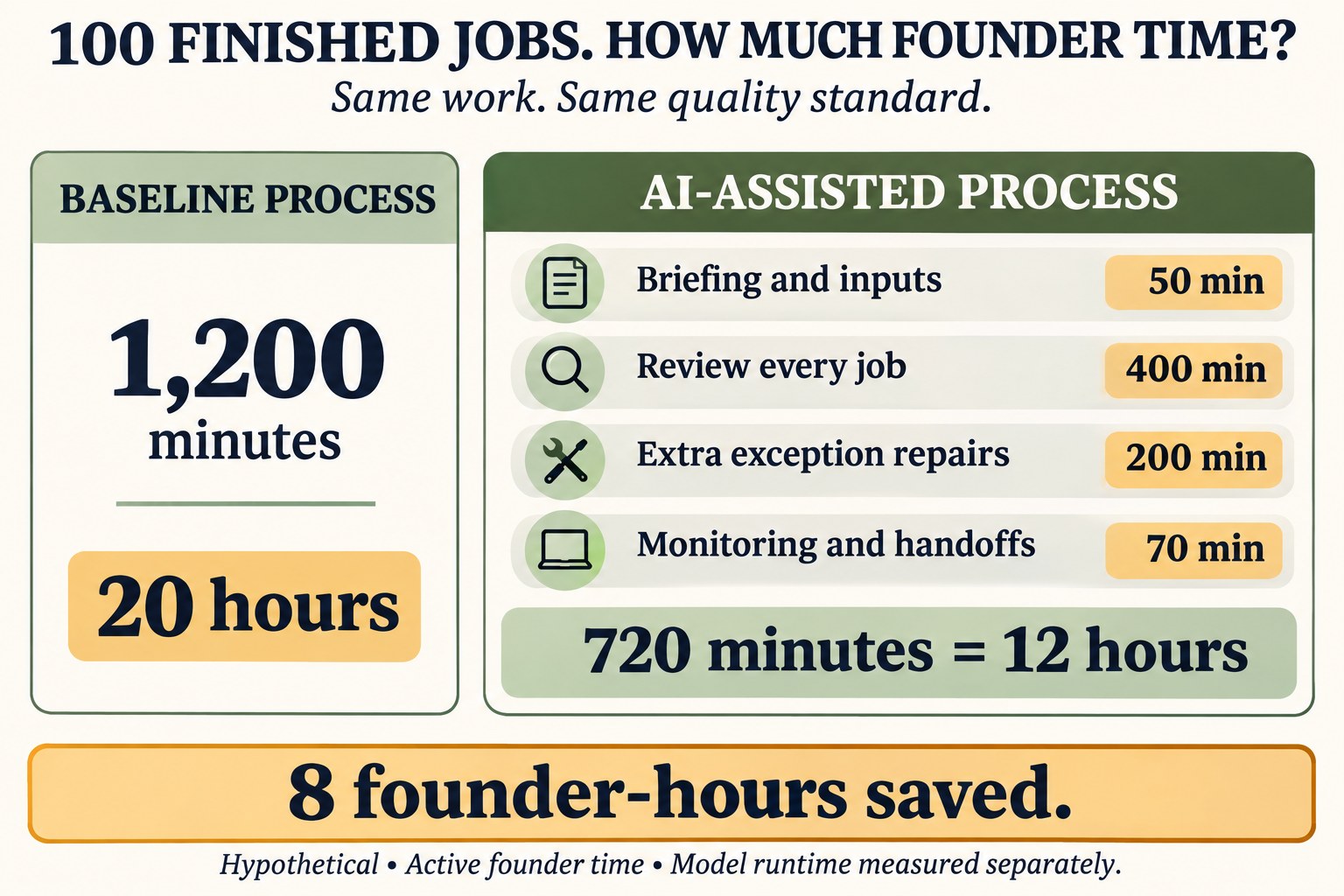
Consider a hypothetical solo founder delivering catalog entries to Indian homeware brands. She compares one hundred finished entries of similar difficulty, using the same quality standard. Every entry includes review before delivery.
Her baseline process takes twelve minutes per entry, including drafting and checks. One hundred entries therefore require 1,200 minutes, or twenty hours. These figures are assumptions chosen for the example.
With an AI-assisted process, the same batch requires:
| Founder work | Minutes |
|---|---|
| Briefing and preparing inputs | 50 |
| Reviewing all 100 entries at four minutes each | 400 |
| Repairing 20 exceptions at ten extra minutes each | 200 |
| Monitoring runs and handling handoffs | 70 |
| Total active founder time | 720 |
The batch now takes twelve active hours, saving eight against the baseline. The twenty exception repairs are additional to the first review of every entry. Model-running time is separate, and the example assumes it does not block other useful work.
The process still leaves twelve hours of founder work for that batch. If your available delivery time falls below that amount, the schedule still needs attention.
Then compare costs. Include model usage, tools, and any outside help alongside the founder's time. Use the AI startup costs guide to connect the measured workload with pricing and cash needs.
Fix Repeat Exceptions Before Adding Agents
Review the repair log after each batch. Group problems by cause so you can see which ones recur. Missing product facts, unsupported claims, and broken output formats should lead to different fixes.
When facts are missing, stop the job and request the information. Another model call cannot establish a specification that the customer never supplied. For repeated format errors, use a fixed template and check the required fields before review.
Keep a small test set of realistic jobs, including examples that previously failed. Run it after changing prompts, models, or tools. A faster workflow needs to preserve the checks that make its results usable.
Set a retry limit as well. If a job keeps failing, route it to a person with the context to resolve it. Unbounded retries can consume money and produce more versions for the founder to compare.
Check AI agent productivity again after each meaningful change. A more elaborate agent setup earns its place when it improves the completed result or reduces the work needed to obtain it. The number of agents is an input to that test.
Decide What Needs Your Judgment
Write down what the reviewer actually decides. Some checks concern missing fields or arithmetic and may support reliable automated tests. Others involve meaning, customer expectations, or an exception to the agreed service.
Give routine review clear acceptance rules before delegating it. Include the original evidence, examples of errors, and conditions that require escalation. Then test whether a qualified person can apply those rules consistently.
During a handover, account for training and oversight. The founder may spend more time at first while another reviewer learns the work. Measure the resulting workload over a suitable period before treating the task as covered.
Some decisions should stay with you at the current stage. If every job needs a fresh product decision, consider narrowing the offer or standardizing the choices. Hiring someone to chase unclear instructions may leave the underlying queue intact.
Use the solo founder or team guide when the evidence points to a recurring coverage gap. The needed capability may be domain review, delivery support, or engineering; identify it before writing a job description.
Run a One-Week AI Agent Productivity Test
Choose one repeatable workflow and define the finished job. Start with a small batch whose quality you can check. Record the starting backlog so old work does not distort the result.
For one working week, log completed jobs, active founder minutes, and repairs. Also note customer complaints and jobs still waiting at the end. Include sales and other essential duties when deciding how many delivery hours you can afford.
Next, cap the amount of work awaiting review. When the queue reaches that limit, pause new generation and resolve the cause. The cap should fit your response promise and available time; this guide does not prescribe a universal number.
At the end-of-week review, choose a specific change. Improve the inputs if briefing dominates. Narrow the offer if exceptions consume the gain. Add qualified coverage if the remaining work is clear and recurring, and the economics support it.
Keep the customer outcome and quality standard constant for the next comparison. You will then have evidence of whether AI agent productivity improved and whether the change released time you could use elsewhere.


