


A solo AI startup needs a business model that one founder can sell and serve reliably. Building a working demo is only part of that test. Before choosing an idea, map what happens after a customer pays and sends real work through the product.
An AI tool might draft a catalog entry in seconds. However, someone must supply accurate product facts, check the result, and decide what goes live. If that same tool changes stock records or places orders, the promise becomes much harder to support.
Choose the customer outcome and the limits of the service together. That decision gives you a useful way to compare ideas before you commit months to building one.
Define What Your Solo AI Startup Will Deliver
For this guide, an AI-native startup sells a result that depends on AI as a core part of the product. A tool that turns product facts into draft catalog copy fits that definition. A conventional shop whose owner uses AI to write emails has a different operating model.
Solo founding means one founder carries the founding role. You can still use contractors, advisers, and employees. Here, the question is how far you can operate with one founder and limited outside help during the initial paid pilot.
Research gives a reason to explore that possibility. An INSEAD working paper on AI-native firms finds smaller teams than at comparable non-AI startups in its US-focused sample. That finding does not establish that these firms can operate with no employees or that the same pattern holds in India.
The solo founder or team guide helps you choose a founding structure. This article goes deeper into the work a specific business model creates.
Test the Work Behind a Solo AI Startup
Start with a real job a buyer wants done. Then follow it from the first sales conversation to payment, delivery, and support. Five questions expose much of the load the founder will face.
Onboarding: Can buyers start with a clear form and sample file, or does each account need a custom setup? If the founder must clean every customer's records, count that time before calling the product self-service.
Data access: Does the customer control the needed data and have permission to share it? Also test whether the files arrive in a usable format. Missing facts and conflicting records can create work that a better prompt cannot remove.
Error consequences: Can the buyer inspect a draft before using it? Ask what happens when a result is wrong, who can spot the mistake, and whether an action can be undone.
Support: Can the service wait until the next business day when something fails? A promise to keep a customer's operations running at all hours needs reliable human coverage.
Sales effort: Can one person explain the value and approve the purchase? A deal involving several departments may require meetings, security reviews, and custom terms before any revenue arrives.
These questions concern your offer, so test them with likely buyers. A small monthly fee can still come with a heavy support burden.
Compare Models for a Solo AI Startup
The following comparison is a starting hypothesis. Test it against the customer and workflow you intend to serve. The same technology can create very different businesses depending on the promise attached to it.
| Business model | Conditions that may fit solo operation | Work to test before committing |
|---|---|---|
| Narrow self-service tool | Standard inputs, inspectable output, bounded support | Setup failures, repeat use, cost of reaching buyers |
| Assisted specialist service | Defined scope, scheduled delivery, founder can judge quality | Review hours, revisions, capacity per account |
| Product connected to customer systems | Limited access, clear approvals, reliable technical coverage | Integration, monitoring, incident response |
A self-service product gives customers a repeatable way to complete a task. For example, they upload agreed product facts and receive draft descriptions for review. The founder must still test demand and quality; an easy signup does not prove that buyers return.
An assisted service includes human work in what the buyer purchases. A founder might deliver a checked catalog batch on a set date. This model can support early learning, provided the price covers review and the scope limits revisions.
Connecting a product to live customer systems adds work. If it changes prices, inventory, or orders, the founder needs clear permissions and a way to handle failures. It may suit a solo founder with capable outside support, but the support must exist before the promise does.
Build a Solo AI Startup Fit Scorecard
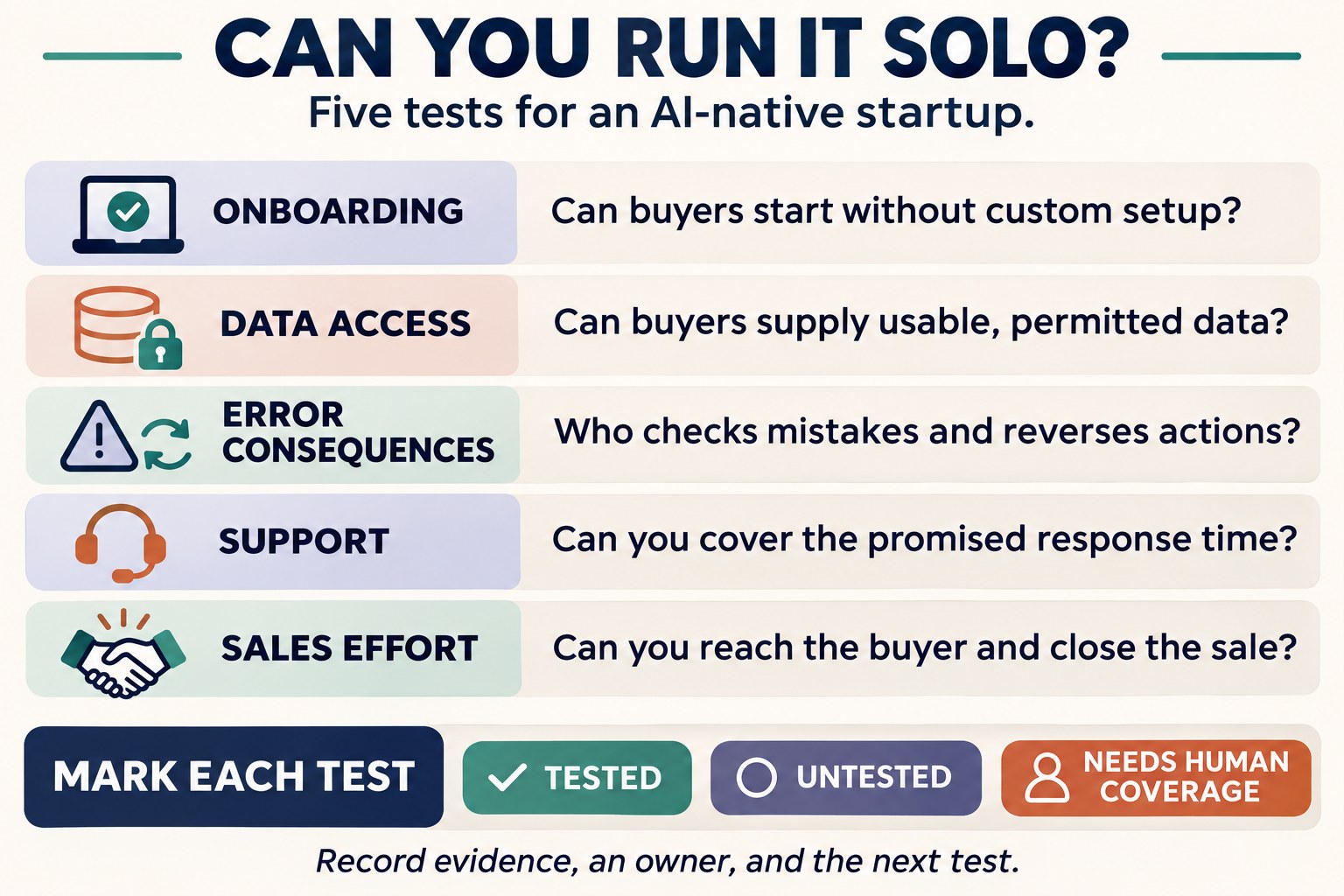
Make one row for each of the five questions above. Add the evidence, the person responsible, and the next test. Then mark each row as tested, untested, or needing human coverage.
Tested means you have seen the workflow operate under the conditions you plan to sell. Untested means a claim still rests on an assumption. Needing human coverage means a task requires skills, availability, or authority that the current setup does not provide.
For example, a buyer may complete onboarding without help while the founder still repairs every output. Record both results. One smooth step does not establish that the whole service is ready.
Do not turn these marks into a total score that hides a critical gap. If nobody can handle a failed action that stops the buyer's work, strong results on setup and sales do not cover it. Narrow the promise or arrange the missing coverage before taking on that duty.
Keep the pilot size and customer type beside the scorecard. Evidence from a few simple jobs supports a limited conclusion. Review the marks again before accepting larger files, new languages, or access to another business system.
Work Through an Indian Solo AI Startup Example
Consider a hypothetical founder in Jaipur serving small homeware brands. She knows how these buyers describe products and prepares an AI tool that drafts English catalog copy from approved facts. Customers review each entry before publishing it.
Her first offer accepts one spreadsheet format, excludes health and performance claims, and promises support on business days. She tests whether buyers can supply the facts and catch errors in the draft. She also measures how often the tool invents details or needs a manual repair.
A customer then asks her to add automatic stock updates across its sales channels. That request changes the product's duties. The service now needs access to live records and a way to detect and recover from incorrect updates.
The founder can keep the catalog tool narrow while testing the new workflow separately. Before offering stock updates, she would need to establish who approves changes, who handles failures, and how records are restored. Customer demand for the feature alone does not establish her ability to deliver it.
This example shows how scope affects operating load. It does not claim that catalog tools are easy to sell or that inventory products always require co-founders. The result depends on the workflow, the consequences, and the support available.
Count Human Review in the Delivery Cost
A solo AI startup can use few employees while still consuming many hours of founder time. Record the full work behind each completed job. Include setup, model usage, review, corrections, and support after delivery.
In a hypothetical assisted service, suppose a job sells for ₹1,500. Model and tool use costs ₹150, other direct delivery costs are ₹100, and human work takes one hour. If the founder assigns that hour a planning value of ₹600, the job leaves ₹650 before other costs.
At two hours of human work, only ₹50 remains on the same basis. These illustrative figures assign a planning value to founder time. The hourly value is an assumption, and the balance is before the other business costs. They exclude customer acquisition, fixed overhead, and taxes, all of which still need funding.
Use the AI startup costs guide to build that wider cash view. Then test whether customers will pay a price that supports the actual service.
Keep the technical design within your ability to maintain it. Anthropic's guidance on building effective agents recommends starting with simple solutions and adding complexity when needed. Its architecture guidance also describes the cost and error trade-offs that come with greater autonomy.
Choose a Pilot You Can Support
Before launching your solo AI startup, write the promise in plain language. Name the buyer, the result, the accepted inputs, and what the customer must check. Also state support hours and actions the product will never take without approval.
Next, test the offer with a small set of paying customers. Log founder hours and failures alongside usage. Track the work required to obtain a usable result, because output volume alone can hide a growing review queue.
Set a capacity limit before sales exceed the time available. If each account needs frequent custom work, you can change the price or scope, add delivery help, or pause new sales. Use the test results to decide which support the venture needs.
Use the AI product readiness guide to check the delivery process before expanding. Start with an outcome you can judge. Record where delivery still needs a person, and limit your promise to the support you can provide. Revisit the model when the work changes.


