


AI startup costs are easier to track when you know the full cost of work your client can use. A cheap model call can still lead to an expensive service. Retries consume more compute, rejected results need repair, and someone must handle exceptions.
Consider a hypothetical service that reads supplier invoices and turns them into records. Its demo handles a clean page quickly. However, real files arrive as blurred scans, mixed formats, and records with missing fields. Some require several attempts and a reviewer before the client can use them.
So the founder needs a cost per usable record. Count the failed attempts as well. This guide shows how to work out that cost, test prices, and plan for cash needs.
Choose the Unit for Your AI Startup Costs
Start with the result you promise. For example, an invoice record may need the right amounts, a valid supplier name, and a match to the purchase order. Agree on what counts as a usable record with the client before you count jobs as done.
Next, check how the client pays you and how you pay suppliers. A customer might pay per seat, per month, or per accepted document. Meanwhile, you may pay for tokens, tool calls, storage, and compute time. Tokens are pieces of text a model processes, often words or parts of words.
Then record both sides of each job. Count the results that meet the agreed standard and what you spent to create them. If a system runs several steps on its own, track the whole run. Include repeated steps and time spent on human checks.
As a result, two clients on the same monthly plan can cost very different amounts to serve. One submits clean files occasionally. Another sends large batches that need frequent checks. An average across all clients can hide the account that takes most of your budget.
Add Up the Full Cost of Each Job
First, choose a recent month and match the logs to the bills. Include model use, production hosting, paid tools, and staff time spent doing the work. Also include review, customer support, and rework for those jobs.
For instance, OpenAI's API pricing documentation lists separate charges for input, cached input, and output, along with tool pricing. Therefore, a single headline token rate may leave out resources your workflow consumes. Check the rates and terms for your actual provider contract.
Give human review its own line. Record time spent checking output, correcting errors, and dealing with cases the system cannot resolve. If a staff member checks results, assign the share of pay that covers those hours to the cost of the work. If you put all that pay in overhead, the job may look cheaper than it is.
Then set aside spending on new product work, sales, and running the firm. These costs still consume cash, but they answer a different question. The cost of each job tells you whether the price covers the work. Total spending tells you whether the firm can keep going.
Use the same method to split shared costs each month. For example, split a shared hosting bill by logged compute use where you can. Write down how you made each estimate when you lack exact data. These estimates help you plan, although your accounts may need to group the costs in a different way.
To find the cost per usable result, divide the full cost of the work by the number of results that meet the standard. Keep failed jobs in the numerator. Otherwise, the calculation hides what you spend on work that never reaches the client.
Test Whether the Price Covers Actual Use
Your business model needs a connection between the value you sell and the costs you incur. Test that link for each client.
Per-seat pricing gives the buyer a predictable bill. However, heavy use can make some accounts cost more to serve than they pay you. State what each tier includes. Then test the costs of clients near its usage limit.
Usage pricing connects revenue more closely to activity. As a result, revenue can rise with use, although the client's bill becomes harder to predict. Give buyers cost estimates and spending controls so they can keep track.
Outcome pricing charges for an agreed result. First, agree how to measure success and deal with disputes. An invoice record with missing fields should not count as a success just because the system finished a run.
Alternatively, a base fee with a usage limit gives you steady income and lets you charge for extra work. Test the limit against real use. It must cover the service you promise, including checks needed to meet the agreed standard.
Whatever the structure, read the signed contract. A forecast based on paid overages is wrong if the contract lets the client use as much as they want.
Compare Three Scenarios for AI Startup Costs
Build a base case from real use, current rates, and signed contracts. Then create a higher-usage case. Include longer inputs, more retries, or a demanding customer that consumes much more than the average.
Finally, test supplier or quality pressure. Model rates may stay flat or rise, and a change in customer requirements may require more review. Then track both the rate you pay and how much you use. A lower rate can still produce a larger bill when use grows faster.
For each scenario, calculate revenue, delivery spending, and what is left to cover other costs. Also count usable results and state the quality standard. Cheaper output offers little benefit if customers reject more of it.
This exercise concerns firms that use models in their products or daily work. A company training a foundation model needs a separate plan for its large training and research costs.
Worked Example: Cost per Accepted Document
Suppose an Indian service has twenty customers paying ₹20,000 each per month. So monthly revenue is ₹4 lakh. This hypothetical example shows the method; its figures are not typical costs or supplier quotes.
In the base case, the service delivers 2,000 accepted documents. The higher-usage case doubles usable output under the same flat monthly fees. Model use, tools, and review rise with that work, while hosting stays unchanged for this example.
In the pressure case, usable output stays at 2,000. However, higher model spending and extra review increase delivery cost. All scenarios assume the same acceptance standard and no change in subscription revenue.
| Monthly measure | Base case | Higher usage | Cost pressure |
|---|---|---|---|
| Accepted documents | 2,000 | 4,000 | 2,000 |
| Revenue | ₹4,00,000 | ₹4,00,000 | ₹4,00,000 |
| Model use, including retries | ₹35,000 | ₹70,000 | ₹50,000 |
| Paid tools | ₹25,000 | ₹50,000 | ₹25,000 |
| Production hosting | ₹20,000 | ₹20,000 | ₹20,000 |
| Direct review and support | ₹60,000 | ₹1,20,000 | ₹85,000 |
| Total delivery cost | ₹1,40,000 | ₹2,60,000 | ₹1,80,000 |
| Cost per accepted document | ₹70 | ₹65 | ₹90 |
| Gross profit | ₹2,60,000 | ₹1,40,000 | ₹2,20,000 |
| Gross margin | 65% | 35% | 55% |
| Other operating spending | ₹4,00,000 | ₹4,00,000 | ₹4,00,000 |
| Simplified monthly cash shortfall | ₹1,40,000 | ₹2,60,000 | ₹1,80,000 |
Gross profit here means revenue less the costs of serving clients listed above. Gross margin is that profit divided by revenue. For this cash estimate, clients pay within the month and you pay all costs in that month. It leaves out taxes, loans, new assets, and changes in cash tied up in stock or unpaid bills.
What the Higher-Usage Case Shows
Notice the higher-usage case. Cost per document falls, yet total delivery spending rises enough to reduce gross margin sharply. Therefore, the cheaper unit cost alone hides the strain on cash.
Next, check the costs of each client. At the base average of ₹70 per accepted document, a customer receiving 100 documents costs ₹7,000 to serve. By contrast, an account receiving 400 documents costs ₹28,000 at that same assumed rate, exceeding its ₹20,000 subscription. Each account will have its own costs, so check those before you change terms.
You could set a usage limit, charge for extra work, or change the process to cut needless retries. Test each option against usable output and review time. A cheaper model that creates more repair work may increase AI startup costs overall.
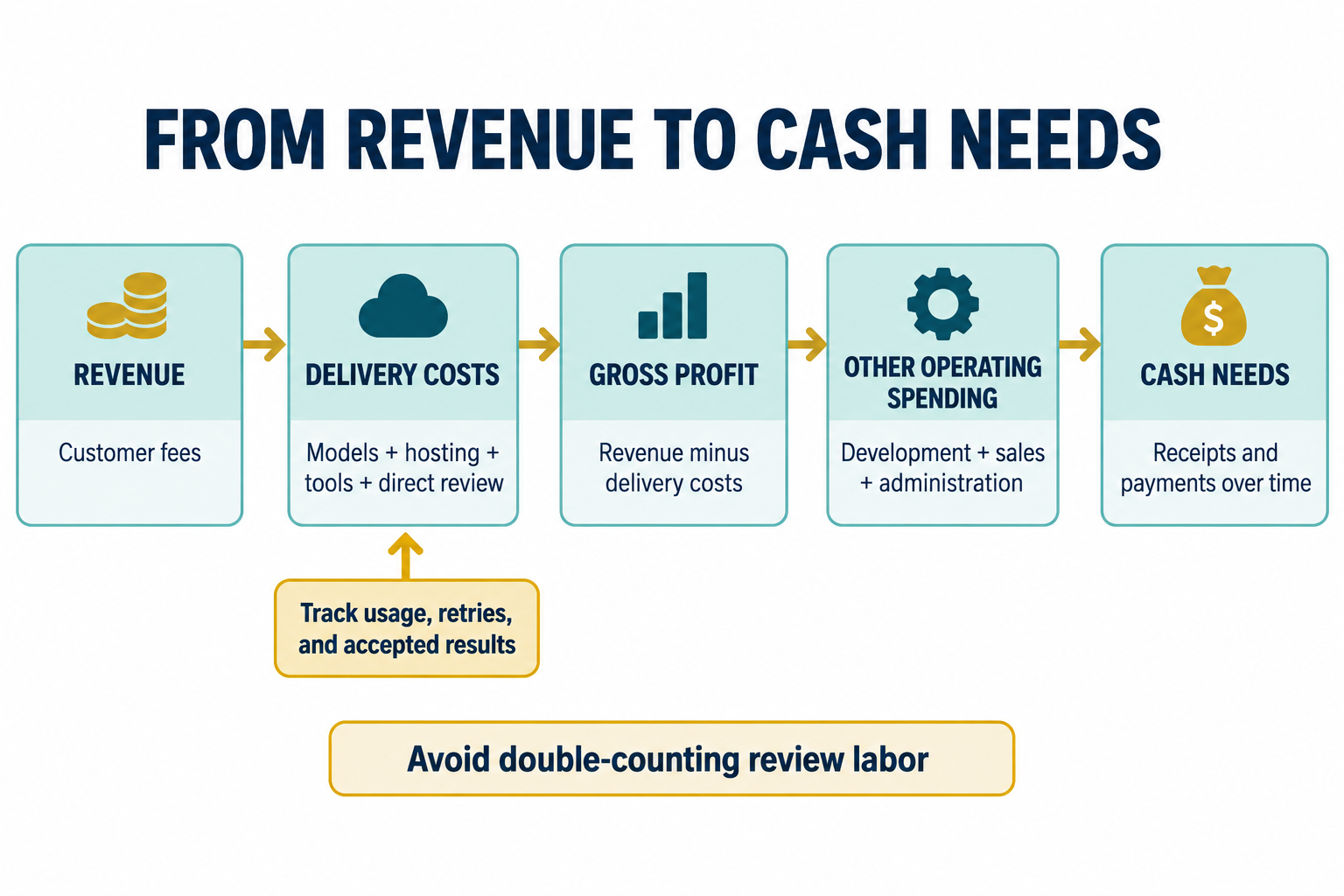
Use this flow to connect delivery economics with the company's cash needs. Gross profit alone does not show whether cash will last.
Use the Costs to Plan Your Cash
Now compare the shortfall with available cash. In this example, ₹12 lakh lasts for about 8.6 months in the base case, 4.6 months with higher usage, or 6.7 months under cost pressure. Those figures assume each month's shortfall stays constant.
For a cash plan, forecast each month on its own. Cash may move unevenly because clients pay late, fees fall due once a year, or you hire staff and buy equipment. Also separate paid pilots from production contracts. Cash from a trial does not prove the client will renew.
Keep the company's cash forecast separate from your household budget. The Founder Runway Planner helps you check the personal side of that choice. Then connect the venture's funding needs to a specific milestone, such as paid renewals or a measured cut in review time. Your capital path should support the evidence you need to obtain.
Build Your AI Startup Costs Worksheet
For your own venture, fill one row per client or group of clients. Use the same month for all rows so you can compare revenue and costs.
| Field | What to record |
|---|---|
| Customer promise | Result definition and acceptance criteria |
| Volume | Submitted jobs, accepted results, and rejected jobs |
| Revenue | Billing unit, contract price, allowances, and overages |
| Model use | Resource quantities, rates, and retry spending |
| Other delivery costs | Hosting, tools, direct review, support, and rework |
| Gross profit | Revenue less consistently allocated delivery costs |
| Operating spending | Development, sales, administration, and other overhead |
| Cash forecast | Opening cash, collection dates, payments, and closing cash |
| Decision | Pricing or workflow change triggered by a scenario |
Start with the most recent complete month. Trace a sample of jobs from start to finish, and check the bills against that record. Then identify the scenario that would force you to change pricing or preserve cash. Choose who will check the largest cost you are unsure about before the next review.


