


A liquidation preference can change how much you receive when your startup sells. Owning eighty percent of the shares does not guarantee eighty percent of the sale proceeds. Before accepting a funding offer, work out how its payment rules behave at several sale prices.
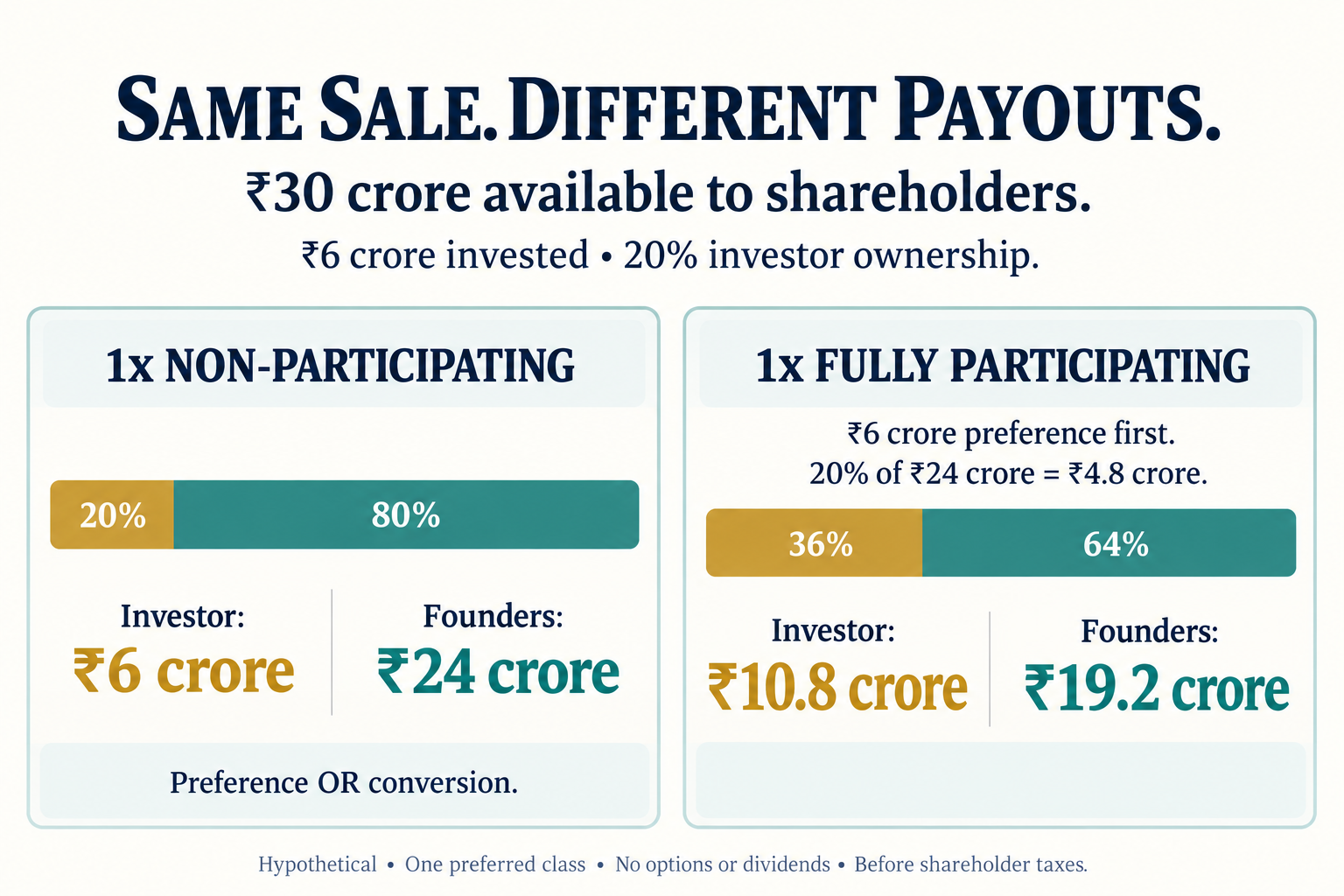
Consider a hypothetical Indian software startup. An investor puts in ₹6 crore for a twenty percent stake. The founders hold the remaining eighty percent, and a buyer later offers ₹30 crore. A quick ownership calculation gives the investor ₹6 crore and the founders ₹24 crore.
That answer holds under some terms. However, a participating preference would give the same investor ₹10.8 crore and leave the founders ₹19.2 crore. The sale price and ownership stay the same. The contract changes the split.
You need a proceeds model before signing, while you still have time to compare offers. This guide explains the terms and gives you a simple example to adapt.
Start Your Liquidation Preference Model With the Money Available
A liquidation preference gives preferred shareholders priority over ordinary shareholders for certain payments. It can apply to a company sale when the documents treat that transaction as a triggering event. Read the definition of that event before assuming the clause applies only to a shutdown.
Next, separate the buyer's headline price from the amount available to shareholders. Debt repayment, transaction costs, and other obligations may reduce that amount. Some deals also defer payments or make part of the price depend on future results.
Our example uses proceeds available to shareholders after those other claims. It assumes one class of preferred shares and only founders holding the ordinary shares. There are no employee options, dividends, later funding rounds, or deferred payments in the calculation. All figures are hypothetical and before shareholder-level taxes.
Keep those assumptions beside the worksheet. Once the company has more share classes or employee awards, add their terms to the model. An unused option pool is not automatically a group of people entitled to receive cash.
Your startup equity dilution guide helps establish the ownership figures. The payment model then shows what each holding receives under the agreed rights.
How a Non-Participating Liquidation Preference Works
The preference multiple sets the starting claim. A one-times preference, often written as 1x, gives our investor a ₹6 crore claim. A two-times preference creates a ₹12 crore claim. Neither amount guarantees a payment when the available proceeds fall short.
With non-participating terms, the holder chooses between its preference and the amount it would receive after converting to ordinary shares. Conversion means using the agreed share-conversion terms to join the ordinary shareholders' distribution. The investor takes whichever choice pays more in this simple example.
At a ₹12 crore sale, twenty percent is ₹2.4 crore. The investor therefore takes its ₹6 crore preference, leaving ₹6 crore for the founders. At ₹60 crore, its ownership share is ₹12 crore, so conversion pays more than the one-times claim.
At ₹30 crore, both choices pay ₹6 crore. That is the point where they meet for these inputs. You can calculate it by dividing the preference claim by the investor's ownership fraction: ₹6 crore divided by 0.20.
AngelList's explanation of liquidation preferences describes this choice and the separate treatment of participating shares. Its overview explains the concepts; your company's documents determine the actual rights.
Participation Changes the Liquidation Preference Payout
A fully participating holder first receives its preference, up to the proceeds available. It then shares in the remaining money using its ownership percentage on an as-converted basis. That percentage treats the preferred holding as the ordinary shares it would become on conversion.
For our ₹30 crore sale, the one-times claim takes ₹6 crore first. Of the remaining ₹24 crore, twenty percent goes to the investor and eighty percent to the founders. The investor receives another ₹4.8 crore, bringing its total to ₹10.8 crore.
The founders receive ₹19.2 crore. Compared with the non-participating offer, participation shifts ₹4.8 crore to the investor at this sale price.
A participation cap limits the holder's total receipts under the participating route. For example, a two-times cap on this investment would limit that route to ₹12 crore. However, if the holder can convert, a larger sale may make its ordinary ownership share worth more than the cap.
Therefore, ask what the cap includes and whether conversion remains available. Calling a provision capped does not establish an absolute ceiling on every possible payment. Carta's guide explains the distinction between participation and capped participation.
Compare the Same Sale Under Different Terms
Compare liquidation preference terms using identical inputs. The table below keeps the investment at ₹6 crore and the investor's as-converted ownership at twenty percent. Each cell shows the investor's payment followed by the founders' payment, in ₹ crore.
| Available sale proceeds | 1x non-participating | 1x fully participating | 2x non-participating |
|---|---|---|---|
| ₹12 crore | ₹6 / ₹6 | ₹7.2 / ₹4.8 | ₹12 / ₹0 |
| ₹30 crore | ₹6 / ₹24 | ₹10.8 / ₹19.2 | ₹12 / ₹18 |
| ₹60 crore | ₹12 / ₹48 | ₹16.8 / ₹43.2 | ₹12 / ₹48 |
At ₹60 crore, the two non-participating structures produce the same split. Under the one-times structure, the investor converts. Under the two-times structure, its preference and conversion choices each pay ₹12 crore.
At ₹12 crore, however, the two-times claim absorbs everything available. The founders still own eighty percent of the company and receive nothing in that scenario. If proceeds fell to ₹4 crore, every structure in this table would pay the investor ₹4 crore and the founders zero.
This comparison isolates the payment terms. Two actual offers may also differ in valuation or the amount invested, which changes ownership and the preference claim. Model each complete offer before deciding which outcomes you can accept.
Start with a low sale price, a plausible middle case, and a strong outcome. Also test an amount below the preference claim. These are scenarios you choose to examine, with no promise that a buyer will pay any of them.
Add Later Rounds to the Payment Order
Once you raise again, a second investor class may carry its own liquidation preference. Seniority describes the order in which those classes receive their preferred payments. Equal-ranking classes share available proceeds according to the terms governing their claims; senior classes receive priority over junior ones.
For example, assume an earlier class has a ₹6 crore claim and a later class has a ₹4 crore claim. Each holds twenty percent on an as-converted basis, and the founders hold sixty percent. At ₹5 crore of available proceeds, both retain their preferences because conversion would pay less. If the later class ranks first, it receives ₹4 crore and the earlier class receives ₹1 crore.
If the claims rank equally and share proportionately, the earlier class receives ₹3 crore and the later class ₹2 crore. The founders receive zero in either case. Payment order changes the split between investors even when it leaves the founders' result unchanged.
The preference stack is the total of the claims that remain in the preferred payment queue. A class that converts changes the queue and the shares that divide what remains. Consequently, a shortcut using one class's percentage of the entire sale can fail when another class takes a preference first.
Also check any dividends or other amounts that increase a claim. Ask your finance lead and advisers to reconcile each class's payment choice with the remaining proceeds. The final payments must add up to the money available.
Use a Liquidation Preference Worksheet Before Signing
Create a worksheet with one row for each share class. Record the invested amount and preference multiple. Then add participation terms, any cap, and the payment order. Include conversion rights and amounts that accrue over time.
Next, run the proposed sale scenarios. Show each investor's receipts and the amount left for ordinary shareholders. When employee awards exist, model their exercise and payment terms separately so you can explain what holders might receive.
Ask the people drafting your Indian financing documents to check the model against the share terms and transaction structure. A generic spreadsheet cannot establish that a clause works as intended in your agreement. Identify which documents govern the entitlement and resolve conflicting wording before signing.
AI can help organize a list of terms or prepare a spreadsheet layout. However, verify the formulas and conversion decisions yourself, and have the model checked before relying on it. A neat table can conceal an incorrect payment order or an assumed right that the contract never grants.
Use the startup funding requirement guide to connect the proposed raise with the work it funds. Then bring the proceeds comparison into the negotiation, alongside ownership and control. Keep the worksheet current after later rounds so a future board discussion starts with numbers everyone can examine.
Before accepting your next offer, ask for a payment breakdown at a sale price below the latest valuation. Check who receives each rupee and what remains for your shares. That calculation gives you a concrete basis for discussing the terms.


