


AI workflow accountability starts with naming the person responsible for the result a customer receives. A system can finish its steps while the customer's problem stays open. The team needs to know who checks the work, who can stop it, and who takes over when it fails.
Consider a hypothetical Indian software service that uses AI to answer support requests. A buyer asks why an order is missing from the account. The system sends a clear answer based on a help page, then closes the ticket. However, the answer concerns a different type of order.
The buyer still needs help. The dashboard shows a completed task, and nobody checks the closed case. Before increasing volume, the founder must fix the gap between system activity and a useful result.
Start AI Workflow Accountability With the Actual Task
Map the work from the customer's request to the result. Then divide it into tasks. Support might include finding the request type, checking account details, drafting a reply, and deciding whether to grant a refund.
Each task can use a different mix of people and tools. For example, a system may retrieve a help page on its own, while a person decides how to handle a disputed bill. Calling the whole support function automated hides that difference.
Use these work types as a starting point:
AI leads, with selective oversight. The system does the routine work within a defined scope. A person checks a sample and takes over when a case meets an exception rule. This can suit repeat tasks with clear inputs and a reliable fallback.
A person leads with AI support. AI may find records or draft text, but a person checks the result before acting. This can suit work that needs account context or a judgment the system cannot make safely on its own.
A person leads the work. AI helps with preparation, such as a case summary. However, the person holds the conversation and makes the decision. Customer disputes and sensitive commitments may need this approach.
Choose the type based on the task and what happens if it goes wrong. Also revisit it when the task changes. A routine request can become a dispute once the customer challenges the answer.
AI Workflow Accountability Requires Authority to Act
For each workflow, name one person responsible for the end result. That owner may share the work with others, but must know where a case stands and how to resolve gaps. A team name alone leaves too much room for a case to fall between roles.
Next, name who checks quality and who handles exceptions. In a small team, one person may hold all three roles. As volume rises, the roles may split. Record the handoff so the split does not create a new gap.
The owner needs authority as well as a name on a sheet. State who can pause a workflow, move a case to human review, or approve a change to its rules. Otherwise, the person accountable for failures may be unable to prevent them.
Also define who can make promises to the customer. A support lead may correct a reply but lack authority to grant a refund. Route that case to a named decision-maker, with the details needed to decide.
Your team structure should make these roles practical. If every exception still waits for the founder, the venture has a bottleneck that more automation may increase.
Build Review and Handoffs Into AI Workflow Accountability
Decide which results need a check before they reach the customer. Then specify which routine results can run with sample checks afterward. The choice depends on the harm of an error, how easy it is to spot, and whether you can reverse the action.
For example, drafting an answer and sending it are separate steps. You can allow AI to draft freely while requiring a person to approve replies that change account terms. Keep those boundaries clear in the system and in staff instructions.
Define exception rules that people can use. A request outside the supported scope should trigger a handoff. So should missing records, repeated failed attempts, or a customer who says the answer is wrong. A confidence score alone may not catch these cases.
The handoff needs a destination. State who receives the case, what context they get, and when the customer should expect an update. If nobody is on duty, keep the case visibly open and tell the customer how follow-up will work.
The NIST AI Risk Management Framework offers voluntary guidance on managing AI risks across design, use, and evaluation. The worksheet here is a practical starting point for a small venture. It provides no compliance certification.
Track the Result, the Errors, and the Spend
Count cases resolved under the agreed standard. Also count reopened requests, corrections, and cases still waiting for a person. A rising completion count can conceal more work for the review team.
For the support service, a closed ticket counts as resolved only when the reply addresses the request. Check a sample against that standard. Meanwhile, record repeat contacts about the same issue and time spent fixing an earlier answer.
Track how much the work costs. Include model use, paid tools, review time, and rework. If the team handles more requests, supplier bills and human checks may rise even when headcount stays flat.
Before switching a model or changing the workflow, keep a record of the prior results. Then test the new version on the same kinds of cases. This makes it easier to see whether a change improves the service or shifts errors elsewhere.
Review AI Workflow Accountability Through Concrete Decisions
At the next operating review, ask what the initiative should change in the business. Start with the work that can stop if the system succeeds. Perhaps staff can stop drafting routine answers from scratch, while keeping their review role.
Next, state the effort needed to build and maintain the workflow. Include engineering time, staff training, and ongoing checks. Also name the product work that the team will postpone to make room for it.
Finally, decide what evidence the team will bring to the next review. A useful report combines customer results, error patterns, and cost. Screenshots of an AI feature do not establish that the change has helped the business.
For example, a review might find fewer minutes spent on routine replies but more repeat contacts after incorrect answers. The next decision is to repair the weak part and test again. Expanding the workflow would increase a problem the team already understands.
This discipline works even without an investor board. The founder can use it with a support lead or a colleague. The point is to link spending and staff time to a result you can check.
Worked Example: Support With Clear Ownership
Return to the hypothetical software service. The founder maps routine help, account-specific requests, and customer disputes. The rows below describe a proposed setup, not a tested claim about an actual company.
| Task | Who leads? | Owner and review | Exception path | What to track |
|---|---|---|---|---|
| Find a standard help answer | AI within a defined scope | Support lead samples results | Missing match or repeat contact goes to a person | Correct resolutions, reopened cases, and cost |
| Explain an account-specific issue | A person with an AI draft | Specialist checks the records before sending | Unclear records go to a senior specialist | Corrections, handling time, and review effort |
| Resolve a customer dispute | A person | Named decision-maker reviews the case | Support lead routes promises beyond their authority | Open cases, decisions, and follow-up |
After a limited test, suppose routine help meets the agreed standard. However, account-specific drafts still mix up similar order types. The founder can expand routine help gradually, repair the account lookup, and keep disputes under human control.
The worksheet avoids an all-or-nothing decision. Each task has its own evidence and owner. Therefore, one strong result does not justify expanding every part of the workflow. Keep AI workflow accountability visible at the weekly review, especially when several people share the work.
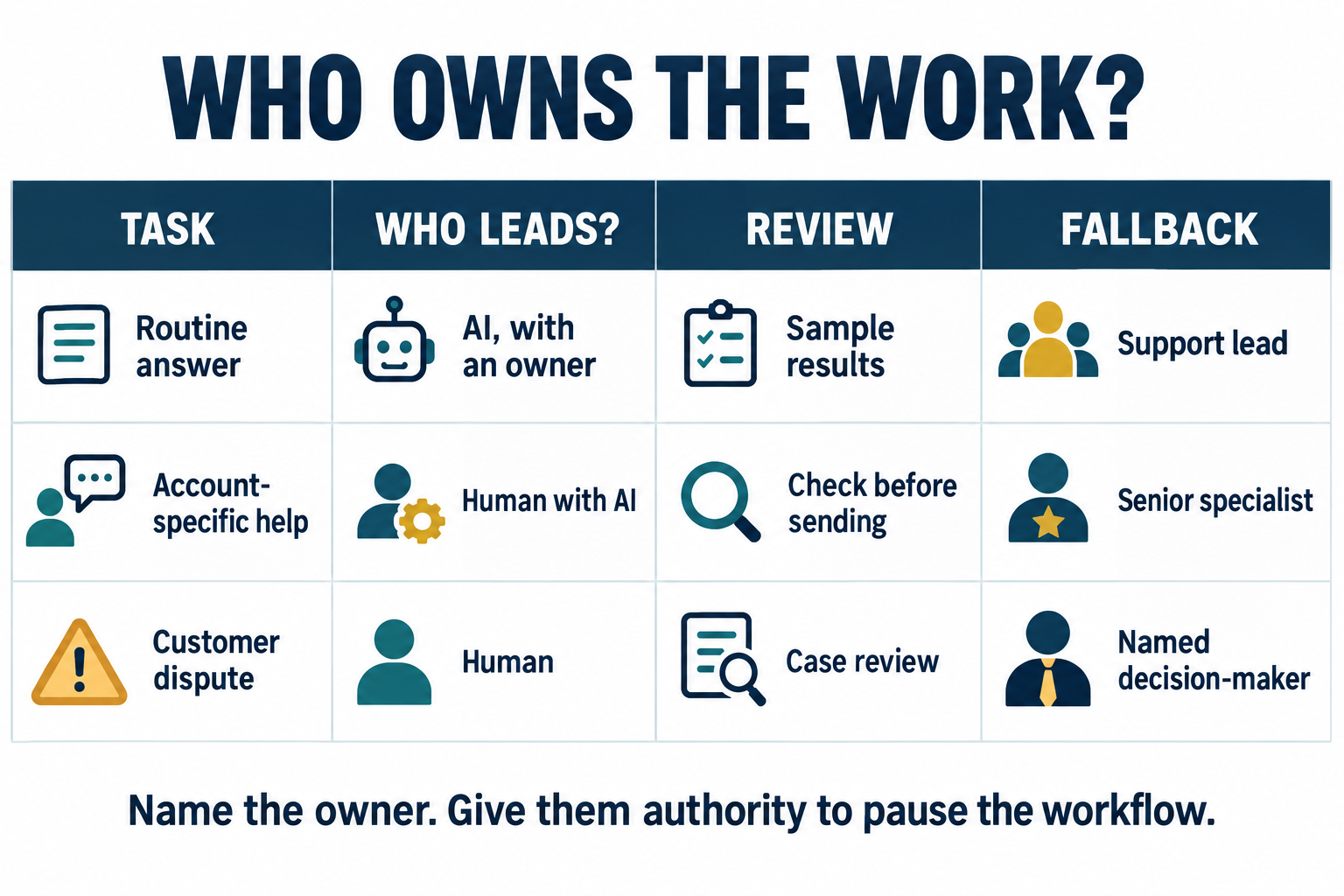
Use this matrix to make ownership and handoffs visible before increasing volume.
Write the Ownership Record Before You Scale
For one live workflow, record its scope, work type, owner, review method, and exception route. Add who can stop the system and who can approve a customer commitment. Then attach the results and cost measures you will review.
Use the startup scaling guide to decide which work should grow next. Your build, buy, or compose choice also affects who maintains the system and how quickly the team can repair it.
Before raising volume, ask the owner to walk through a failed case. Check where it would go, what the customer would hear, and who would resolve it. AI workflow accountability becomes useful when that route works during a real problem.


