


A startup board meeting needs a clear question for directors to work through. Before you build the slide deck, name the decision that matters most. What evidence will help the board judge your recommendation, and what should happen after the meeting?
Consider a hypothetical Indian software venture serving small manufacturers. Sales have grown, and a larger customer segment wants the product. However, those buyers need more setup work, while the current team already has a backlog.
The founder presents a long progress report. Directors ask about revenue and hiring, then time runs out before anyone examines the expansion plan. The founder leaves with several suggestions and no clear basis for the next spending decision.
You can prepare for a more useful discussion. This guide shows how to frame the question, assemble the evidence, and turn the meeting's outcome into work someone can follow.
Start Your Startup Board Meeting With the Decision Needed
Write the main question before gathering the slides. For the manufacturing service, it could be whether to fund a small pilot with larger firms now. State why the question needs attention and when the team needs an answer.
Next, label each agenda item by its purpose. Some items inform directors about a change. Others invite discussion or ask the board to decide or approve a proposal. The label helps members prepare for the work you expect from them.
Also clarify the process for any approval with the people responsible for your company's governance. A useful discussion can inform a decision, but you still need to follow the company's actual requirements. Identify any further consent or step before committing money or making a promise.
Keep the routine progress summary in the material you send beforehand. Your monthly investor updates can provide a record of what changed between meetings. Use that history to explain the current issue without repeating every month's report.
Prepare Evidence That Lets Directors Compare Options
A board pack is the set of documents members receive before the meeting. Include a concise founder update, the measures needed for the discussion, and the proposed agenda. Where cash affects the choice, add a forecast that reflects the spending you propose.
The decision brief should explain each option and its trade-offs. Show what you know, where the figures come from, and which assumptions remain open. Then state your recommendation so directors can test your reasoning.
For example, the founder might recommend a limited pilot because the team has yet to prove it can support larger firms. The supporting evidence would include setup time, unresolved cases, and what those buyers need. A sales pipeline alone would leave the delivery question unanswered.
Brad Feld's board-meeting guidance recommends sending the pack several days beforehand so members can prepare. Agree on a practical review window for your board, alongside the formal meeting process. Complex proposals may need more time and an earlier conversation.
Invite questions before the meeting where appropriate. If a director cannot reconcile the cash forecast with the spending plan, resolve that gap early. Keep a list of questions that still need discussion so the agenda reflects the remaining work.
Use the Startup Board Meeting to Test the Recommendation
Work with the chair, or whoever leads the meeting, to protect time for the main question. The person leading the board discussion helps members hear each other and reach a clear outcome. Management then needs to organize the work that follows within the agreed authority.
Ask directors to challenge the assumptions that drive your recommendation. For the proposed pilot, that might mean testing whether larger buyers will accept a narrow scope. Another question is whether setup work would delay service for existing customers.
Explain what would change your view. If the recommendation depends on a short setup process, show how you will measure it. When the evidence is weak, identify the test you need before making a larger commitment.
Also make requests for help specific. A director with relevant operating experience could review the pilot's support plan. Someone with suitable contacts might help the founder speak to a buyer who has managed a similar rollout.
Disagreement may expose a gap in the proposal. Record the unresolved question and the evidence needed to answer it. If the board defers the matter, agree on who will bring it back and what must change first.
Make AI Progress a Business Question
An AI initiative belongs in the discussion when it affects the choice before the board. Explain which work it should change and how that change would affect customers or costs. More generated reports tell directors little about whether delivery has improved.
Next, show the effort the initiative requires. Engineering time spent on an AI setup tool may delay a repair that existing customers need. Put that trade-off in the proposal so the board can compare uses of the same team.
Choose a measure the team will report at the next review. In our hypothetical venture, that could include setup completion time and the share of cases needing human correction. Track the quality of the finished customer task alongside the time spent on it.
Your AI workflow accountability plan should identify the person responsible for delivery and exceptions. The board discussion can then examine whether that person has the capacity and authority to carry out the proposed plan.
AI can also help organize checked information for the board pack. However, a founder must verify every figure and explanation before circulation. A tool may invent a cause for a missed target when the notes leave a gap. Use tools and access arrangements suited to the information you share.
Worked Example: Expand Now or Fix Delivery First?
Return to the hypothetical manufacturing-software venture. Larger firms want integrations and more setup help. The founder brings three options to the startup board meeting, with the evidence and trade-offs below.
| Option | What it commits | Main uncertainty |
|---|---|---|
| Broad rollout | Sales effort and delivery capacity for the new segment | Can the team support larger firms while clearing current cases? |
| Limited pilot | A small group, fixed scope, and a defined spending limit | Will those buyers accept the scope, and what setup work will they need? |
| Delay expansion | Time to repair delivery before seeking more buyers | Will the opportunity remain available after the repair? |
These options are illustrative. The founder still needs estimates from the people who will do the work, plus a cash forecast for each choice. The startup growth readiness guide provides checks for demand, costs, and capacity that can feed this discussion.
Suppose the discussion supports a limited pilot with two firms for six weeks. The team sets an illustrative spending ceiling of ₹1.5 lakh and appoints the operations lead to run it. It also specifies which integrations the pilot excludes and who will review the results.
Before starting, the founder records the evidence needed for a wider rollout. That includes customer acceptance, setup effort, delivery cost, and the effect on existing customers. The team checks urgent problems as they arise and brings the results to the agreed review.
The pilot can still fail. If it consumes too much support time or buyers reject the narrow scope, the founder has evidence for revising the plan. The decision brief should make that possibility visible before the team commits.
Close Your Startup Board Meeting With Clear Follow-Up
Confirm the outcome while everyone can still correct a misunderstanding. Record what the board decided, the reason for the decision, and any conditions attached. Name the person responsible for each action and the date for its next review.
Keep a working action log alongside the company's formal records and processes. The log helps the team track progress between meetings. People responsible for the formal records should ensure those records capture the meeting through the appropriate process.
For a bootstrapped founder, the same brief can support a structured review with trusted advisers. They can challenge the evidence and offer expertise. Their advice remains separate from decisions and approvals that belong to the company's formal governance.
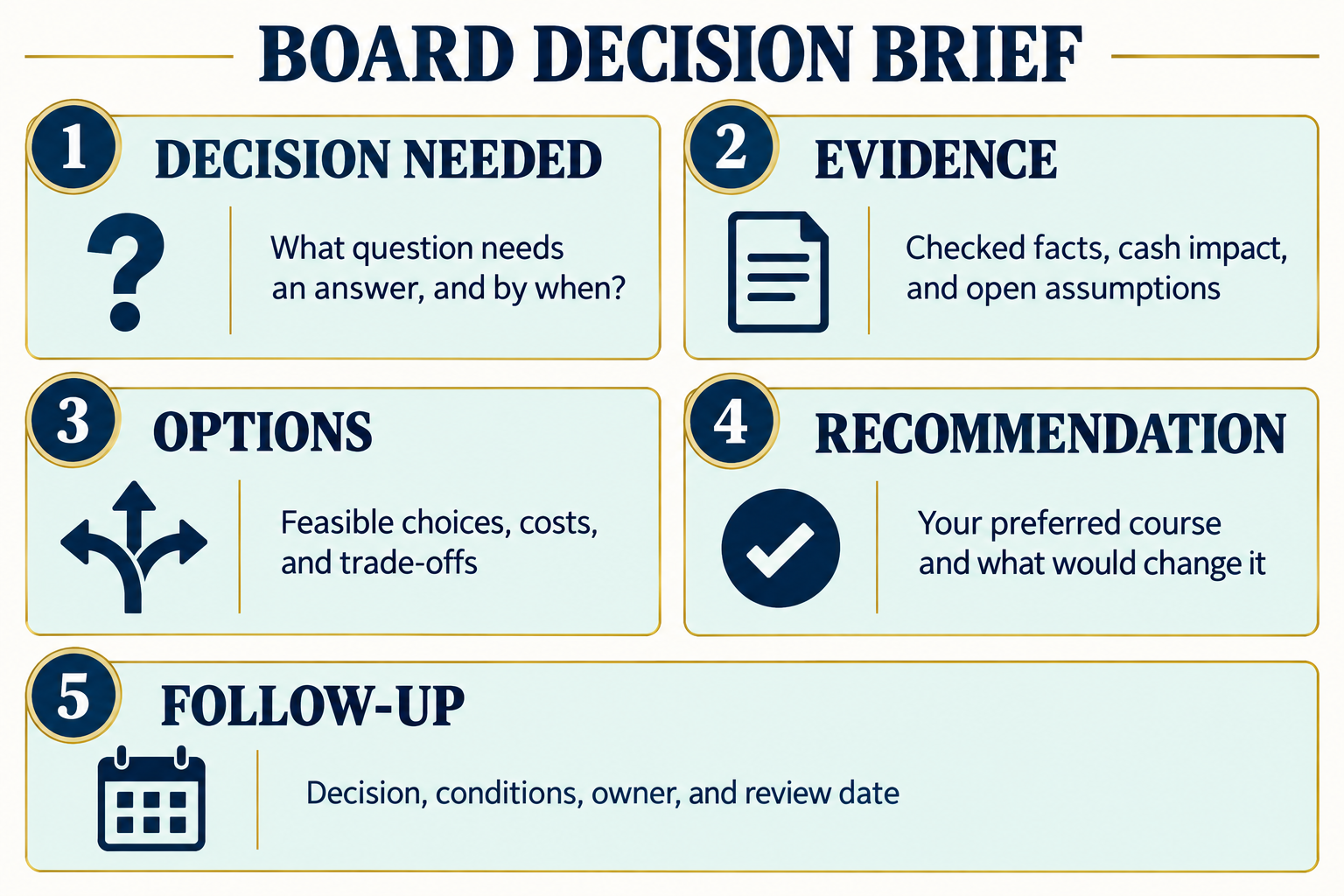
Use this short template for the next proposal:
| Field | What to write |
|---|---|
| Decision needed | The question, timing, and required outcome |
| Evidence | Checked facts, cash implications, and open assumptions |
| Options | Feasible choices and their costs or trade-offs |
| Recommendation | Your preferred course and what would change your view |
| Follow-up | Outcome, conditions, owner, and review date |
Choose one unresolved question before your next startup board meeting. Draft the brief, ask the relevant team members to check it, and agree on how members will prepare. After the meeting, use the recorded outcome to guide the next action.


