


Startup due diligence tests whether the evidence supports the business you described in your pitch. When an investor asks how you earned last month's revenue, you need a trail from the customer agreement to the accounts. A slide with a rising line gives them a claim to investigate.
Consider a hypothetical Indian software startup preparing for an equity round. Its latest quarter shows ₹60 lakh in revenue. The founders have customer contracts, invoices, and bank records, but those files sit in different folders. Someone must explain which records support the figure and why cash receipts differ.
You can prepare that explanation before the VC asks. Build an evidence map around the claims that matter to the investment. Then record the gaps openly so the team can investigate them.
Scope Startup Due Diligence to Your Stage
A young company may have a working product and a few pilots. It cannot offer years of renewal data that do not exist. However, it can show who used the product, what they paid, and which claims remain untested.
Agree on the scope of startup due diligence with the investor. Ask which questions could stop the investment and who will review each area. Also clarify how customer references and sensitive documents will be handled.
As the company grows, more evidence becomes available. An investor can examine customer groups over time, test how revenue converts to cash, and review a longer operating history. The work should fit the company and the planned deal.
Use the size and purpose of the raise to explain that context. The startup funding requirement guide helps connect the capital request with the work it will fund. A diligence list should support that investment decision without promising a fixed timetable.
Reconcile Ownership Before Sharing the Cap Table
For startup due diligence, your cap table needs support from the records behind it. This table lists who holds shares and other rights that could become shares. First, state its date and explain whether the figures include options and convertible instruments.
Next, compare it with share records, past financing agreements, and approvals. Ask the advisers handling your Indian financing to check the filings and match the changes since the last round. If an entry differs, put the gap in an open-questions log.
Options need a separate check. Distinguish the reserved pool from actual grants, and show the approvals and vesting terms for those grants. Vesting describes when a holder earns the right under the agreed schedule. Also record any promises to employees that need further review.
The startup equity dilution guide explains how a new round changes ownership. Here, the task is to establish whether the starting figures reconcile.
Include the records that explain debt, company structure, and ownership of the product's intellectual property. An investor may need to trace work by employees or contractors to the signed agreements. A missing signature creates a question for review; a tidy folder does not answer it.
Trace Startup Due Diligence Revenue to Cash
Return to the hypothetical startup's ₹60 lakh quarter. Assume it recognized and invoiced that amount, collected ₹48 lakh against those invoices, and had ₹12 lakh outstanding at quarter-end. These are illustrative figures for one period, with no opening receivables or tax adjustments.
The totals reconcile arithmetically: ₹48 lakh received plus ₹12 lakh outstanding equals ₹60 lakh invoiced. However, that alone does not prove that the company earned the revenue. Recognition concerns when the company earns revenue under its accounting policy, which may differ from the invoice or payment date.
Startup due diligence needs a clear explanation of those dates. Show the contract, the work or service delivered, the invoice, the ledger entry, and the matching receipt where available. Ask your accountant to explain exceptions and the policy used.
Then break down the unpaid ₹12 lakh by customer and due date. An invoice within its agreed payment period raises a different question from one months overdue. Separate disputed amounts from invoices the customer accepts but has yet to pay.
Also list deals with people or firms linked to the founders or directors. Explain the relationship and commercial terms. The investor can then check whether the sales reflect outside demand and whether customers paid.
Avoid combining forecasts with actual results. A signed contract, an unpaid invoice, and a possible sale in the pipeline describe different positions. Label each one so reviewers can follow the same definitions as the team.
Show Retention and Customer Concentration
Revenue alone leaves important startup due diligence questions unanswered. Which customers keep paying after the initial trial? Does growth depend on one buyer? What happens if that buyer delays payment or leaves?
Group customers by when they started, then show what happens to each group over time. This is a cohort view. Define whether your retention measure counts customers, revenue, or product use, because each measure answers a different question.
Next, list revenue by customer for the same period. In our hypothetical quarter, suppose the largest customer accounts for ₹21 lakh of the ₹60 lakh total. Its share is thirty-five percent. That concentration is a fact to investigate; it does not by itself decide whether the business is investable.
Show the largest customer's agreement duration, renewal terms, and any dependency on that account. Meanwhile, explain whether the customer uses the product across its organization or runs a small pilot. A reference call can test how the customer describes the value and its plans.
Offer suitable contacts and agree on how the investor will approach them. A review may include former customers as well as current ones. Keep those conversations separate from the founder's own account of why a customer left.
Keep Evidence and Judgment Separate
Organize startup due diligence questions according to what the team can establish. Ownership records may support a direct reconciliation. A large set of customer contracts may require sampling. Future market demand still involves judgment.
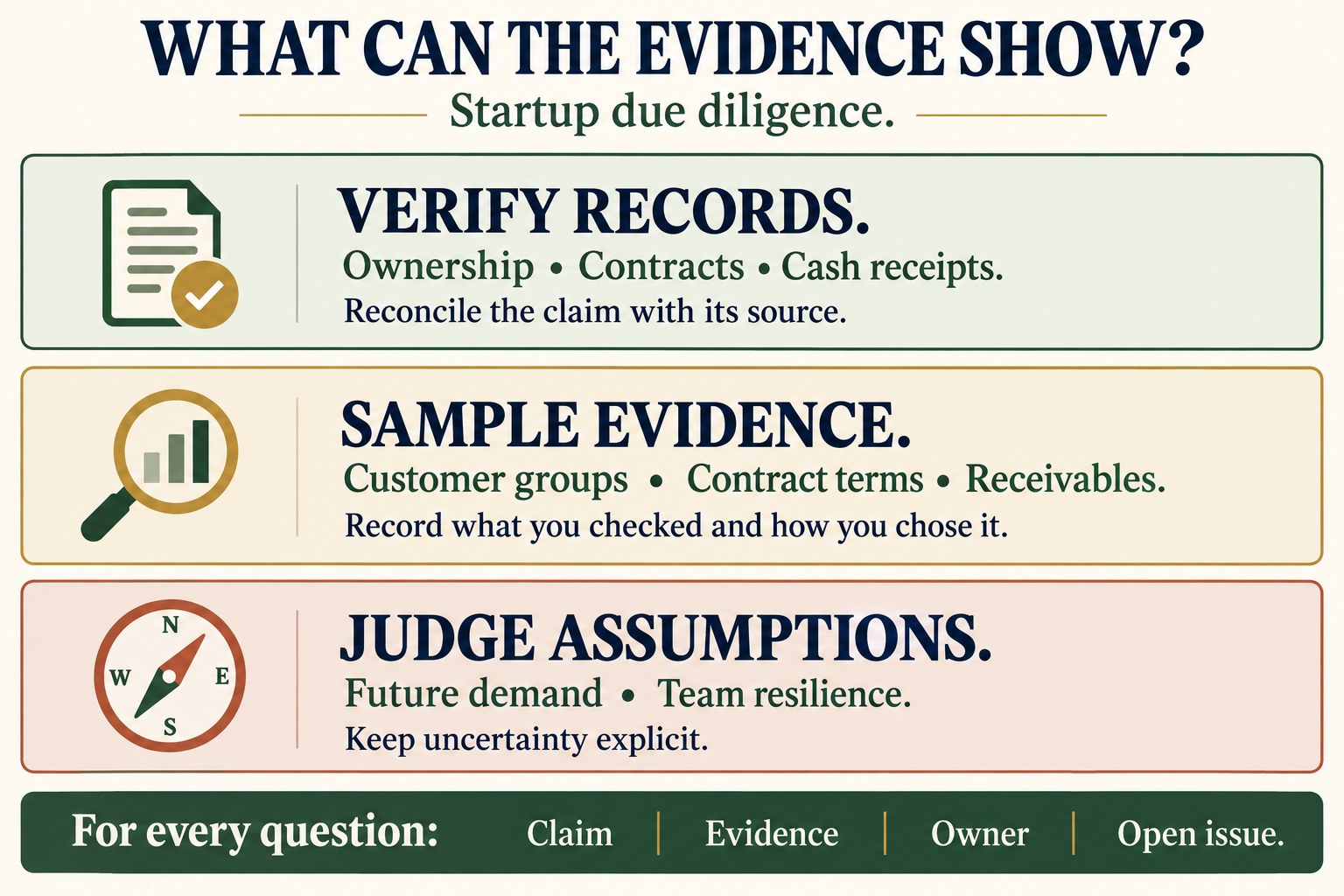
Build Your Startup Due Diligence Evidence Map
Use the following evidence map as a starting point. Use it to plan the review. Ask your advisers which records or filings your company needs. The named owners are illustrative roles; a small team may assign several tasks to one person.
| Claim or question | Evidence to check | Owner | Open question |
|---|---|---|---|
| Ownership totals reconcile | Share records, agreements, dated cap table | Founder and legal adviser | Which entries differ? |
| Quarterly revenue is earned | Contracts, delivery evidence, revenue schedule | Finance lead | Which entries need review? |
| Invoices convert to cash | Receipts and receivables aging | Finance lead | Which payments are overdue? |
| Customers renew | Cohort data and reference calls | Customer lead | Why did others leave? |
| Product rights are clear | Employee, contractor, and license agreements | Legal and product leads | Which rights need clarification? |
| Forecast is plausible | Assumptions and tests completed so far | Founder | Which assumptions remain untested? |
For samples, state what the reviewer examined and how they chose it. A review of only the largest contracts may miss a problem shared by smaller customers. Keep the method alongside the result so someone else can assess its limits.
Also record where each answer came from. A statement from management, a document, and confirmation from the document's issuer offer different support. Having the file shows that you collected it. After checking it, record what you verified.
Control the Data Room and Track Open Questions
A data room is a shared document workspace for the review. For startup due diligence, give it a clear index and assign one person to manage updates. Use the same file-naming rules throughout, and mark the date each financial schedule covers.
Cooley GO's guidance on organizing company records explains how preparing them early can reduce disruption during a transaction. Its sample VC request list offers useful document categories. Because it addresses a US context, use it as an organizing reference and have advisers adapt requests to your company in India.
Next, limit access according to the agreed review scope. Check confidentiality obligations before sharing customer contracts or personal information. Keep sensitive files in restricted folders. Where needed, redact details before sharing.
Maintain a log with the question, its owner, the evidence still needed, and the next action. Mark an issue resolved only after the reviewer checks the explanation and supporting material. If a record does not exist, say so and identify what the team will do next.
Check AI Summaries Against the Original Files
During startup due diligence, AI can draft an index or flag inconsistent dates in documents that your organization permits it to process. However, a person must check the result against the original. A generated summary cannot confirm that a customer paid or that an agreement grants the rights you assumed.
After the evidence review, use the liquidation preference guide to examine the proposed deal's payment terms. Understanding the business and understanding the offer both matter before you commit.
Start now with one material pitch claim. Find its supporting records, note their dates, and write the questions they leave open. Repeat that process until the claims driving the raise have evidence someone else can examine.


