


A solo founder can use AI and outside specialists to cover more work, but someone still has to own the result. Before you add a partner or hire a team, map the work your venture must deliver. Then choose a structure you can fund and sustain.
Consider a founder who can sell a service but needs help delivering it. A contractor might fill that gap. A co-founder becomes worth considering when the venture needs another person to share long-term judgment and responsibility.
Each choice creates duties you will have to meet. Use the four tests below to work out what the business needs next.
Solo Founder and Small Team Can Describe the Same Venture
Separate two questions: who owns and leads the business, and who does the work? A solo founder can hire employees. Two co-founders can run a small firm with contractors. Counting founders tells you little about the workload each person can handle.
For this decision, compare three starting setups:
| Arrangement | Who carries founder responsibility? | How the work gets done |
|---|---|---|
| Solo with outside support | One founder | Founder, software, and specialists for defined tasks |
| Small hired team | One or more founders | A few employees own recurring functions; specialists fill gaps |
| Co-founder partnership | Two or more founders | Partners divide leadership; hires follow the work required |
These setups can overlap and change. Your aim is to choose a setup that works for the next stage. A growing order book may call for delivery staff while ownership stays with one person.
The founder runway planner helps you check how much room you have to test a setup. Use it before making commitments that depend on steady future sales.
Four Tests for a Solo Founder or Founding Team
The Path-Selection Matrix compares functional coverage, capital trajectory, founder sustainability, and strategic ambition. In plain terms: can the work get done, can you pay for it, can you keep doing it, and does it fit your goal?
Assess each test against a specific milestone, such as delivering a paid pilot. Avoid scoring an imagined future company before you know what its customers need.
1. Can You Cover the Work That Matters?
List the functions needed to reach that milestone. Include sales, delivery, customer support, administration, and any specialist work your offer requires. Then name an owner and a backup for each.
A task counts as covered when someone can do it to the required standard within the available time. Owning a tool or knowing a freelancer’s phone number gives you only a possible route.
For example, AI may help draft a proposal. You still need a person who can judge the scope and price. A technical contractor may build a prototype while leaving you responsible for help after launch.
Test the uncertain tasks before choosing the team. If a gap involves repeated work with a clear brief, a contractor or employee may fit. If it requires ongoing business judgment across functions, explore a partner with that capability.
2. Does the Setup Fit Your Capital Path?
Compare the full cost of each arrangement over the same period. Include pay, tools, specialist fees, and the founder’s time spent coordinating work. Hiring cheaply can still cost you hours of review and rework.
Next, connect those costs to the cash you can access. Revenue-funded growth, savings, and outside investment each create different constraints. Estimate how long the setup can operate if a customer pays late or a sale slips.
Some investors favor teams with skills that fill gaps. However, preferences vary by investor and venture. Ask the funding sources you plan to approach what they need to see; hiring several people cannot by itself make a business investable.
A cash gap needs its own plan. Bringing in a co-founder to reduce a salary bill creates an ownership relationship that can outlast the original shortage.
3. Can the Founder Sustain the Load?
Build a realistic week before committing. Count customer calls, delivery, checking AI output, managing contractors, and resolving failures. Also include time away from the business and responsibilities at home.
Then test what happens when you are unavailable. Can a customer get help? Can someone find the current files and continue essential work? If every answer requires you, the setup has a continuity gap.
For a solo founder, a peer group or adviser can help challenge decisions. That support serves a different purpose from covering operations. Make clear which need you are trying to meet before choosing how to meet it.
A team also creates management work. After adding a person, check whether the hours they remove exceed the time needed for briefing and review. The answer can change as you both learn the job.
4. Does It Fit the Business You Want to Build?
Describe the scope you intend to serve. A narrow service with a few accounts may need a different setup from a product sold across regions. Delivery hours, language needs, and customer commitments can matter more than a revenue target.
For example, a local food venture may need people on site during preparation and dispatch. Software can help with planning, while physical checks and delivery still need reliable coverage.
Match the structure to these duties and the pace you can support. Headcount follows from the work, its complexity, and the level of service you promise. Treat your desired growth rate as something to test against those limits.
A Solo Founder Scorecard You Can Use
For each setup, mark every test as covered, untested, or gap. Add the evidence behind your judgment and the next test needed. A row marked untested should stay visible until you have checked it.
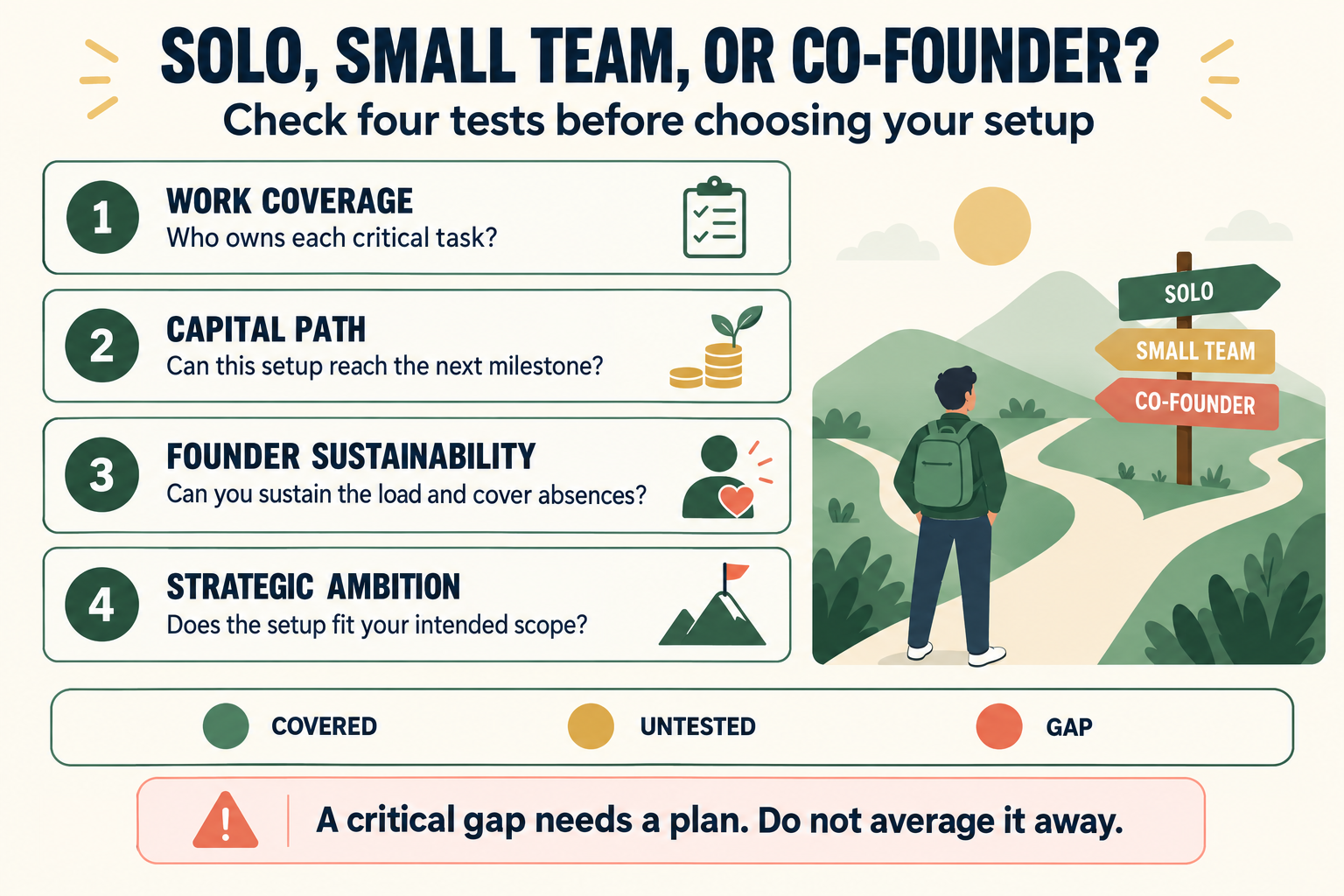
Use the scorecard to expose conflicts. You might prefer sole ownership while finding that customer support needs an employee. Or a partner may cover a skill gap while your cash plan still needs work.
Do not average away a critical gap. A setup that scores well on cost can still fail when nobody can serve customers. Identify which unresolved issue would stop the venture from meeting its next commitment.
Then write a short decision note: chosen arrangement, reasons, unresolved gaps, and the evidence that would change your choice. Attach a date for review.
Worked Example: Keep Ownership Solo, Add Delivery Help
Consider a hypothetical founder in Pune offering inventory-reporting services to small distributors. She understands the customers and wins paid pilots. However, building reports and fixing data errors take time away from sales.
She compares three options: continue alone with AI support, hire a delivery analyst, or seek a technical co-founder. The scorecard reveals a recurring delivery gap. Her immediate offer uses existing tools and a documented process.
The founder tests a specialist on a limited, paid assignment before agreeing to a longer role. She records the briefing time, errors, customer response, and hours saved. For this venture, the trial provides evidence about delivery coverage without deciding its future ownership.
If the service becomes a software product, the judgment may change. A partner who can shape the product and share long-term technical responsibility could become useful. That need would justify a fresh assessment and a working trial together.
The scenario illustrates a choice; it does not report a real company’s results.
Before Choosing a Co-Founder, Work Together
A shared vision can start a conversation. Working on a difficult task shows more about how you will handle the business. Y Combinator’s co-founder guidance recommends a time-boxed trial project with clear goals and expectations.
Choose work that requires each person to contribute. For instance, one person can lead buyer interviews while the other builds a test version. Review the result together, including the views that proved wrong.
During the trial, watch how you handle disagreement, missed deadlines, and unwelcome customer feedback. Discuss working hours and personal constraints as well. A promising skills match still needs a workable relationship.
Before proceeding, write down roles, time commitments, and how you will decide when you disagree. Discuss ownership expectations and what happens if one person leaves. Get qualified advice for the formal agreements; this article does not prescribe an equity split.
What AI Changes for a Solo Founder
AI can reduce parts of research, drafting, and routine production. Measure that benefit in the work you actually do. A quick first draft may still need extensive checking before a customer can use it.
Anthropic’s engineering guidance recommends starting with simple solutions and adding complexity when the task requires it. Apply that principle to your support tools: begin with a narrow workflow you can check and maintain.
The build, buy, or compose guide helps you choose how to obtain those capabilities. Include the time needed to monitor them in your team plan.
The AI Pass for this choice is:
- Still true: Critical work needs accountable owners and people who can judge its quality.
- Compressed: AI can shorten selected tasks when the output meets your standard.
- Inverted: You can test an offer with limited support before choosing a lasting team.
- New question: Who checks automated work and keeps service running when a tool fails?
- Wrong assumption: Access to AI means one person can meet every commitment unaided.
Use the hours saved to test customer demand or remove a known bottleneck. Increasing the number of tasks you attempt can consume the same time again.
Build Your First Ninety-Day Plan
After choosing an arrangement, create the work habits it needs. The periods below are a planning template; adapt them to your customer commitments.
Days one to thirty: Assign owners to essential work and run tests on uncertain tasks. Document access to files and tools. If you are exploring a partnership, agree on the trial goals and each person’s contribution.
Days thirty-one to sixty: Test delivery under a realistic workload. Track time spent on briefing, checking, and rework. Ask what happened when an owner was unavailable and close any gap the test exposes.
Days sixty-one to ninety: Compare the results with the assumptions in your decision note. Confirm what each person owns, revise the cash plan, and decide whether the setup still fits the next milestone.
For a small team, a short weekly review can keep decisions visible. For a solo founder, schedule outside challenge and a continuity check. Partners should review both delivery and how the working relationship is developing.
Revisit the setup when customer duties, cash needs, or the time you can give the business changes. Use the startup scaling guide when the next question becomes how to increase output.
Start with one page this week. Name your next milestone, complete the four tests, and run the smallest work trial that could change your decision.


